A Survey on Efficient Architectures for LLMs
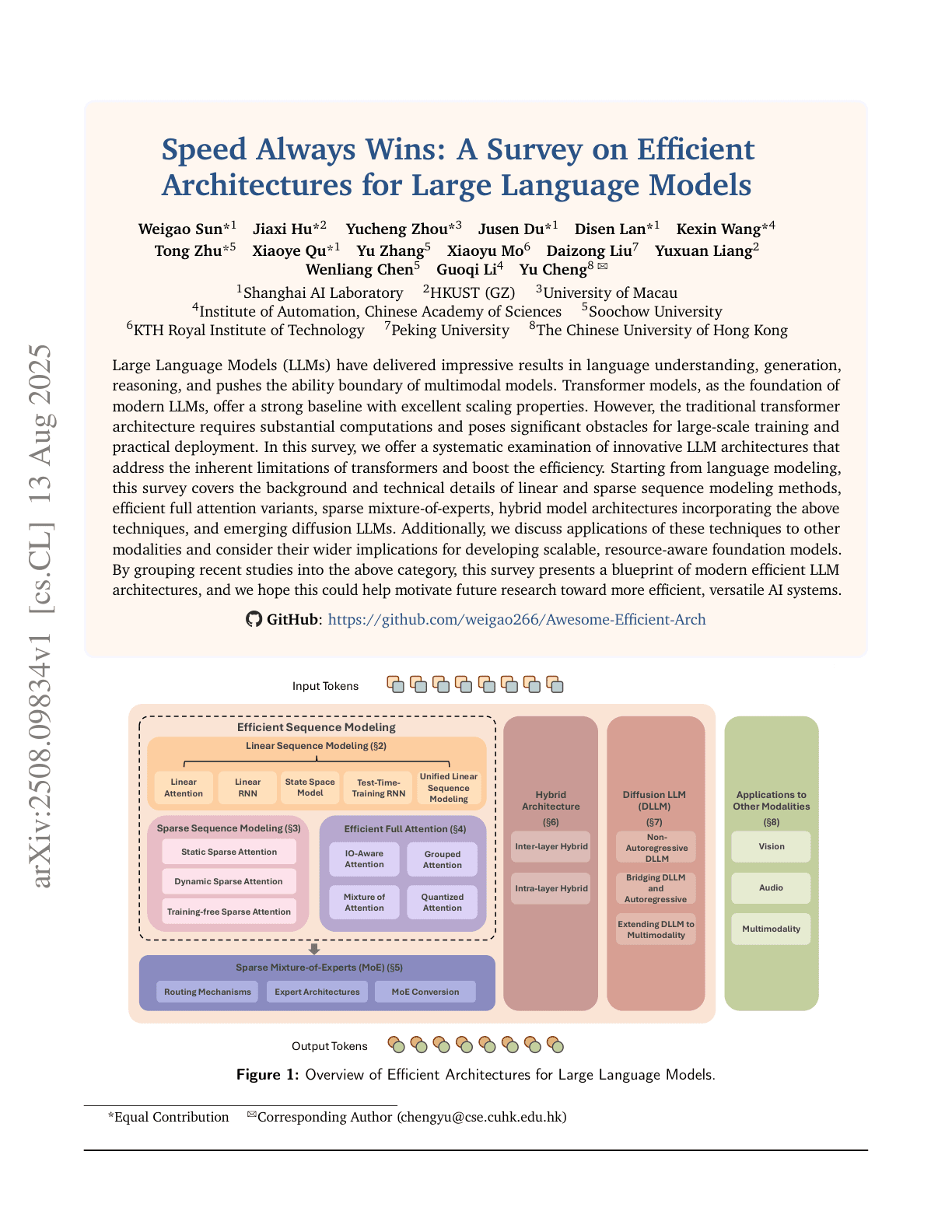
This survey reviews advances in efficient LLM architectures beyond traditional transformers, including linear and sparse sequence models, efficient attention variants, sparse MoEs, hybrid designs, and diffusion-based LLMs. It highlights cross-modal applications and outlines a blueprint for building scalable, resource-efficient foundation models.
Ask this paper
Abstract
Large Language Models (LLMs) have delivered impressive results in language understanding, generation, reasoning, and pushes the ability boundary of multimodal models. Transformer models, as the foundation of modern LLMs, offer a strong baseline with excellent scaling properties. However, the traditional transformer architecture requires substantial computations and poses significant obstacles for large-scale training and practical deployment. In this survey, we offer a systematic examination of innovative LLM architectures that address the inherent limitations of transformers and boost the efficiency. Starting from language modeling, this survey covers the background and technical details of linear and sparse sequence modeling methods, efficient full attention variants, sparse mixture-of-experts, hybrid model architectures incorporating the above techniques, and emerging diffusion LLMs. Additionally, we discuss applications of these techniques to other modalities and consider their wider implications for developing scalable, resource-aware foundation models. By grouping recent studies into the above category, this survey presents a blueprint of modern efficient LLM architectures, and we hope this could help motivate future research toward more efficient, versatile AI systems.