AdaRepair-Mem: Adaptive Experience Orchestration for Repository-Level Program Repair
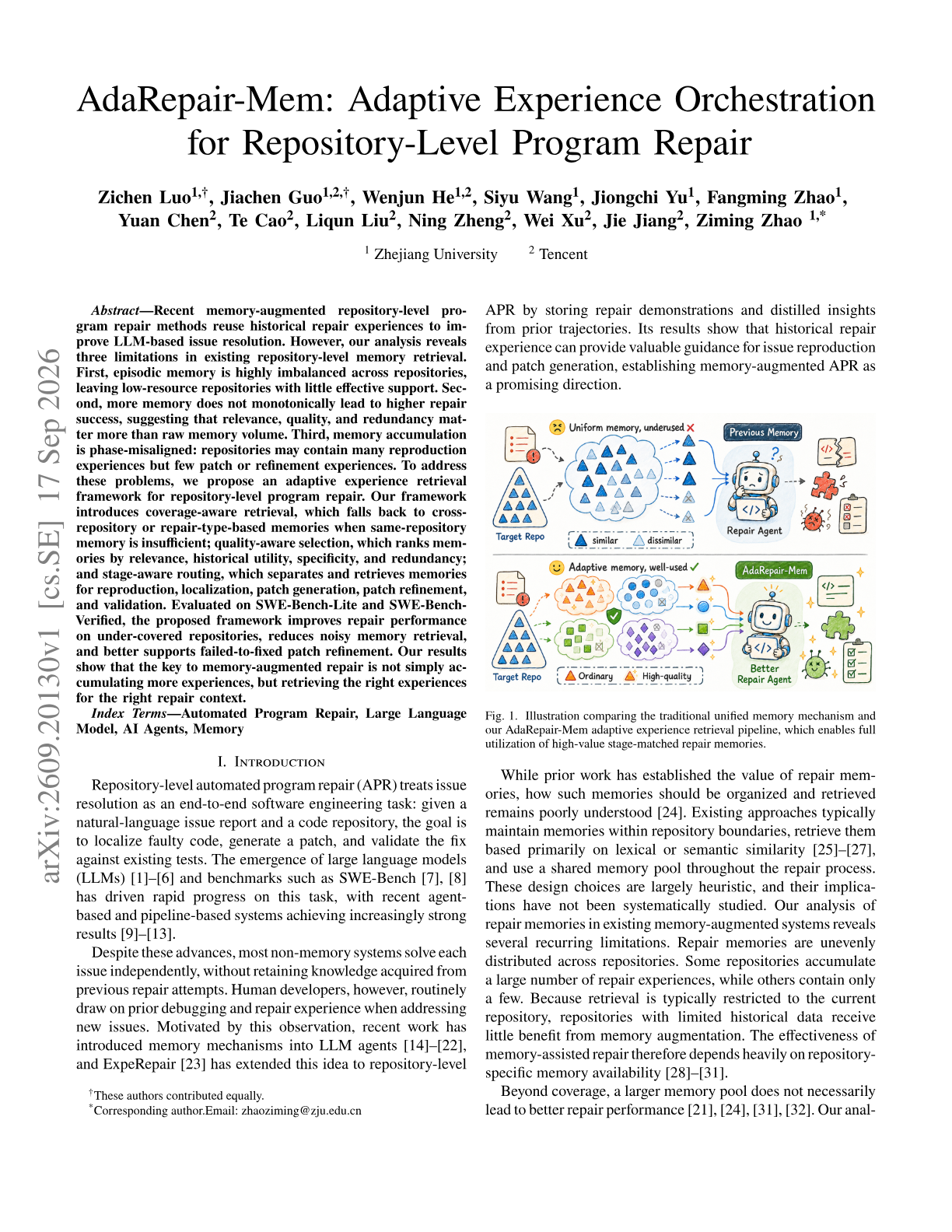
Z. C. Luo and a 13-author team diagnose three failures in repository-level memory retrieval for program repair, then route memory by repair stage rather than by similarity alone.
Ask this paper
Memory is imbalanced across repositories. Episodic memory concentrates in a few repos, leaving low-resource repositories with little usable support.
More memory does not monotonically help. Repair success does not rise with memory volume, which points at relevance, quality and redundancy rather than quantity.
Memory is phase-misaligned. A repository may hold many reproduction experiences and almost no patch or refinement experiences, so retrieval returns the wrong kind of help.
Three mechanisms. Coverage-aware retrieval falls back to cross-repository or repair-type memory when same-repository memory is thin; quality-aware selection ranks by relevance, historical utility, specificity and redundancy; stage-aware routing keeps separate memories for reproduction, localization, patch generation, refinement and validation.
Results. On SWE-Bench-Lite and SWE-Bench-Verified the framework improves repair on under-covered repositories, reduces noisy retrieval, and better supports failed-to-fixed patch refinement.
Abstract
Recent memory-augmented repository-level program repair methods reuse historical repair experiences to improve LLM-based issue resolution. However, our analysis reveals three limitations in existing repository-level memory retrieval. First, episodic memory is highly imbalanced across repositories, leaving low-resource repositories with little effective support. Second, more memory does not monotonically lead to higher repair success, suggesting that relevance, quality, and redundancy matter more than raw memory volume. Third, memory accumulation is phase-misaligned: repositories may contain many reproduction experiences but few patch or refinement experiences. To address these problems, we propose an adaptive experience retrieval framework for repository-level program repair. Our framework introduces coverage-aware retrieval, which falls back to cross-repository or repair-type-based memories when same-repository memory is insufficient; quality-aware selection, which ranks memories by relevance, historical utility, specificity, and redundancy; and stage-aware routing, which separates and retrieves memories for reproduction, localization, patch generation, patch refinement, and validation. Evaluated on SWE-Bench-Lite and SWE-Bench-Verified, the proposed framework improves repair performance on under-covered repositories, reduces noisy memory retrieval, and better supports failed-to-fixed patch refinement. Our results show that the key to memory-augmented repair is not simply accumulating more experiences, but retrieving the right experiences for the right repair context.