Affora: A Design System for Agent-Friendly Interfaces
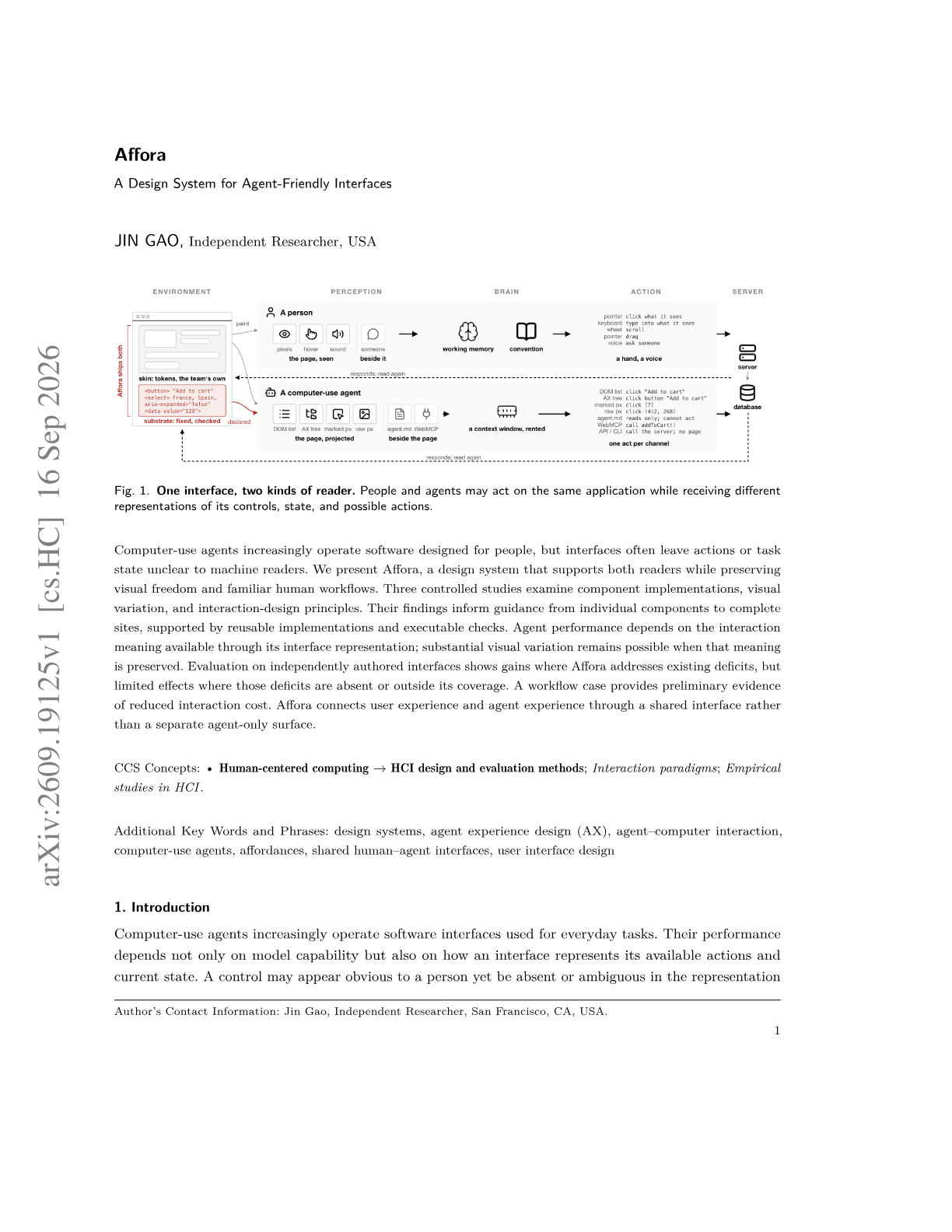
Jin Gao (independent researcher) presents Affora, a design system for interfaces that both people and computer-use agents can operate, without a separate agent-only surface.
Ask this paper
Controlled studies. Three studies examine component implementations, visual variation and interaction-design principles.
Main finding. Agent performance depends on the interaction meaning exposed in the interface representation, and visual variation is tolerated when that meaning is preserved.
Scope of gains. On independently authored interfaces, Affora helps where existing deficits match its coverage and has limited effect elsewhere; a workflow case suggests lower interaction cost.
Abstract
Computer-use agents increasingly operate software designed for people, but interfaces often leave actions or task state unclear to machine readers. We present Affora, a design system that supports both readers while preserving visual freedom and familiar human workflows. Three controlled studies examine component implementations, visual variation, and interaction-design principles. Their findings inform guidance from individual components to complete sites, supported by reusable implementations and executable checks. Agent performance depends on the interaction meaning available through its interface representation; substantial visual variation remains possible when that meaning is preserved. Evaluation on independently authored interfaces shows gains where Affora addresses existing deficits, but limited effects where those deficits are absent or outside its coverage. A workflow case provides preliminary evidence of reduced interaction cost. Affora connects user experience and agent experience through a shared interface rather than a separate agent-only surface.