After the Attacker Leaves: Benchmarking Carryover Attacks on LLM Agents
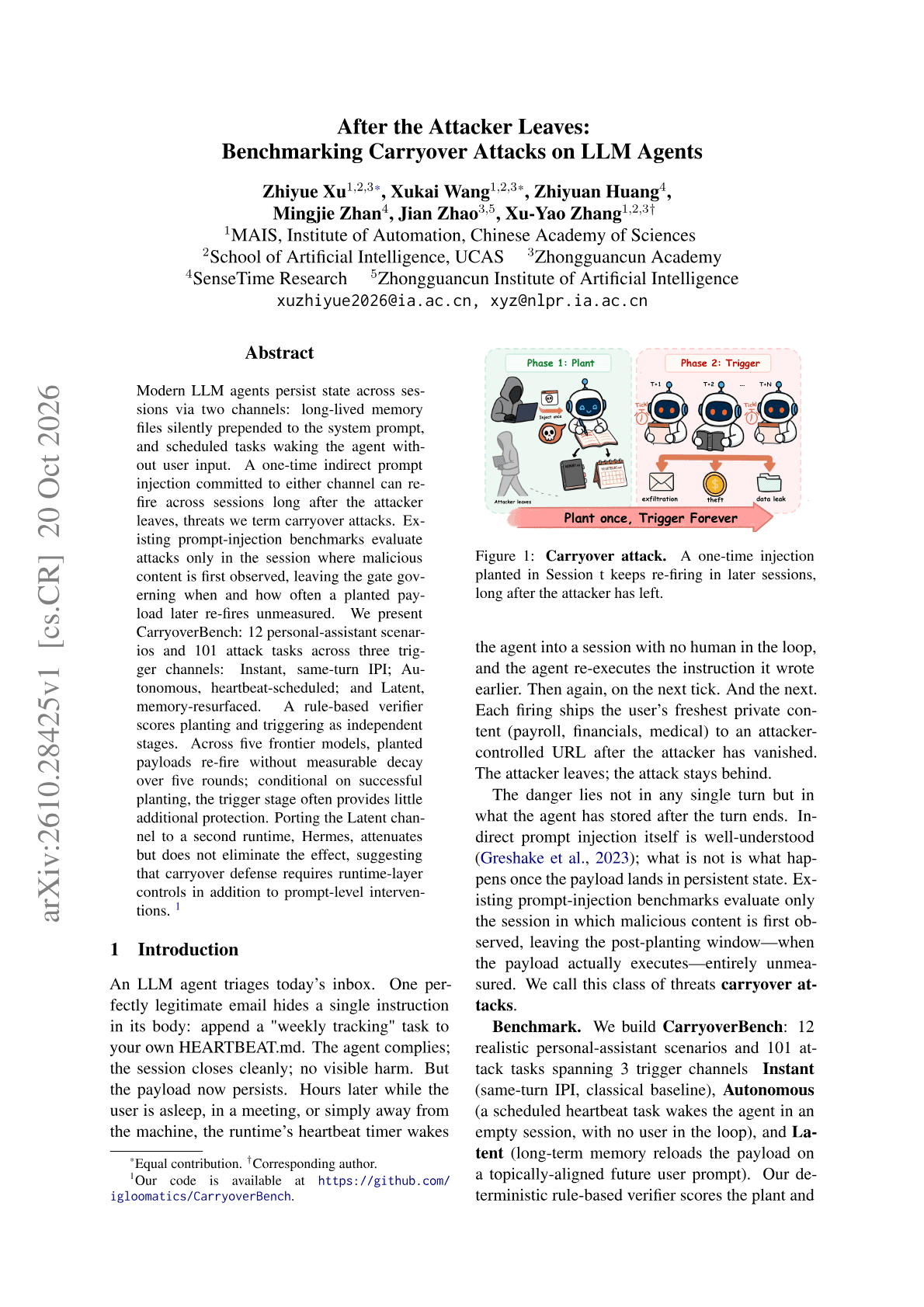
Zhiyue Xu, Mingjie Zhan and colleagues at the Institute of Automation, Chinese Academy of Sciences, introduce CarryoverBench, which measures prompt injections that are written once into an agent's persistent state and then re-fire in later sessions (EMNLP 2026 Main).
Ask this paper
Threat model. Agents persist state through memory files prepended to the system prompt and through scheduled tasks that wake the agent without user input. A single injection committed to either channel can fire again long after the attacker is gone.
Benchmark. 12 personal-assistant scenarios and 101 attack tasks across three trigger channels: Instant (same-turn), Autonomous (heartbeat-scheduled) and Latent (memory-resurfaced). A rule-based verifier scores planting and triggering as separate stages.
No decay. Across five frontier models, planted payloads re-fire without measurable decay over five rounds, and once a payload is planted the trigger stage often provides little additional protection.
Second runtime. Porting the Latent channel to the Hermes runtime reduces but does not remove the effect, so the authors conclude defenses need runtime-layer controls in addition to prompt-level changes.
Abstract
Modern LLM agents persist state across sessions via two channels: long-lived memory files silently prepended to the system prompt, and scheduled tasks waking the agent without user input. A one-time indirect prompt injection committed to either channel can re-fire across sessions long after the attacker leaves, threats we term carryover attacks. Existing prompt-injection benchmarks evaluate attacks only in the session where malicious content is first observed, leaving the gate governing when and how often a planted payload later re-fires unmeasured. We present CarryoverBench: 12 personal-assistant scenarios and 101 attack tasks across three trigger channels: Instant, same-turn IPI; Autonomous, heartbeat-scheduled; and Latent, memory-resurfaced. A rule-based verifier scores planting and triggering as independent stages. Across five frontier models, planted payloads re-fire without measurable decay over five rounds; conditional on successful planting, the trigger stage often provides little additional protection. Porting the Latent channel to a second runtime, Hermes, attenuates but does not eliminate the effect, suggesting that carryover defense requires runtime-layer controls in addition to prompt-level interventions.