Agent Lightning v1.0
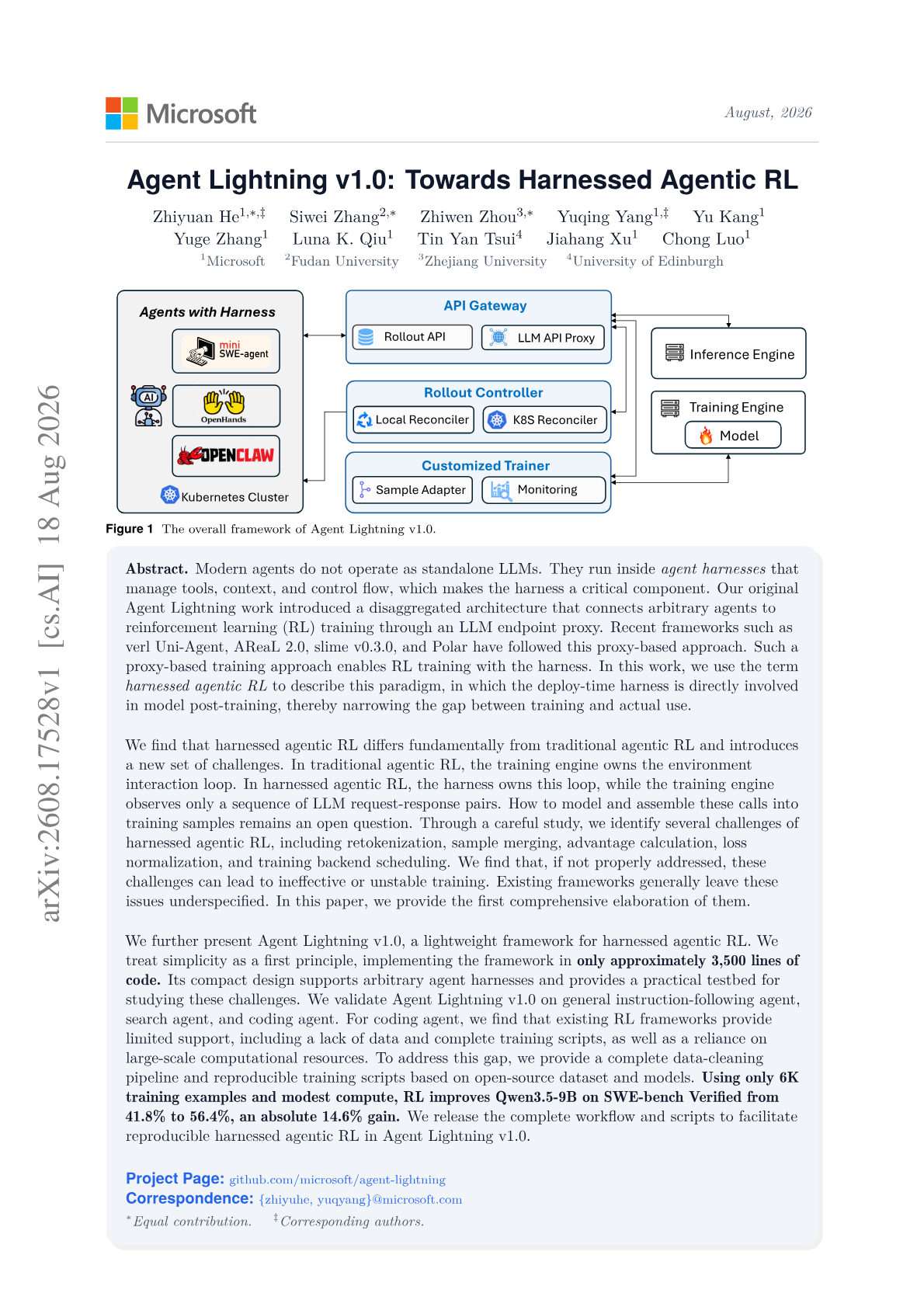
Modern agents run inside a harness that owns tools, context, and control flow. When you want to train one, that ownership becomes the problem: the harness runs the environment loop and the trainer only ever sees LLM request and response pairs. This work from Microsoft treats that boundary as the integration point instead of an obstacle.
Ask this paper
The harness stays opaque: An endpoint proxy sits at the model boundary and connects any harness to RL in roughly 3,500 lines, so agents built on mini-SWE-agent, OpenHands, or OpenClaw train without being rewritten for the trainer.
The hard part is everything after the proxy: The paper works through what actually breaks in that setup, retokenization, sample merging, advantage calculation, loss normalization, and backend scheduling. That list is the real contribution, because each item silently corrupts gradients when a harness sits between the policy and the reward.
Small budget, real movement: Using 6K training examples and modest compute, it moves Qwen3.5-9B on SWE-bench Verified from 41.8% to 56.4%.
Why it matters: This is the clearest expression yet of the theme running through this week's papers, that the harness is a first-class object in the training stack rather than deployment plumbing. If your agent already works, you can now train the model against the exact system it runs in.