Agent-R$^2$: Scaling Agents for Realistic Productivity Work via Real-Source Data Synthesis
Teng Pan, Yongliang Shen and colleagues at Zhejiang University and Baidu build Agent-R², a data synthesis pipeline for training agents on realistic office work, grounded in real occupations, workflow evidence from web corpora and real web-sourced files.
Ask this paper
Pipeline. Starting from 10k web-corpus candidates, Agent-R² distills 4k tasks that pair real multi-format attachments with deliverable-level rubrics, instead of hand-written workflows or LLM-generated files.
Training. Agent-R²-4B is trained with supervised fine-tuning followed by rubric-based RL.
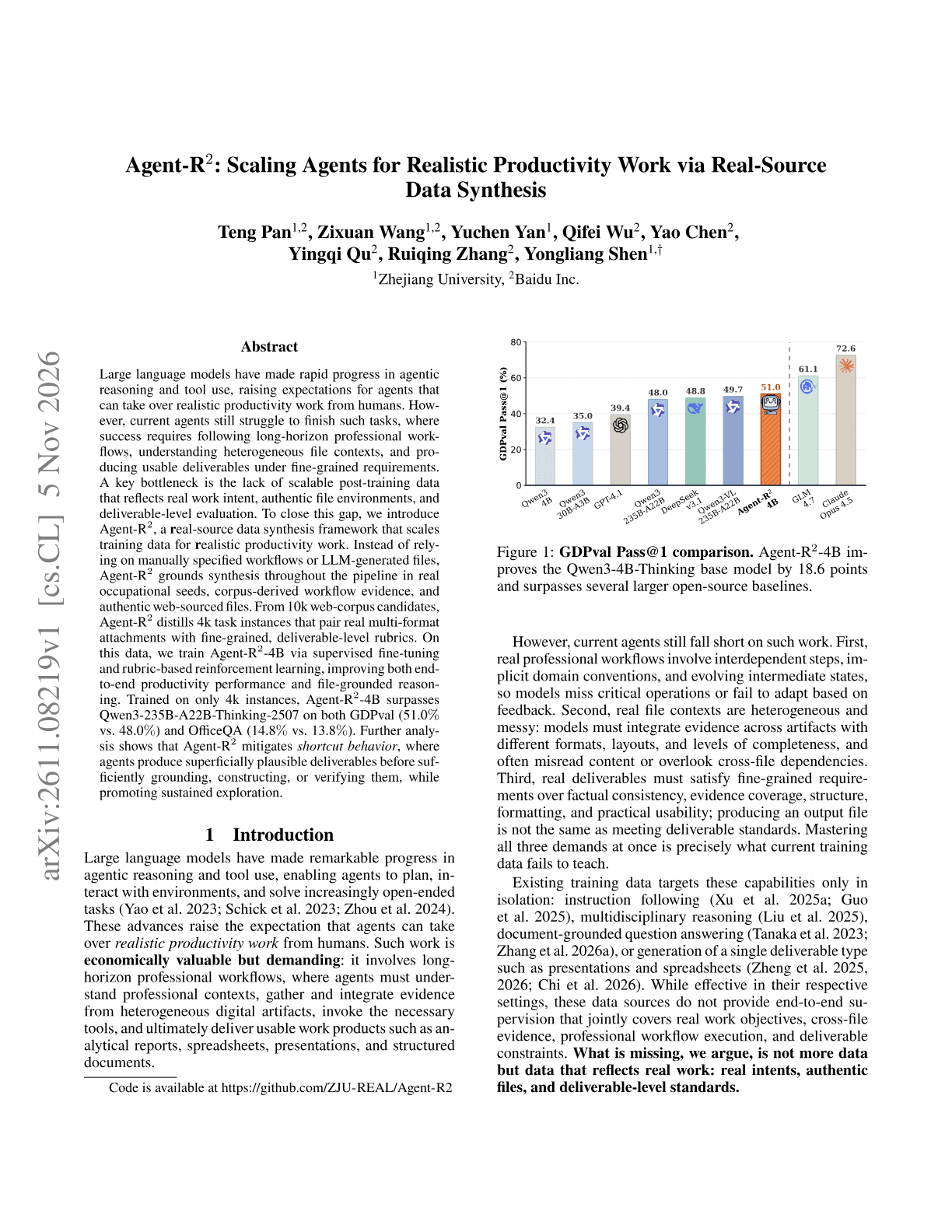
Results. With 4k instances, the 4B model beats Qwen3-235B-A22B-Thinking-2507 on GDPval (51.0% vs 48.0%) and OfficeQA (14.8% vs 13.8%).
Behavior. Training reduces shortcut behavior, where agents produce plausible deliverables before reading, building or checking enough, and increases sustained exploration.
Checks. The authors report a decontamination audit covering file hashes, source domains, near-duplicates and instruction similarity.
Abstract
Large language models have made rapid progress in agentic reasoning and tool use, raising expectations for agents that can take over realistic productivity work from humans. However, current agents still struggle to finish such tasks, where success requires following long-horizon professional workflows, understanding heterogeneous file contexts, and producing usable deliverables under fine-grained requirements. A key bottleneck is the lack of scalable post-training data that reflects real work intent, authentic file environments, and deliverable-level evaluation. To close this gap, we introduce Agent-R$^2$, a $\textbf{r}$eal-source data synthesis framework that scales training data for $\textbf{r}$ealistic productivity work. Instead of relying on manually specified workflows or LLM-generated files, Agent-R$^2$ grounds synthesis throughout the pipeline in real occupational seeds, corpus-derived workflow evidence, and authentic web-sourced files. From 10k web-corpus candidates, Agent-R$^2$ distills 4k task instances that pair real multi-format attachments with fine-grained, deliverable-level rubrics. On this data, we train Agent-R$^2$-4B via supervised fine-tuning and rubric-based reinforcement learning, improving both end-to-end productivity performance and file-grounded reasoning. Trained on only 4k instances, Agent-R$^2$-4B surpasses Qwen3-235B-A22B-Thinking-2507 on both GDPval (51.0$\%$ vs. 48.0$\%$) and OfficeQA (14.8$\%$ vs. 13.8$\%$). Further analysis shows that Agent-R$^2$ mitigates shortcut behavior, where agents produce superficially plausible deliverables before sufficiently grounding, constructing, or verifying them, while promoting sustained exploration.