AI Research Agents for Machine Learning
Presents a new framework, AIRA-dojo, for developing and evaluating AI research agents. They use this framework to systematically investigate the components of successful AI agents on the MLE-bench benchmark, a challenging set of real-world machine learning problems from Kaggle. Key findings:
Ask this paper
Disentangling Agent Components – The authors formalize AI research agents as search algorithms with two key components: a search policy (e.g., Greedy, MCTS, Evolutionary) and a set of operators (e.g., DRAFT, DEBUG, IMPROVE). This separation allows for a more rigorous analysis of what drives agent performance.
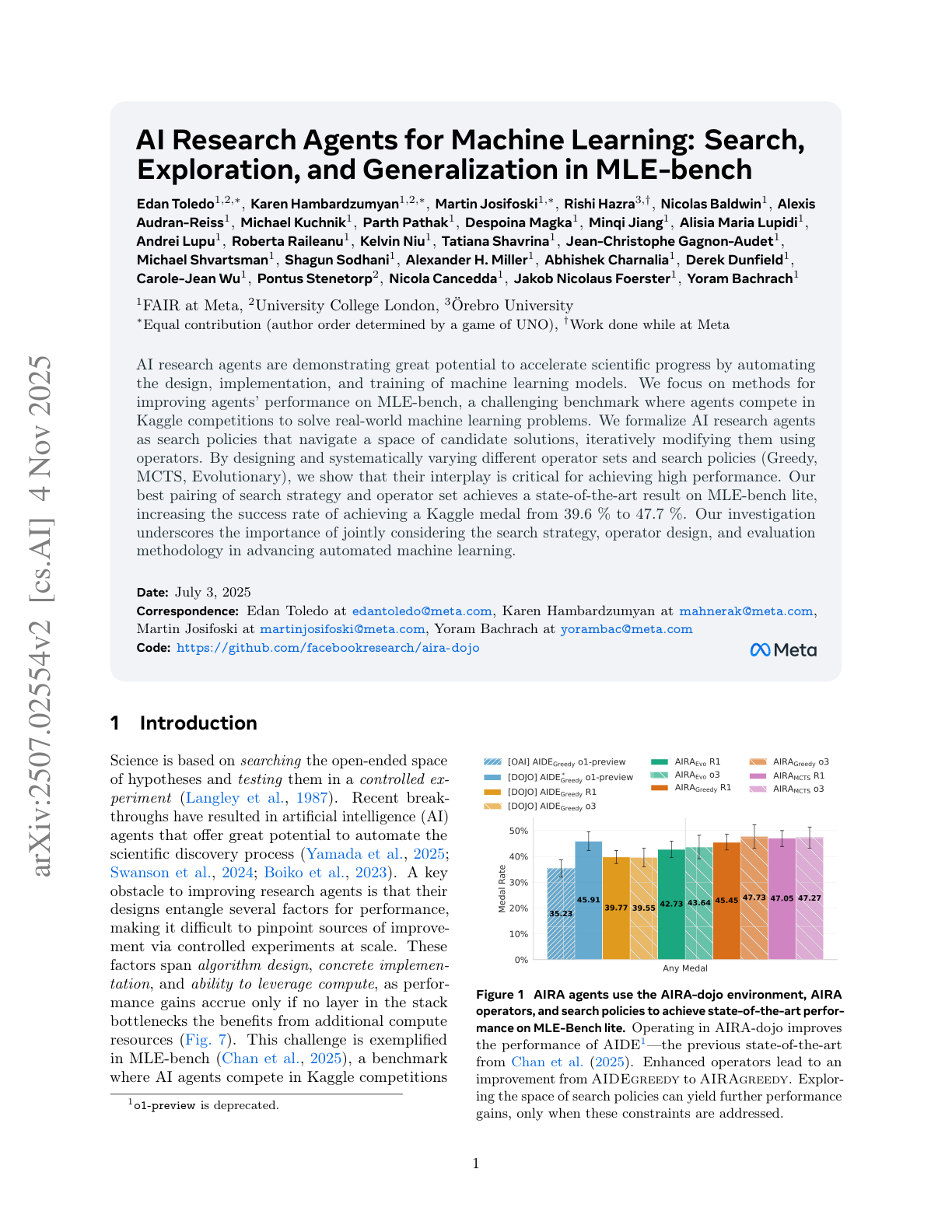
Operators are the Bottleneck – Through controlled experiments, the researchers show that the performance of the state-of-the-art AIDE agent is not limited by its greedy search policy, but by the capabilities of its operators. More advanced search policies like MCTS and Evolutionary algorithms provide no benefit when paired with AIDE's original operators.
Improved Operators Lead to SOTA – The team designed a new set of operators, OAIRA, which feature prompt-adaptive complexity, scoped memory, and "think tokens" for more structured reasoning. When combined with an MCTS search policy, these new operators achieve a new state-of-the-art on MLE-bench lite, increasing the Kaggle medal success rate from 39.6% to 47.7%.
The Generalization Gap is Real – The study highlights a significant generalization gap between an agent's performance on its validation set and the final test set. This overfitting is a fundamental limitation, and the authors show that more robust final-node selection strategies can close this gap by 9-13%.