An Empirical Study of Harness Design for Coding Agents
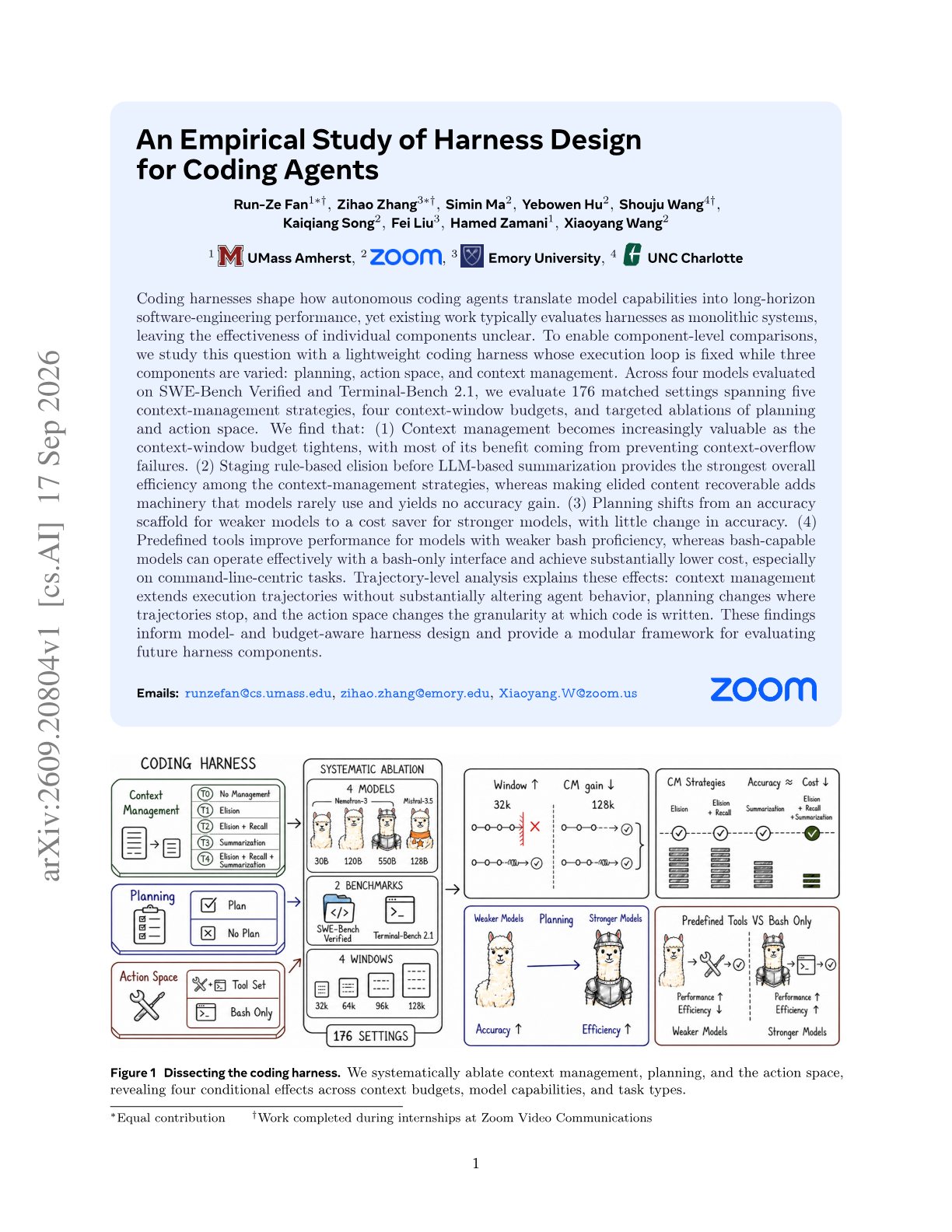
Run-Ze Fan and colleagues at UMass Amherst, Emory, UNC Charlotte and Zoom hold a coding harness's execution loop fixed and vary three components (planning, action space, context management) across 176 matched settings, four models, SWE-Bench Verified and Terminal-Bench 2.1.
Ask this paper
Context management matters more as the window shrinks. Most of its measured benefit comes from preventing context-overflow failures rather than from improving reasoning, so its value is a function of the budget rather than of the model.
Rule-based elision before LLM summarization wins. Staging the two gives the best accuracy-to-cost trade-off of five strategies. Making elided content recoverable adds machinery the models rarely invoke and produces no accuracy gain.
Planning changes role with model strength. For the weakest model it raises the success rate; for stronger models accuracy barely moves and the gain shows up as lower cost, because planning shortens post-edit verification.
Action space trades scaffolding for cost. Predefined tools help models with weak bash proficiency; bash-capable models run a bash-only interface at substantially lower cost, especially on command-line-centric tasks.
Trajectory analysis explains each effect. Context management lengthens trajectories without changing behaviour, planning changes where trajectories stop, and the action space changes the granularity at which code gets written.
Abstract
Coding harnesses shape how autonomous coding agents translate model capabilities into long-horizon software-engineering performance, yet existing work typically evaluates harnesses as monolithic systems, leaving the effectiveness of individual components unclear. To enable component-level comparisons, we study this question with a lightweight coding harness whose execution loop is fixed while three components are varied: planning, action space, and context management. Across four models evaluated on SWE-Bench Verified and Terminal-Bench 2.1, we evaluate 176 matched settings spanning five context-management strategies, four context-window budgets, and targeted ablations of planning and action space. We find that: (1) Context management becomes increasingly valuable as the context-window budget tightens, with most of its benefit coming from preventing context-overflow failures. (2) Staging rule-based elision before LLM-based summarization provides the strongest overall efficiency among the context-management strategies, whereas making elided content recoverable adds machinery that models rarely use and yields no accuracy gain. (3) Planning shifts from an accuracy scaffold for weaker models to a cost saver for stronger models, with little change in accuracy. (4) Predefined tools improve performance for models with weaker bash proficiency, whereas bash-capable models can operate effectively with a bash-only interface and achieve substantially lower cost, especially on command-line-centric tasks. Trajectory-level analysis explains these effects: context management extends execution trajectories without substantially altering agent behavior, planning changes where trajectories stop, and the action space changes the granularity at which code is written. These findings inform model- and budget-aware harness design and provide a modular framework for evaluating future harness components.