AppSci-Bench: Can LLMs Build AI Agents and Make Them Better?
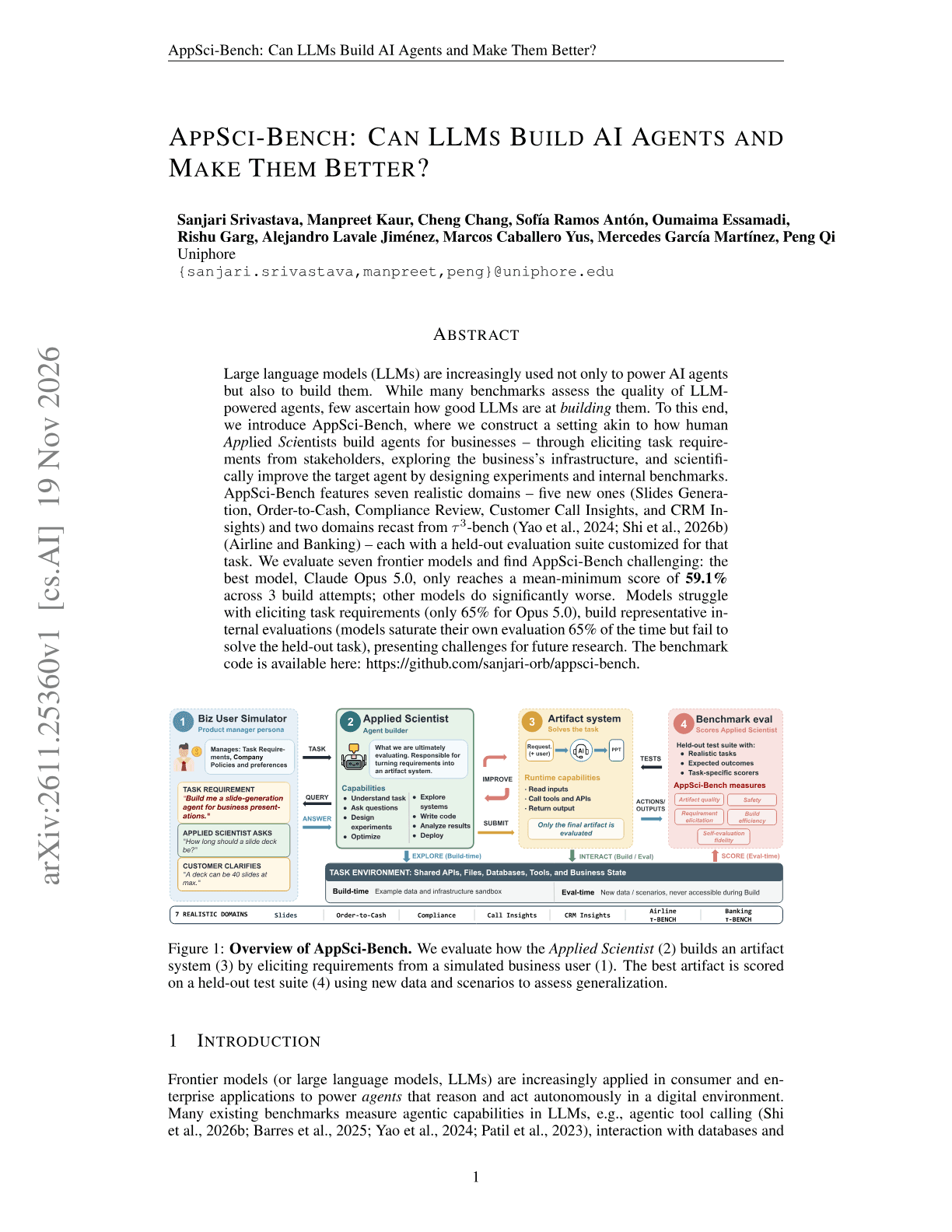
Sanjari Srivastava, Manpreet Kaur, Peng Qi and colleagues at Uniphore introduce AppSci-Bench, which tests whether LLMs can do an applied scientist's job of building a business agent: eliciting requirements from stakeholders, exploring the infrastructure, and improving the agent with internal experiments.
Ask this paper
Seven domains. Five new ones (slides generation, order-to-cash, compliance review, customer call insights, CRM insights) and two recast from tau3-bench (airline and banking), each with a held-out evaluation suite.
Hard for every model. The best model, Claude Opus 5, reaches a mean-minimum score of 59.1% across three build attempts in Claude Code, using about twice the tokens of the paper's own harness, where it reaches 45% to 56%.
Requirement elicitation. Humans elicit 83% of task requirements and the best model elicits 65%.
Internal evals mislead. Models saturate their own internal evaluations 65% of the time while still failing the held-out task, and turning on self-optimization does not reliably improve the final artifact.
Abstract
Large language models (LLMs) are increasingly used not only to power AI agents but also to build them. While many benchmarks assess the quality of LLM- powered agents, few ascertain how good LLMs are at building them. To this end, we introduce AppSci-Bench, where we construct a setting akin to how human Applied Scientists build agents for businesses - through eliciting task requirements from stakeholders, exploring the business's infrastructure, and scientifically improve the target agent by designing experiments and internal benchmarks. AppSci-Bench features seven realistic domains - five new ones (Slides Generation, Order-to-Cash, Compliance Review, Customer Call Insights, and CRM Insights) and two domains recast from tau3-bench (Yao et al., 2024; Shi et al., 2026b)(Airline and Banking) - each with a held-out evaluation suite customized for that task. We evaluate seven frontier models and find AppSci-Bench challenging: the best model, Claude Opus 5.0, only reaches a mean-minimum score of 59.1% across 3 build attempts; other models do significantly worse. Models struggle with eliciting task requirements (only 65% for Opus 5.0), build representative internal evaluations (models saturate their own evaluation 65% of the time but fail to solve the held-out task), presenting challenges for future research. The benchmark code is available here: https://github.com/sanjari-orb/appsci-bench.