ARISE: Practical Self-Evolving Memory for Accurate and Cost-Efficient Enterprise Agents
Jiangyun Zhang, Yi Zhang and colleagues at Amazon present ARISE, a memory architecture in which an enterprise agent learns from its own failures without changing model weights, tools or workflow code.
Ask this paper
Micro to macro memory. The model, or a teacher model, attributes each failure and proposes a correction. Corrections are stored as retrievable micro memory and then consolidated into macro rules.
Held-out acceptance. A rule update is accepted only if held-out accuracy rises, which keeps the memory from growing with corrections that do not generalize.
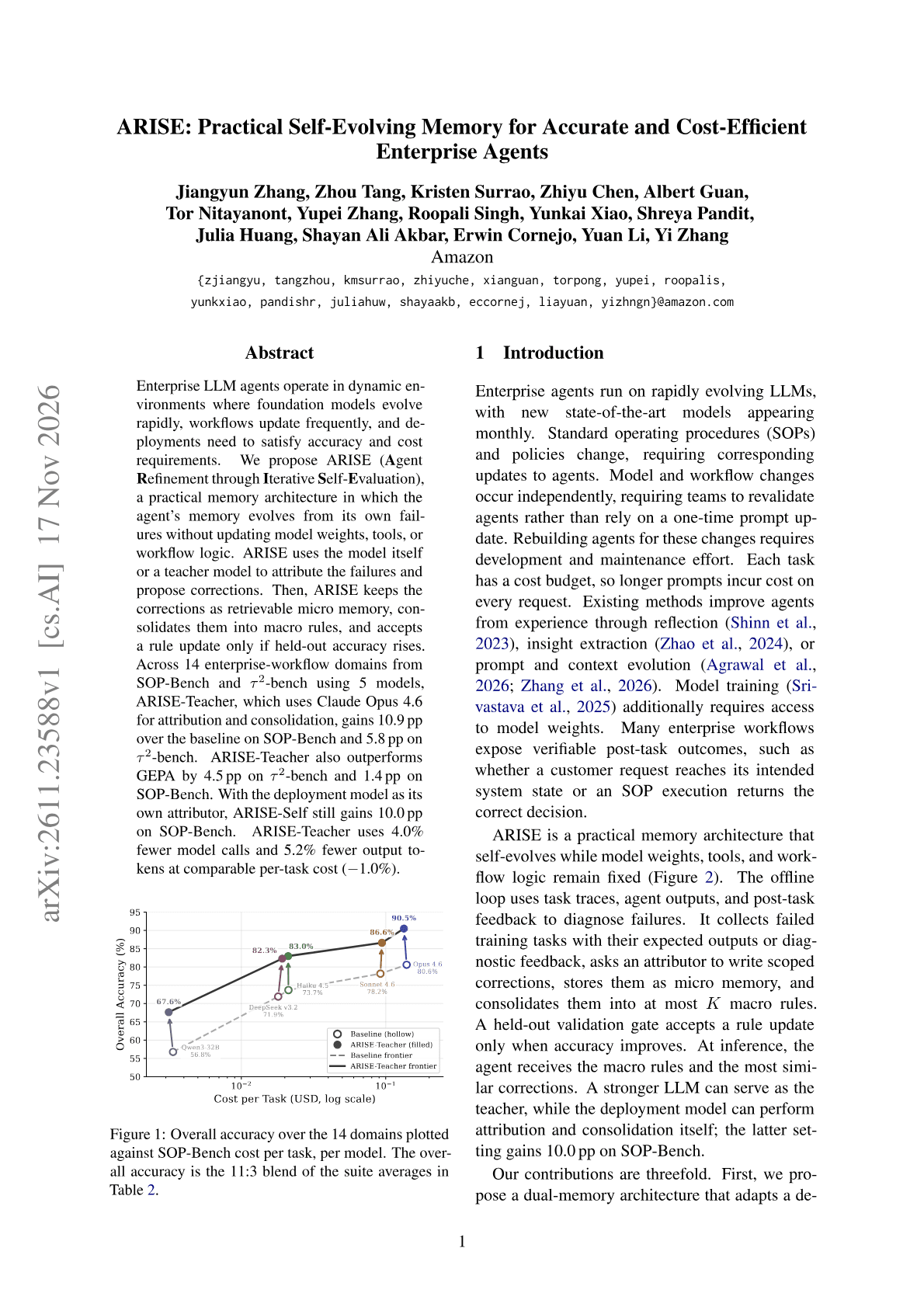
Results. Across 14 enterprise-workflow domains and 5 models, ARISE-Teacher (Claude Opus 4.6 as attributor) gains 10.9 points on SOP-Bench and 5.8 points on tau2-bench, and beats GEPA by 4.5 and 1.4 points. With the deployment model as its own attributor, ARISE-Self still gains 10.0 points on SOP-Bench.
Cost. ARISE-Teacher uses 4.0% fewer model calls and 5.2% fewer output tokens at roughly the same per-task cost (-1.0%).
Abstract
Enterprise LLM agents operate in dynamic environments where foundation models evolve rapidly, workflows update frequently, and deployments need to satisfy accuracy and cost requirements. We propose ARISE (Agent Refinement through Iterative Self-Evaluation), a practical memory architecture in which the agent's memory evolves from its own failures without updating model weights, tools, or workflow logic. ARISE uses the model itself or a teacher model to attribute the failures and propose corrections. Then, ARISE keeps the corrections as retrievable micro memory, consolidates them into macro rules, and accepts a rule update only if held-out accuracy rises. Across 14 enterprise-workflow domains from SOP-Bench and $τ^2$-bench using 5 models, ARISE-Teacher, which uses Claude Opus 4.6 for attribution and consolidation, gains 10.9 pp over the baseline on SOP-Bench and 5.8 pp on $τ^2$-bench. ARISE-Teacher also outperforms GEPA by 4.5 pp on $τ^2$-bench and 1.4 pp on SOP-Bench. With the deployment model as its own attributor, ARISE-Self still gains 10.0 pp on SOP-Bench. ARISE-Teacher uses 4.0% fewer model calls and 5.2% fewer output tokens at comparable per-task cost (-1.0%).