AutoMaster: Autonomous Post-Training by Making the Same Model a Better Teacher
Guoxin Chen, Shuang Sun, Ruihua Song and Wayne Xin Zhao at Renmin University propose Skill-FT, which uses natural-language skills to change a teacher's behavior during rollouts, and AutoMaster, an agent that designs those skills and runs the post-training process itself.
Ask this paper
Success is not enough. Successful teacher trajectories can still contain unsupported assumptions, repetition and superficial verification. Skill-FT uses skills to suppress these habits and to bring out effective behaviors that appear rarely.
Autonomous loop. AutoMaster analyzes trajectories, designs skills, selects data and uses feedback from rollouts and target-model evaluation to improve the interventions.
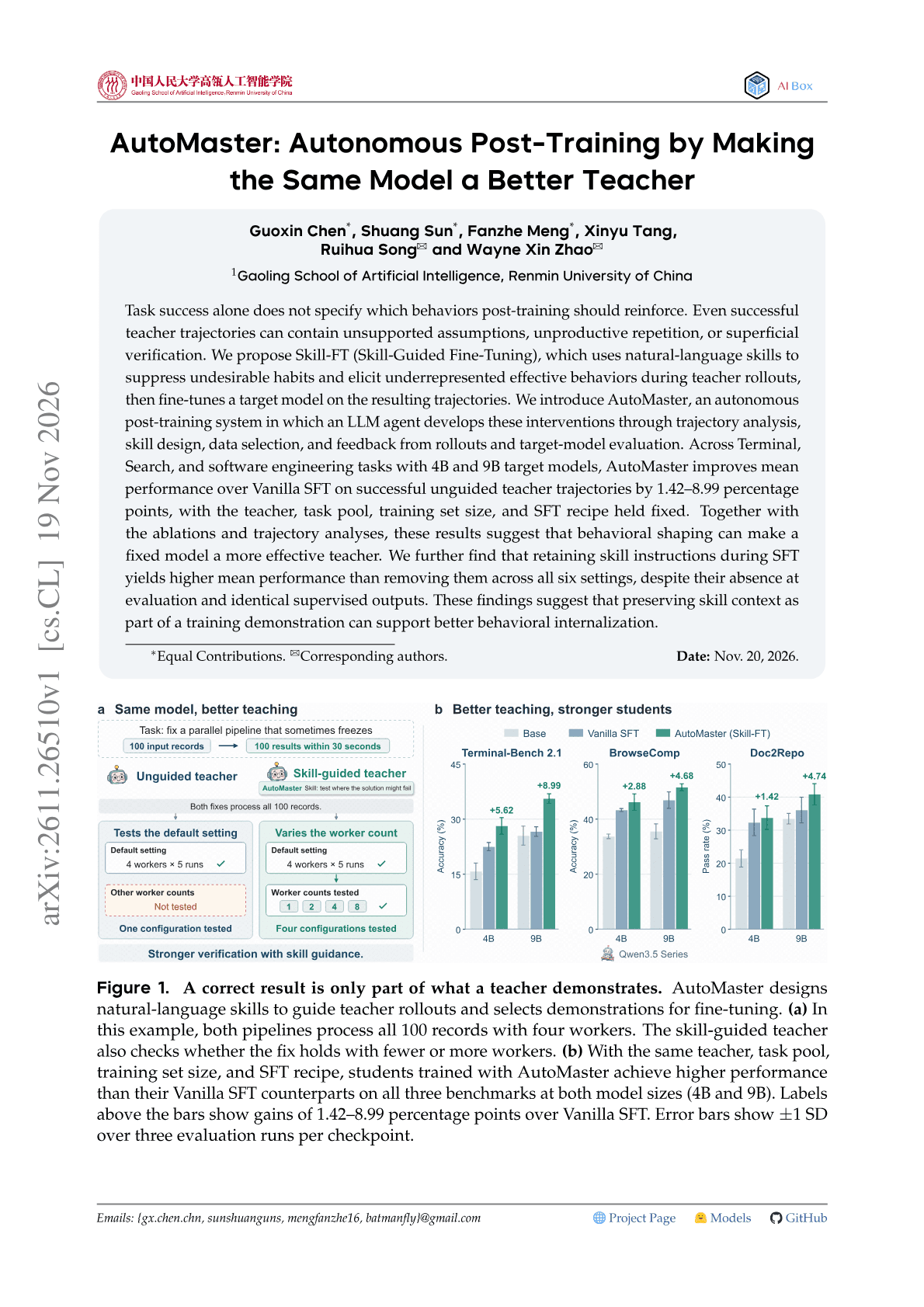
Results. On Terminal, Search and software engineering tasks with 4B and 9B targets, AutoMaster beats vanilla SFT on successful unguided teacher trajectories by 1.42 to 8.99 points, with teacher, task pool, data size and SFT recipe held fixed.
Keep the skill in training. Keeping the skill instructions in the training context gives higher mean performance in all six settings than removing them, even though they are absent at evaluation and the supervised outputs are identical.
Abstract
Task success alone does not specify which behaviors post-training should reinforce. Even successful teacher trajectories can contain unsupported assumptions, unproductive repetition, or superficial verification. We propose Skill-FT (Skill-Guided Fine-Tuning), which uses natural-language skills to suppress undesirable habits and elicit underrepresented effective behaviors during teacher rollouts, then fine-tunes a target model on the resulting trajectories. We introduce AutoMaster, an autonomous post-training system in which an LLM agent develops these interventions through trajectory analysis, skill design, data selection, and feedback from rollouts and target-model evaluation. Across Terminal, Search, and software engineering tasks with 4B and 9B target models, AutoMaster improves mean performance over Vanilla SFT on successful unguided teacher trajectories by 1.42-8.99 percentage points, with the teacher, task pool, training set size, and SFT recipe held fixed. Together with the ablations and trajectory analyses, these results suggest that behavioral shaping can make a fixed model a more effective teacher. We further find that retaining skill instructions during SFT yields higher mean performance than removing them across all six settings, despite their absence at evaluation and identical supervised outputs. These findings suggest that preserving skill context as part of a training demonstration can support better behavioral internalization.