AutoRobotics-Zero
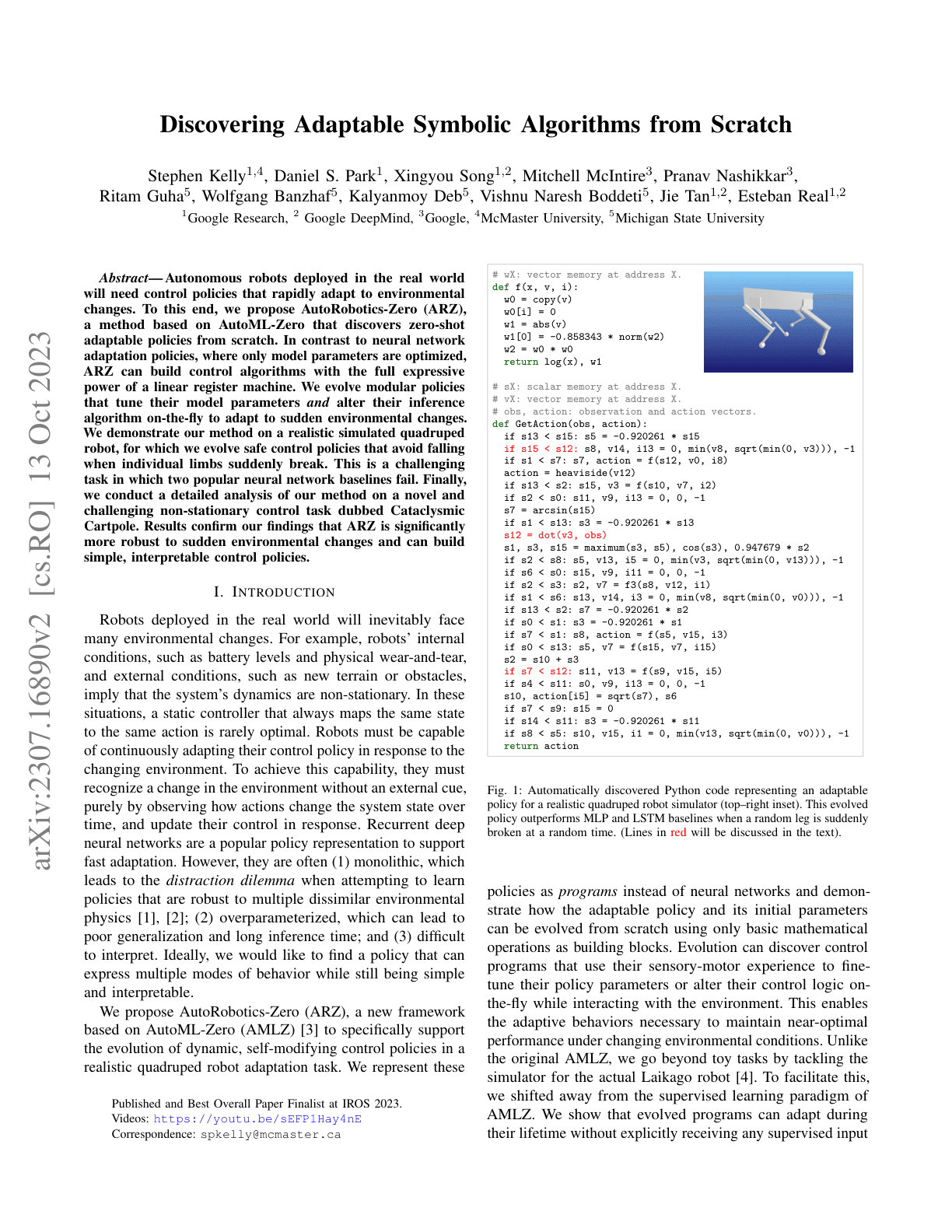
Discovers zero-shot adaptable robot policies from scratch, including the automatic discovery of Python control code.
Ask this paper
Zero-shot adaptability: Policies adapt to sudden environmental changes without any fine-tuning at test time - a critical property for robust robotics.
Python-code policies: Automatically discovers Python code that implements robot controllers - an interpretable, auditable policy representation.
Discovery from scratch: Policies are discovered from scratch rather than fine-tuned from pretrained ones, reducing assumptions about prior knowledge.
AutoML for robotics: Extends the AutoML paradigm into robotics, using search over code rather than over neural architectures.
Abstract
Autonomous robots deployed in the real world will need control policies that rapidly adapt to environmental changes. To this end, we propose AutoRobotics-Zero (ARZ), a method based on AutoML-Zero that discovers zero-shot adaptable policies from scratch. In contrast to neural network adaptation policies, where only model parameters are optimized, ARZ can build control algorithms with the full expressive power of a linear register machine. We evolve modular policies that tune their model parameters and alter their inference algorithm on-the-fly to adapt to sudden environmental changes. We demonstrate our method on a realistic simulated quadruped robot, for which we evolve safe control policies that avoid falling when individual limbs suddenly break. This is a challenging task in which two popular neural network baselines fail. Finally, we conduct a detailed analysis of our method on a novel and challenging non-stationary control task dubbed Cataclysmic Cartpole. Results confirm our findings that ARZ is significantly more robust to sudden environmental changes and can build simple, interpretable control policies.