Belief-State Management Meets Rubric Rewards for Agentic Forecasting
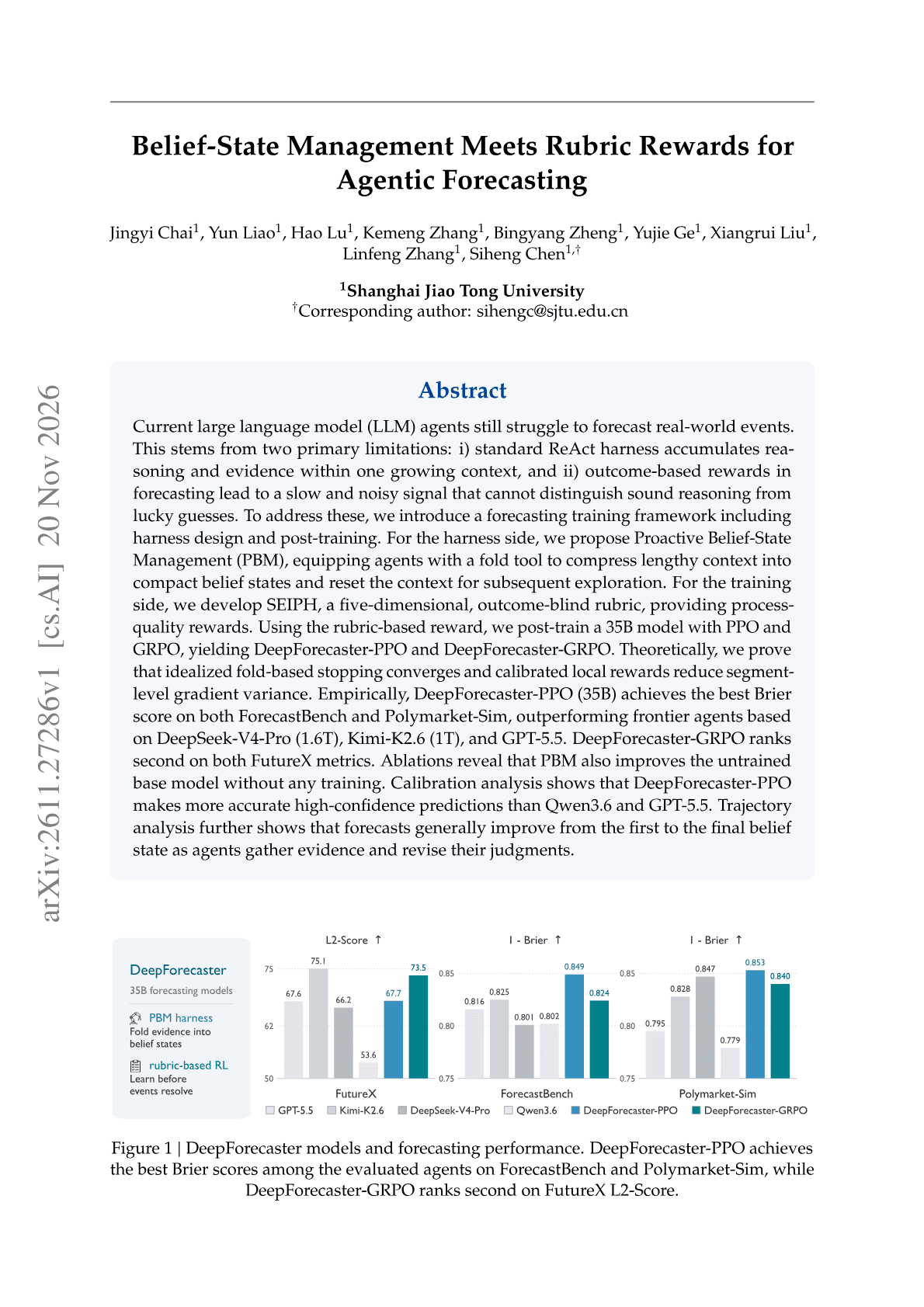
Jingyi Chai, Siheng Chen and colleagues at Shanghai Jiao Tong University train forecasting agents with two changes: a harness tool that folds long context into a compact belief state, and an outcome-blind rubric that rewards reasoning quality instead of only final correctness.
Ask this paper
Harness change. Proactive Belief-State Management (PBM) gives the agent a fold tool that compresses accumulated evidence into a belief state and resets context before further search. PBM improves the untrained base model on its own.
Reward change. SEIPH is a five-dimension rubric that scores process quality without seeing the outcome, which addresses slow, noisy outcome rewards that cannot separate sound reasoning from luck.
Training. A 35B model is post-trained with PPO and GRPO on these rewards, producing DeepForecaster-PPO and DeepForecaster-GRPO. The authors prove that idealized fold-based stopping converges and that calibrated local rewards reduce gradient variance.
Results. DeepForecaster-PPO gets the best Brier score on ForecastBench (0.151) and Polymarket-Sim (0.147), ahead of agents built on DeepSeek-V4-Pro, Kimi-K2.6 and GPT-5.5. Market prices still do better (Brier 0.134).
Abstract
Current large language model (LLM) agents still struggle to forecast real-world events. This stems from two primary limitations: i) standard ReAct harness accumulates reasoning and evidence within one growing context, and ii) outcome-based rewards in forecasting lead to a slow and noisy signal that cannot distinguish sound reasoning from lucky guesses. To address these, we introduce a forecasting training framework including harness design and post-training. For the harness side, we propose Proactive Belief-State Management (PBM), equipping agents with a fold tool to compress lengthy context into compact belief states and reset the context for subsequent exploration. For the training side, we develop SEIPH, a five-dimensional, outcome-blind rubric, providing process-quality rewards. Using the rubric-based reward, we post-train a 35B model with PPO and GRPO, yielding DeepForecaster-PPO and DeepForecaster-GRPO. Theoretically, we prove that idealized fold-based stopping converges and calibrated local rewards reduce segment-level gradient variance. Empirically, DeepForecaster-PPO (35B) achieves the best Brier score on both ForecastBench and Polymarket-Sim, outperforming frontier agents based on DeepSeek-V4-Pro (1.6T), Kimi-K2.6 (1T), and GPT-5.5. DeepForecaster-GRPO ranks second on both FutureX metrics. Ablations reveal that PBM also improves the untrained base model without any training. Calibration analysis shows that DeepForecaster-PPO makes more accurate high-confidence predictions than Qwen3.6 and GPT-5.5. Trajectory analysis further shows that forecasts generally improve from the first to the final belief state as agents gather evidence and revise their judgments.