τ-bench-LILT: Evaluating Conversational Agents on Realistic Multilingual Tool-Use Tasks
Kaden Uhlig, Joern Wuebker and colleagues at LILT and TU Berlin extend τ³-bench to German, Korean, Turkish and Farsi across airline, retail, telecom and banking, localizing databases, user simulators and tasks rather than translating them.
Ask this paper
Localization. Customer databases use culturally appropriate records, user-simulator prompts are refined with native-language experts through contrastive annotation, and tasks are updated to match local data and realistic regional requests.
Realistic setup. Policies and system prompts stay in English, matching a US company that extends an English-built support agent to new markets.
Results. Across eight agent models, the largest drops versus English are in Korean and Farsi retail, by up to 61 points in pass^4.
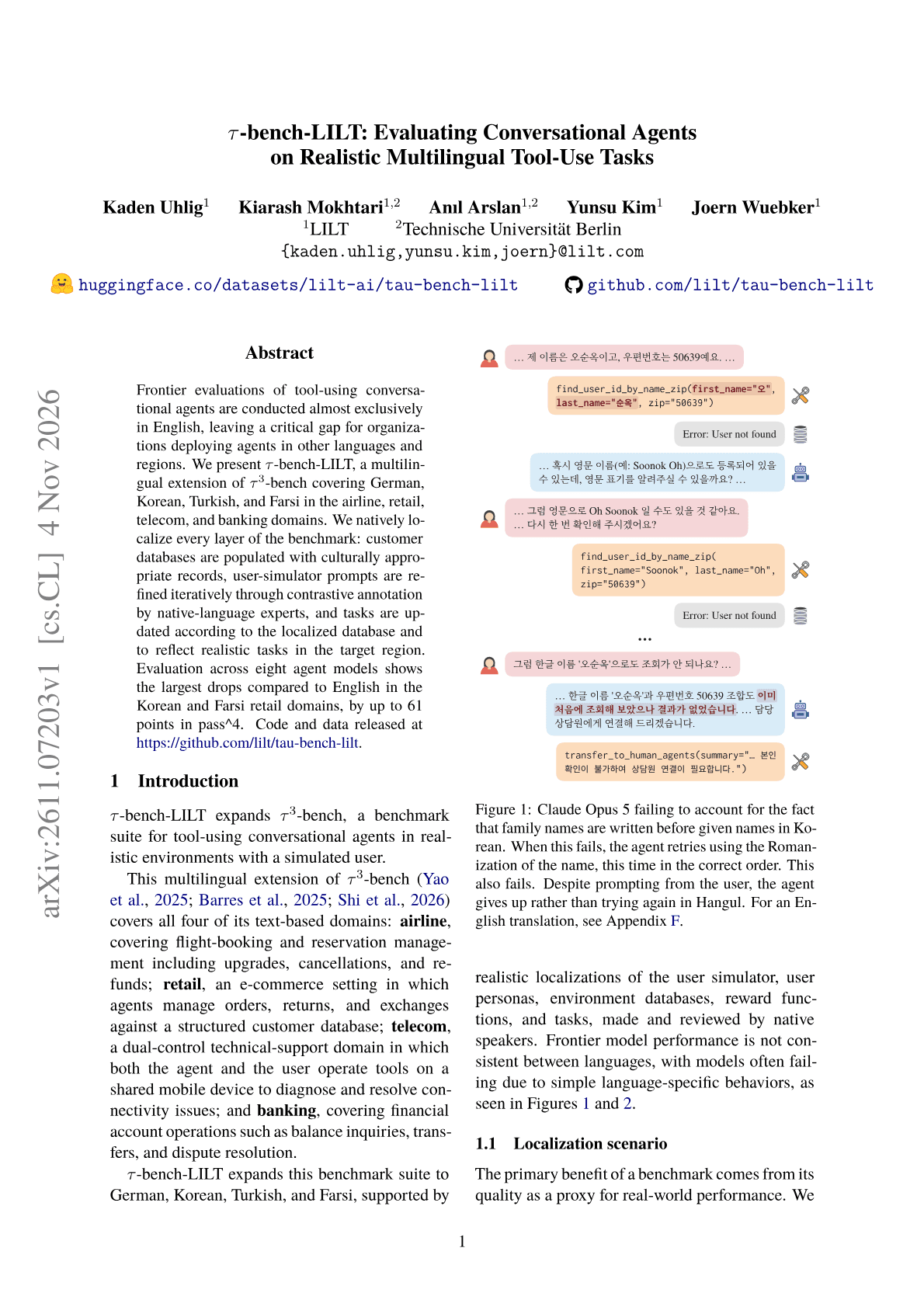
Failure examples. Claude Opus 5 fails a Korean retail task it passes 100% of the time in English by inventing a rule that accounts can only be found by email or English name.
Infrastructure bugs. τ³-bench's English-first design surfaces real internationalization issues, such as escaped Unicode in lookup results and first_name/last_name fields that assume Western name order.
Abstract
Frontier evaluations of tool-using conversational agents are conducted almost exclusively in English, leaving a critical gap for organizations deploying agents in other languages and regions. We present $τ$-bench-LILT, a multilingual extension of ${τ^3}$-bench covering German, Korean, Turkish, and Farsi in the airline, retail, telecom, and banking domains. We natively localize every layer of the benchmark: customer databases are populated with culturally appropriate records, user-simulator prompts are refined iteratively through contrastive annotation by native-language experts, and tasks are updated according to the localized database and to reflect realistic tasks in the target region. Evaluation across eight agent models shows the largest drops compared to English in the Korean and Farsi retail domains, by up to 61 points in pass^4. Code and data released at https://github.com/lilt/tau-bench-lilt.