Benchmarking Task Takeover Across Agent Handoffs
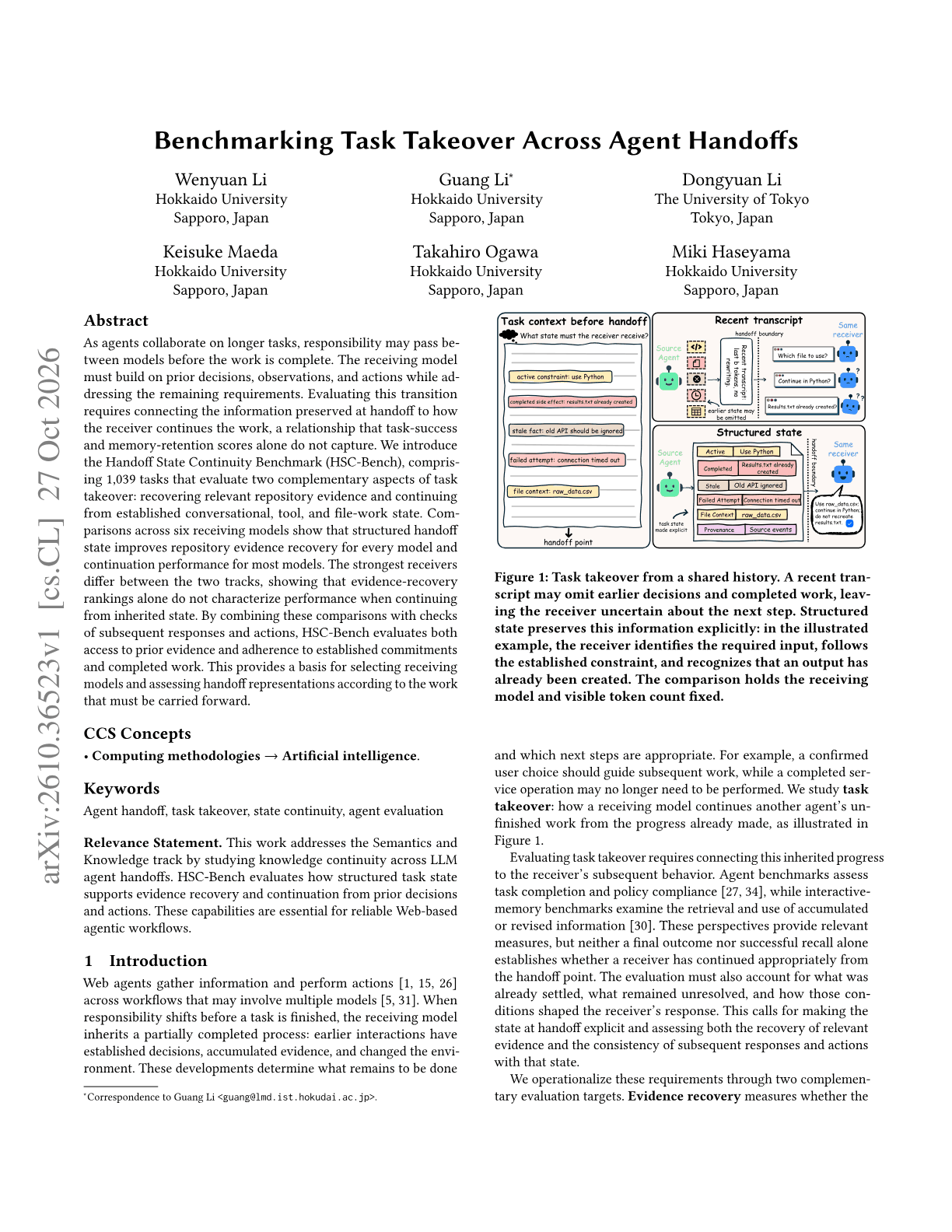
Wenyuan Li, Guang Li, Dongyuan Li and colleagues (Hokkaido University, University of Tokyo) introduce HSC-Bench, 1,039 tasks that test whether a receiving model can take over partly finished agent work, and compare structured handoff state against recent transcripts at the same token count.
Ask this paper
Two tracks. One track tests recovery of relevant repository evidence. The other tests continuation from established conversational, tool and file-work state, with explicit targets for the receiver's next responses and actions.
Controlled comparison. Six receivers, including GPT-5.4, Claude Sonnet 5, DeepSeek V3.2 and Kimi K2, take over the same source histories at fixed handoff points. Structured state and recent transcripts are matched on visible token count.
Results. Structured handoff state improves repository evidence recovery for every model. For GPT-5.4, line-F1 rises from 0.075 with the recent transcript to 0.229 with structured state. Continuation improves for most models.
Rankings differ. The strongest receiver on evidence recovery is not the strongest on continuation, so evidence-recovery rankings alone do not predict how well a model continues inherited work.
Abstract
As agents collaborate on longer tasks, responsibility may pass between models before the work is complete. The receiving model must build on prior decisions, observations, and actions while addressing the remaining requirements. Evaluating this transition requires connecting the information preserved at handoff to how the receiver continues the work, a relationship that task-success and memory-retention scores alone do not capture. We introduce the Handoff State Continuity Benchmark (HSC-Bench), comprising 1,039 tasks that evaluate two complementary aspects of task takeover: recovering relevant repository evidence and continuing from established conversational, tool, and file-work state. Comparisons across six receiving models show that structured handoff state improves repository evidence recovery for every model and continuation performance for most models. The strongest receivers differ between the two tracks, showing that evidence-recovery rankings alone do not characterize performance when continuing from inherited state. By combining these comparisons with checks of subsequent responses and actions, HSC-Bench evaluates both access to prior evidence and adherence to established commitments and completed work. This provides a basis for selecting receiving models and assessing handoff representations according to the work that must be carried forward.