bf16 Rounding Silently Discards Most RL Policy Updates: A Hidden Training-Inference Mismatch and an Unbiased One-Line Fix
Andrew Gao and William Gao (Stanford University) show that round-to-nearest conversion of fp32 master weights to the bf16 rollout copy discards most per-step RL updates, and propose Fair Cast, a one-line change to unbiased rounding.
Ask this paper
Finding. At common learning rates most updates are smaller than half a bf16 spacing. On Qwen3-1.7B only 0.4 to 0.5% of served weights change per step, and the rollout policy lags the optimizer by 50 to 150 steps.
Why existing fixes miss it. Current mismatch corrections compare two copies that both sit downstream of the same rounding, so they cannot observe the lag.
Fair Cast. Export with stochastic rounding or error feedback and compute the loss on the served copy. It adds no hyperparameters and costs 22 to 38 ms per export of 1.7B parameters.
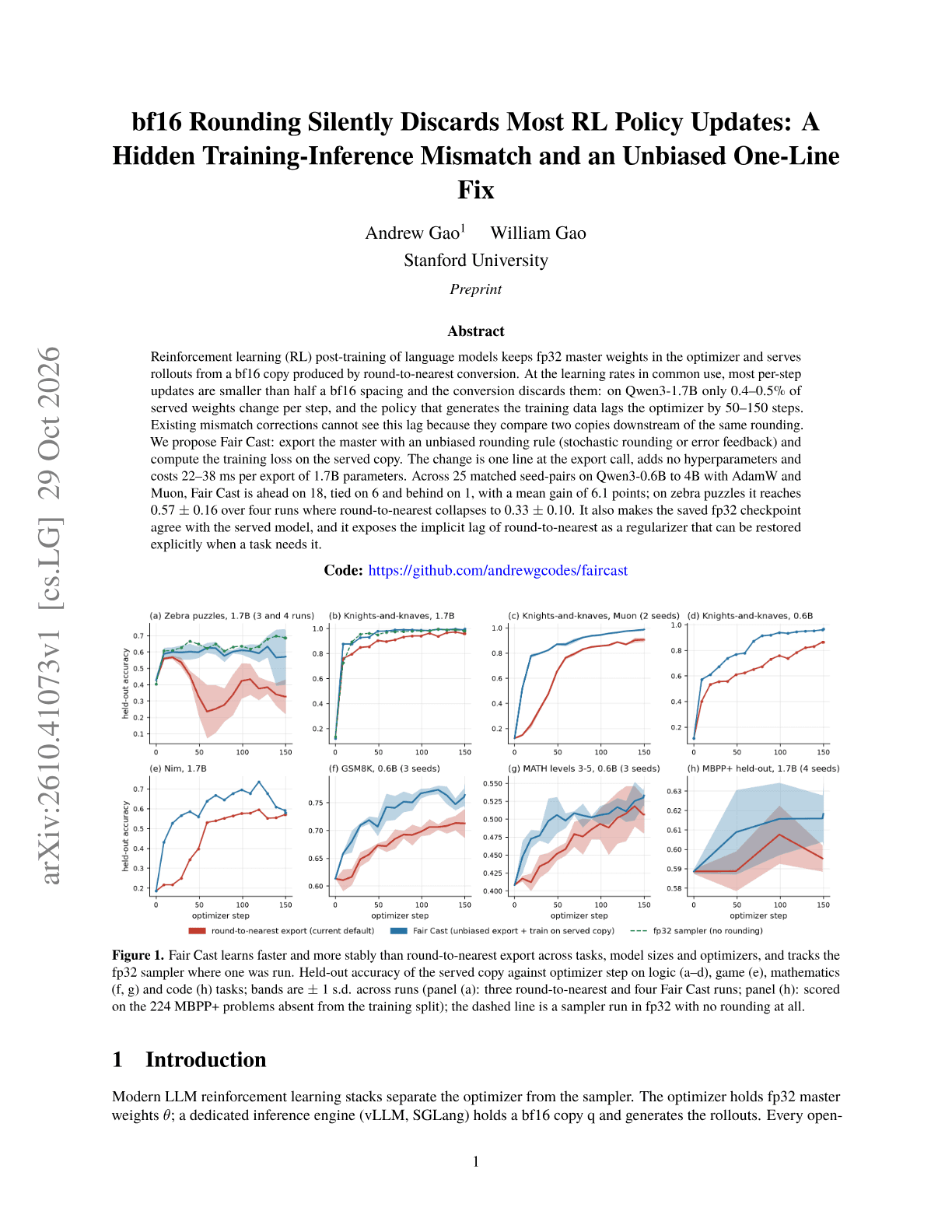
Results. Across 25 matched seed-pairs on Qwen3-0.6B to 4B with AdamW and Muon, Fair Cast wins 18, ties 6 and loses 1, with a mean gain of 6.1 points. On zebra puzzles it reaches 0.57 against 0.33 for round-to-nearest, which collapses.
Caveat. The rounding lag acts as an implicit regularizer. In two configurations removing it hurts unless an explicit lag is added back.
Abstract
Reinforcement learning (RL) post-training of language models keeps fp32 master weights in the optimizer and serves rollouts from a bf16 copy produced by round-to-nearest conversion. At the learning rates in common use, most per-step updates are smaller than half a bf16 spacing and the conversion discards them: on Qwen3-1.7B only 0.4-0.5% of served weights change per step, and the policy that generates the training data lags the optimizer by 50-150 steps. Existing mismatch corrections cannot see this lag because they compare two copies downstream of the same rounding. We propose Fair Cast: export the master with an unbiased rounding rule (stochastic rounding or error feedback) and compute the training loss on the served copy. The change is one line at the export call, adds no hyperparameters and costs 22-38 ms per export of 1.7B parameters. Across 25 matched seed-pairs on Qwen3-0.6B to 4B with AdamW and Muon, Fair Cast is ahead on 18, tied on 6 and behind on 1, with a mean gain of 6.1 points; on zebra puzzles it reaches 0.57 +/- 0.16 over four runs where round-to-nearest collapses to 0.33 +/- 0.10. It also makes the saved fp32 checkpoint agree with the served model, and it exposes the implicit lag of round-to-nearest as a regularizer that can be restored explicitly when a task needs it.