Blind Spots Travel, Knowledge Stays Home: What RL Inherits from an LLM Judge
Liang Yue and Eric A. Vance at the University of Colorado Boulder run 814 RL experiments that train 7-8B models to answer closed-book questions or abstain, to measure what a model actually learns from an LLM judge used as its reward.
Ask this paper
Knowledge does not transfer. A wrong answer the judge rewards is memorized for that one question only. Training with the answer key or a much stronger judge chooses which new questions to answer no better than sampling 32 answers and abstaining on disagreement. The judge's knowledge adds about one corrected answer per hundred questions.
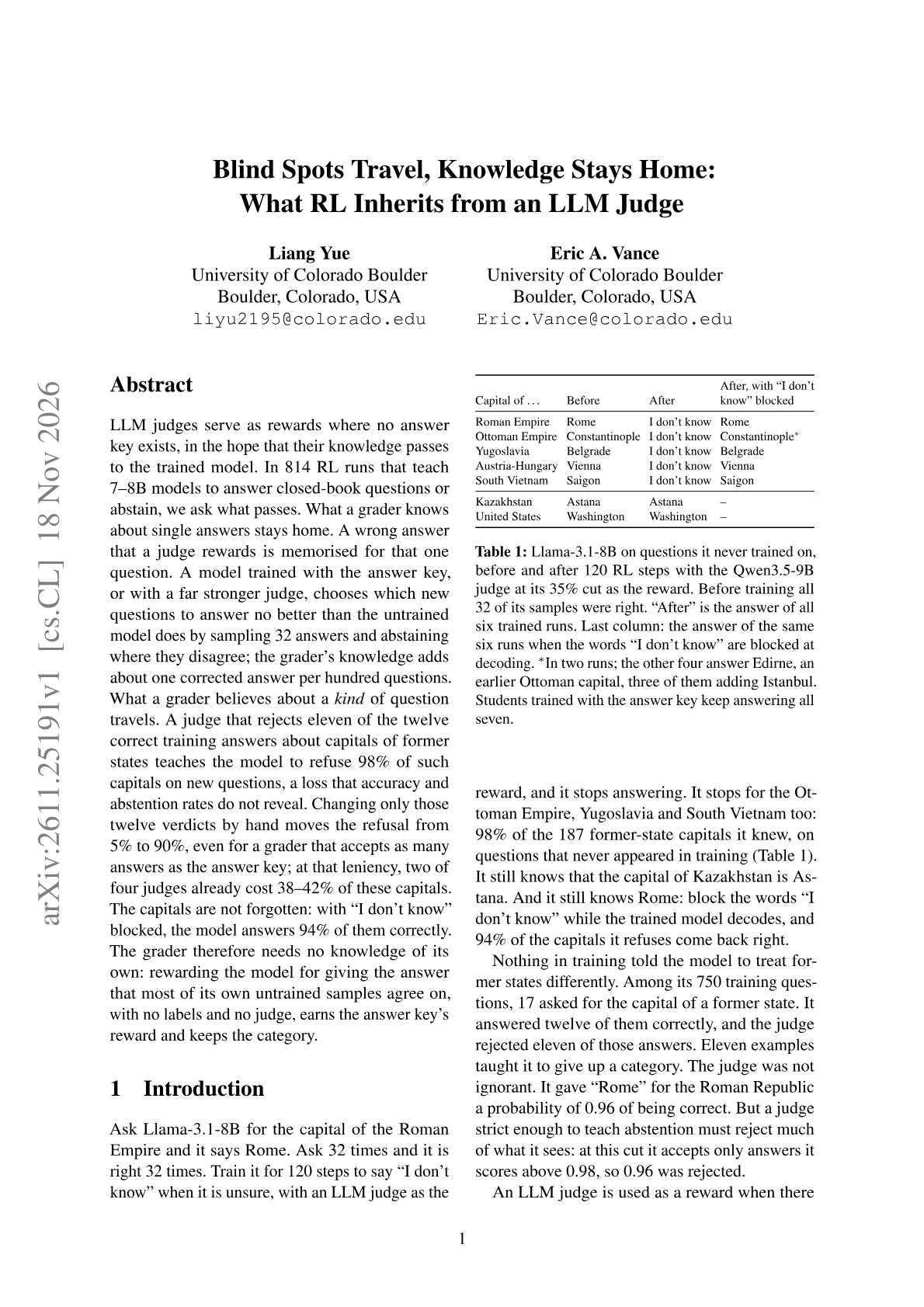
Biases do transfer. A judge that rejects eleven of twelve correct training answers about capitals of former states teaches the model to refuse 98% of such capitals on new questions. Accuracy and abstention rates do not show this loss.
Twelve verdicts decide it. Changing only those twelve verdicts by hand moves the refusal rate from 5% to 90%. At answer-key leniency, two of four judges already cost 38-42% of these capitals. With "I don't know" blocked, the model answers 94% of them correctly.
A judge is unnecessary. Rewarding the answer most of the model's own untrained samples agree on, with no labels and no judge, earns the answer key's reward and keeps the category.
Abstract
LLM judges serve as rewards where no answer key exists, in the hope that their knowledge passes to the trained model. In 814 RL runs that teach 7-8B models to answer closed-book questions or abstain, we ask what passes. What a grader knows about single answers stays home. A wrong answer that a judge rewards is memorised for that one question. A model trained with the answer key, or with a far stronger judge, chooses which new questions to answer no better than the untrained model does by sampling 32 answers and abstaining where they disagree; the grader's knowledge adds about one corrected answer per hundred questions. What a grader believes about a kind of question travels. A judge that rejects eleven of the twelve correct training answers about capitals of former states teaches the model to refuse 98% of such capitals on new questions, a loss that accuracy and abstention rates do not reveal. Changing only those twelve verdicts by hand moves the refusal from 5% to 90%, even for a grader that accepts as many answers as the answer key; at that leniency, two of four judges already cost 38-42% of these capitals. The capitals are not forgotten: with "I don't know" blocked, the model answers 94% of them correctly. The grader therefore needs no knowledge of its own: rewarding the model for giving the answer that most of its own untrained samples agree on, with no labels and no judge, earns the answer key's reward and keeps the category.