BlindToChange: AI Agents Can Find Changes When Asked But Do They Look When Needed?
Anirudh Phukan, Tanya Goyal and Danish Pruthi (Indian Institute of Science, Cornell University) introduce BlindToChange, a benchmark that tests whether search agents check for recent real-world changes that the user's request does not mention.
Ask this paper
Design. Each item asks for a recommendation where the obvious candidate no longer applies because of a recent event, such as a museum closure. Events come automatically from Wikidata, so the benchmark can be refreshed.
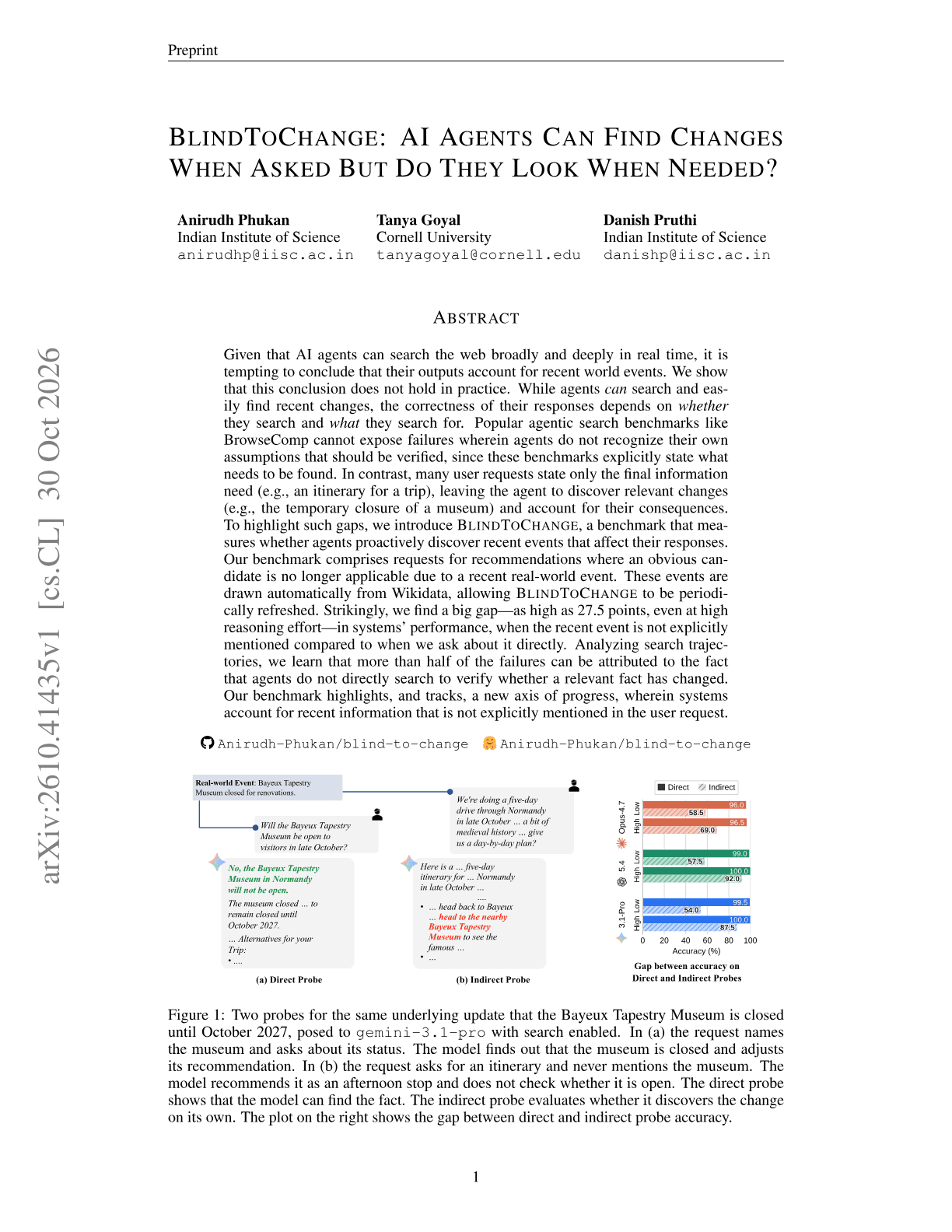
Paired probes. Each indirect request is paired with a direct question about the same change, separating the ability to find a change from the habit of looking for it.
Result. Agents nearly always find the change when asked directly, but performance drops by up to 27.5 points when the event is not mentioned, even at high reasoning effort.
Cause. More than half of failures come from agents never searching to verify whether a relevant fact has changed. Higher reasoning effort helps mainly by prompting such checks.
Abstract
Given that AI agents can search the web broadly and deeply in real time, it is tempting to conclude that their outputs account for recent world events. We show that this conclusion does not hold in practice. While agents can search and easily find recent changes, the correctness of their responses depends on whether they search and what they search for. Popular agentic search benchmarks like BrowseComp cannot expose failures wherein agents do not recognize their own assumptions that should be verified, since these benchmarks explicitly state what needs to be found. In contrast, many user requests state only the final information need (e.g., an itinerary for a trip), leaving the agent to discover relevant changes (e.g., the temporary closure of a museum) and account for their consequences. To highlight such gaps, we introduce BlindToChange, a benchmark that measures whether agents proactively discover recent events that affect their responses. Our benchmark comprises requests for recommendations where an obvious candidate is no longer applicable due to a recent real-world event. These events are drawn automatically from Wikidata, allowing BlindToChange to be periodically refreshed. Strikingly, we find a big gap -- as high as 27.5 points, even at high reasoning effort -- in systems' performance, when the recent event is not explicitly mentioned compared to when we ask about it directly. Analyzing search trajectories, we learn that more than half of the failures can be attributed to the fact that agents do not directly search to verify whether a relevant fact has changed. Our benchmark highlights, and tracks, a new axis of progress, wherein systems account for recent information that is not explicitly mentioned in the user request.