Budget Internalization: Fixed-Budget RLVR Trades Test-Time Scaling for In-Budget Accuracy
Ilia Zavidnyi and colleagues at JetBrains Research and Czech Technical University show that the fixed rollout cap used in RL with verifiable rewards becomes a learned constraint: trained models stop using extra tokens at test time and lose the accuracy gains of longer reasoning.
Ask this paper
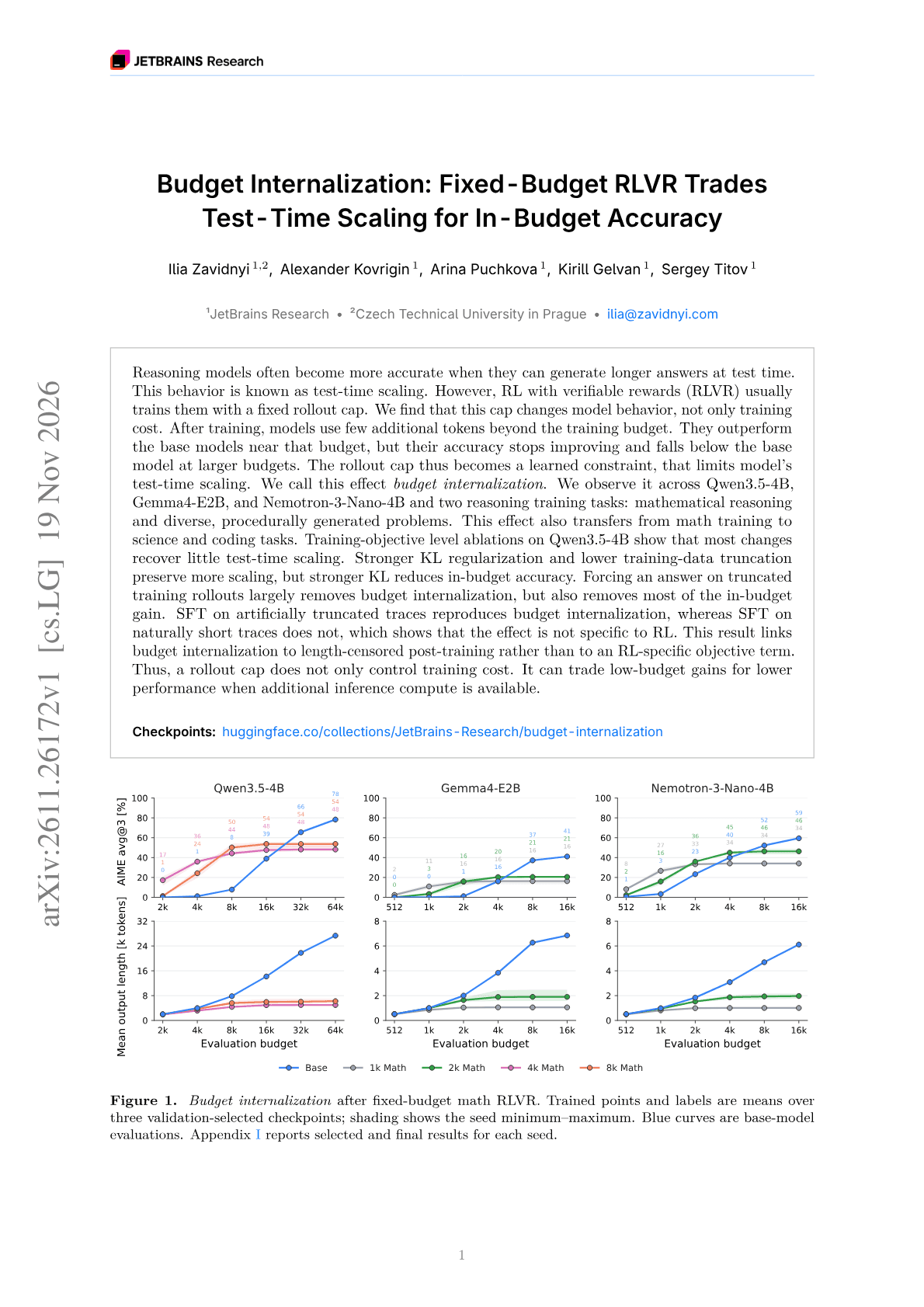
The effect. Qwen3.5-4B trained with a 4k rollout cap gains 34.8 points on AIME at a 4k evaluation budget and loses 30.2 points against the base model at 64k, averaged over three seeds.
Across models. Across six checkpoints from Qwen, Gemma and Nemotron, gains at the training cap range from 11.7 to 46.7 points, and deficits at the largest budget range from 17.2 to 35.0 points. The effect transfers from math training to science and coding.
Ablations. Stronger KL regularization and less training-data truncation keep more test-time scaling, but stronger KL lowers in-budget accuracy. Forcing an answer on truncated rollouts removes the effect and most of the in-budget gain.
Cause. SFT on artificially truncated traces reproduces the effect, while SFT on naturally short traces does not. The cause is length-censored training data, not an RL-specific objective term.
Abstract
Reasoning models often become more accurate when they can generate longer answers at test time. This behavior is known as test-time scaling. However, RL with verifiable rewards (RLVR) usually trains them with a fixed rollout cap. We find that this cap changes model behavior, not only training cost. After training, models use few additional tokens beyond the training budget. They outperform the base models near that budget, but their accuracy stops improving and falls below the base model at larger budgets. The rollout cap thus becomes a learned constraint, that limits model's test-time scaling. We call this effect budget internalization. We observe it across Qwen3.5-4B, Gemma4-E2B, and Nemotron-3-Nano-4B and two reasoning training tasks: mathematical reasoning and diverse, procedurally generated problems. This effect also transfers from math training to science and coding tasks. Training-objective level ablations on Qwen3.5-4B show that most changes recover little test-time scaling. Stronger KL regularization and lower training-data truncation preserve more scaling, but stronger KL reduces in-budget accuracy. Forcing an answer on truncated training rollouts largely removes budget internalization, but also removes most of the in-budget gain. SFT on artificially truncated traces reproduces budget internalization, whereas SFT on naturally short traces does not, which shows that the effect is not specific to RL. This result links budget internalization to length-censored post-training rather than to an RL-specific objective term. Thus, a rollout cap does not only control training cost. It can trade low-budget gains for lower performance when additional inference compute is available.