Building Auditable AI Text Detectors with Sparse Autoencoders
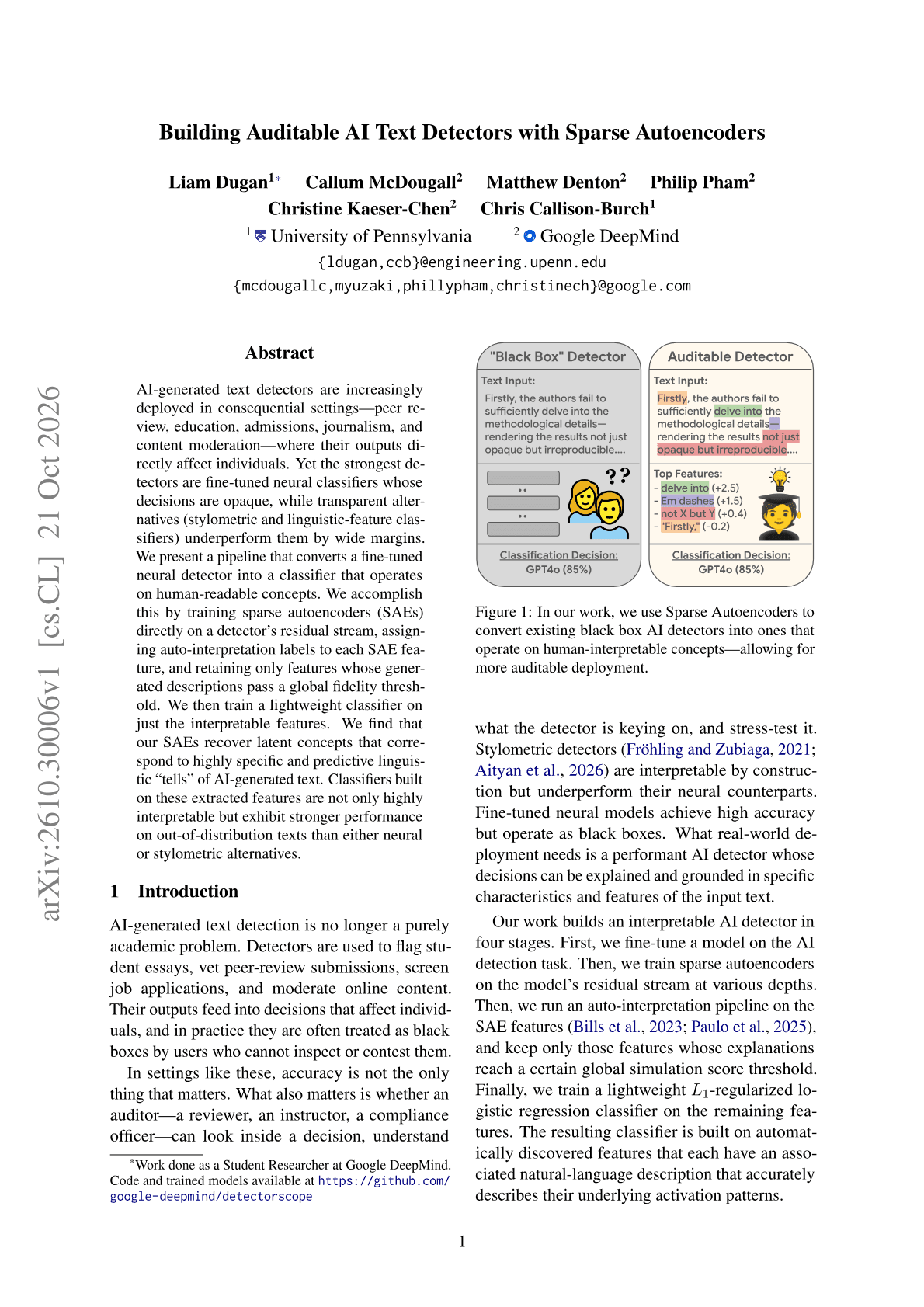
Liam Dugan (UPenn, student researcher at Google DeepMind), Callum McDougall, Chris Callison-Burch and colleagues convert a fine-tuned AI-text detector into a classifier over human-readable concepts by training sparse autoencoders on the detector's residual stream.
Ask this paper
Pipeline. Train SAEs on the detector's residual stream, auto-label every feature, keep only features whose descriptions pass a global fidelity threshold, and fit a lightweight classifier on those features alone.
What the features are. The retained SAE features correspond to specific, predictive linguistic markers of AI-generated text.
Accuracy out of distribution. The interpretable classifier outperforms both the original neural detector and stylometric baselines on out-of-distribution text.
Why it matters. Detectors are used in peer review, admissions and moderation, where an auditable reason for a flag matters. Accepted at EMNLP 2026, with code and models released.
Abstract
AI-generated text detectors are increasingly deployed in consequential settings---peer review, education, admissions, journalism, and content moderation---where their outputs directly affect individuals. Yet the strongest detectors are fine-tuned neural classifiers whose decisions are opaque, while transparent alternatives (stylometric and linguistic-feature classifiers) underperform them by wide margins. We present a pipeline that converts a fine-tuned neural detector into a classifier that operates on human-readable concepts. We accomplish this by training sparse autoencoders (SAEs) directly on a detector's residual stream, assigning auto-interpretation labels to each SAE feature, and retaining only features whose generated descriptions pass a global fidelity threshold. We then train a lightweight classifier on just the interpretable features. We find that our SAEs recover latent concepts that correspond to highly specific and predictive linguistic "tells" of AI-generated text. Classifiers built on these extracted features are not only highly interpretable but exhibit stronger performance on out-of-distribution texts than either neural or stylometric alternatives.