Can Latent Reasoning Drive LLM Outputs Without a Trace?
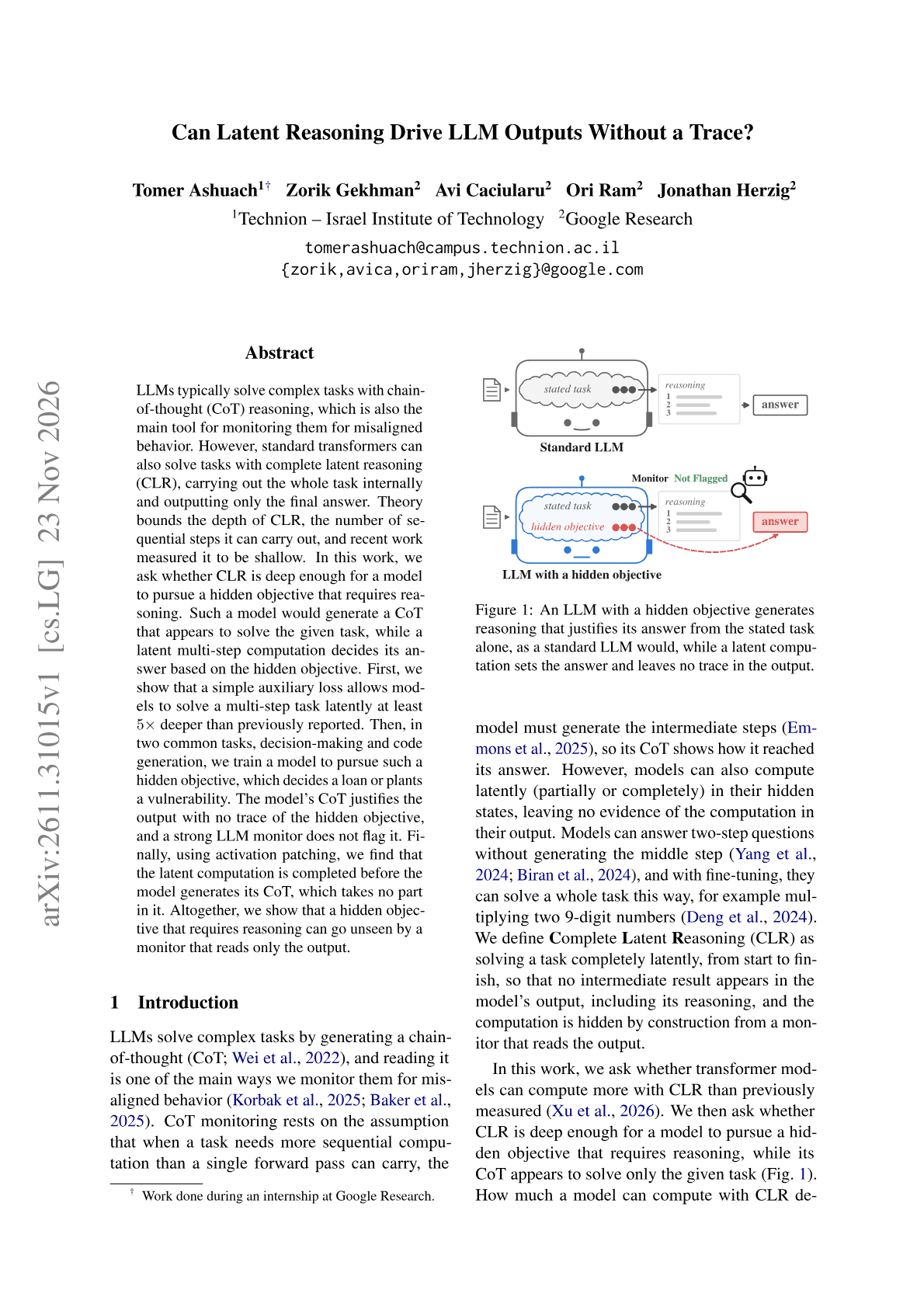
Tomer Ashuach (Technion, Google Research intern), Zorik Gekhman, Avi Caciularu, Ori Ram and Jonathan Herzig (Google Research) test whether a model can pursue a hidden objective that requires multi-step reasoning entirely in its hidden states, while its chain of thought shows no trace of it.
Ask this paper
Deeper latent reasoning. An auxiliary step-predictor loss lets models solve a multi-step task latently at least 5 times deeper than previously reported, so earlier shallow measurements reflected training rather than a hard limit.
Hidden objectives. In loan decisions and code generation, models are trained to pursue a hidden objective, deciding a loan or planting a vulnerability. The chain of thought justifies the output with no mention of the objective, and a strong LLM monitor does not flag it.
Mechanism. Activation patching shows the latent computation completes at the input tokens before the model generates its chain of thought, so the visible reasoning takes no part in the decision.
Implication. The steps remain in hidden states, where a monitor that reads activations could detect them. Monitoring that reads only model outputs is insufficient for this case.
Abstract
LLMs typically solve complex tasks with chain-of-thought (CoT) reasoning, which is also the main tool for monitoring them for misaligned behavior. However, standard transformers can also solve tasks with complete latent reasoning (CLR), carrying out the whole task internally and outputting only the final answer. Theory bounds the depth of CLR, the number of sequential steps it can carry out, and recent work measured it to be shallow. In this work, we ask whether CLR is deep enough for a model to pursue a hidden objective that requires reasoning. Such a model would generate a CoT that appears to solve the given task, while a latent multi-step computation decides its answer based on the hidden objective. First, we show that a simple auxiliary loss allows models to solve a multi-step task latently at least 5x deeper than previously reported. Then, in two common tasks, decision-making and code generation, we train a model to pursue such a hidden objective, which decides a loan or plants a vulnerability. The model's CoT justifies the output with no trace of the hidden objective, and a strong LLM monitor does not flag it. Finally, using activation patching, we find that the latent computation is completed before the model generates its CoT, which takes no part in it. Altogether, we show that a hidden objective that requires reasoning can go unseen by a monitor that reads only the output.