Can LLMs Anticipate Their Cruxes?
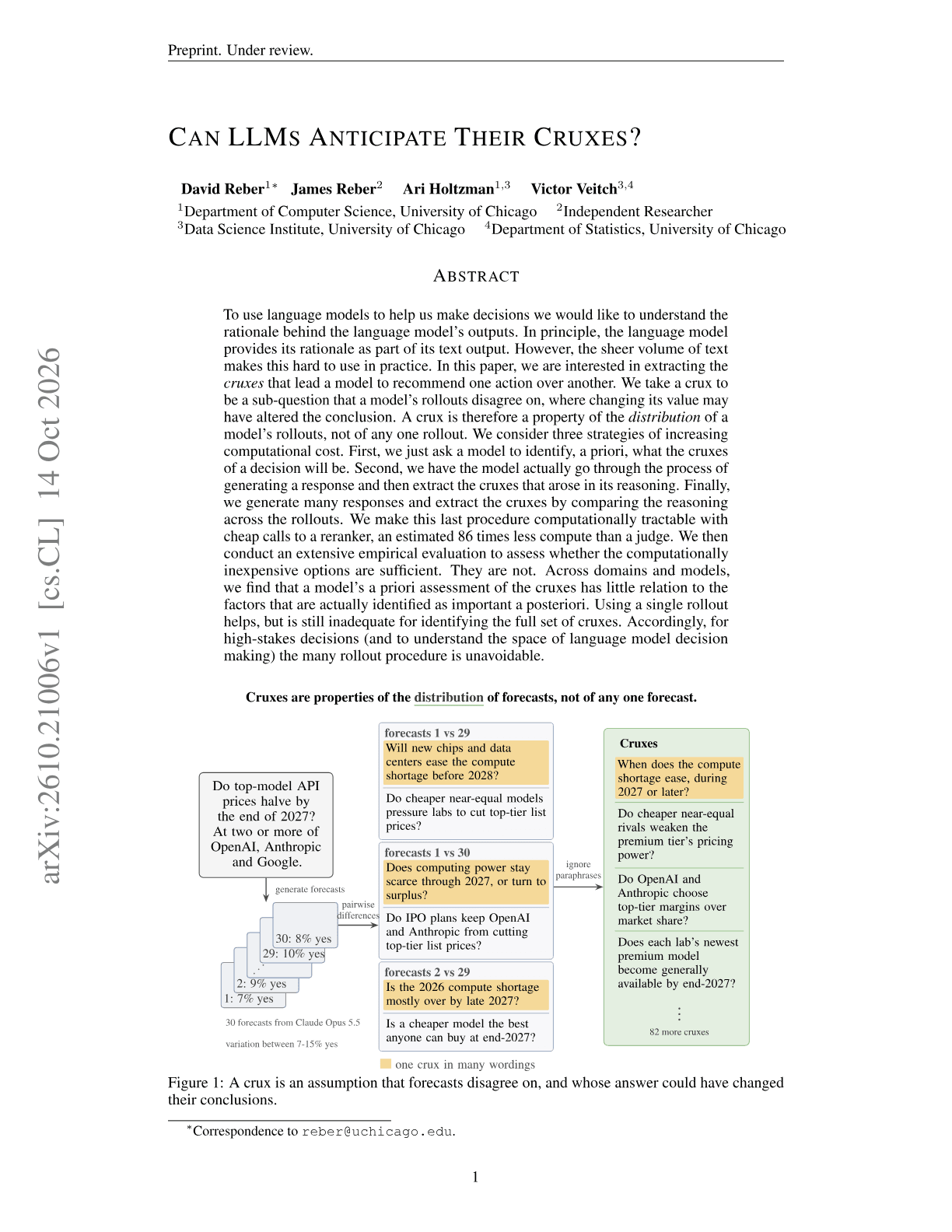
David Reber, Ari Holtzman, Victor Veitch and James Reber (University of Chicago) define a crux as a sub-question on which a model's rollouts disagree and whose answer could change its recommendation, and test whether cheap methods can find a model's cruxes without sampling many rollouts.
Ask this paper
Definition. A crux is a property of the distribution of a model's rollouts, not of any single rollout.
Three strategies. Ask the model to predict its cruxes in advance; extract cruxes from one generated response; or generate many responses and compare their reasoning. The many-rollout method is made affordable with reranker calls estimated at 86x less compute than a judge.
Main finding. Across domains and models, a model's advance prediction of its cruxes has little relation to the cruxes found after the fact. One rollout helps but still misses many of them.
Implication. For high-stakes decisions, understanding why a model recommends one action over another requires sampling and comparing many rollouts.
Abstract
To use language models to help us make decisions we would like to understand the rationale behind the language model's outputs. In principle, the language model provides its rationale as part of its text output. However, the sheer volume of text makes this hard to use in practice. In this paper, we are interested in extracting the cruxes that lead a model to recommend one action over another. We take a crux to be a sub-question that a model's rollouts disagree on, where changing its value may have altered the conclusion. A crux is therefore a property of the distribution of a model's rollouts, not of any one rollout. We consider three strategies of increasing computational cost. First, we just ask a model to identify, a priori, what the cruxes of a decision will be. Second, we have the model actually go through the process of generating a response and then extract the cruxes that arose in its reasoning. Finally, we generate many responses and extract the cruxes by comparing the reasoning across the rollouts. We make this last procedure computationally tractable with cheap calls to a reranker, an estimated 86 times less compute than a judge. We then conduct an extensive empirical evaluation to assess whether the computationally inexpensive options are sufficient. They are not. Across domains and models, we find that a model's a priori assessment of the cruxes has little relation to the factors that are actually identified as important a posteriori. Using a single rollout helps, but is still inadequate for identifying the full set of cruxes. Accordingly, for high-stakes decisions (and to understand the space of language model decision making) the many rollout procedure is unavoidable.