Can LLMs predict the outcomes of machine learning experiments?
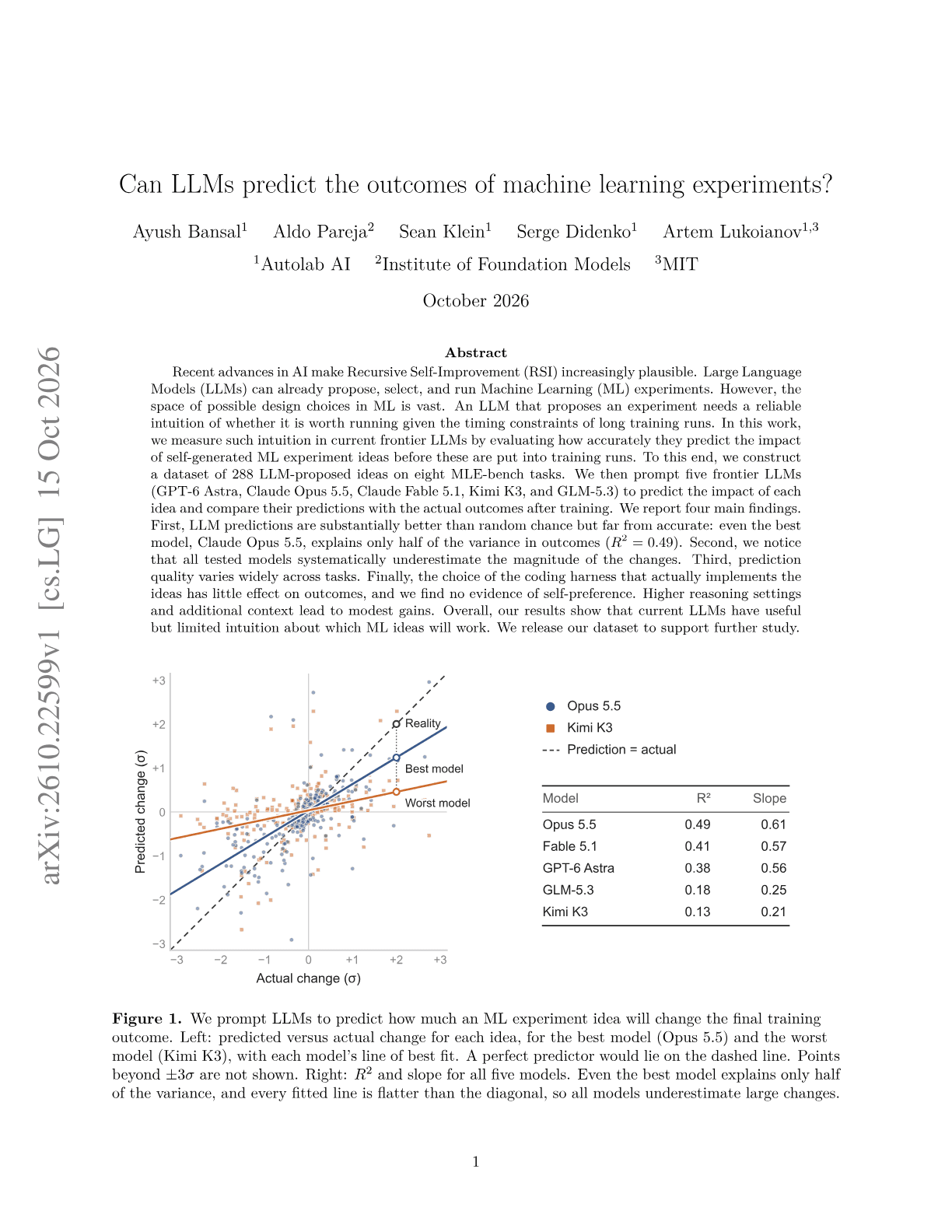
Ayush Bansal, Aldo Pareja, Artem Lukoianov and colleagues (Autolab AI, Institute of Foundation Models, MIT) measure whether frontier LLMs can predict the effect of their own ML experiment ideas before training, using 288 LLM-proposed ideas on eight MLE-bench tasks with measured outcomes.
Ask this paper
Dataset. 288 LLM-proposed ideas across eight MLE-bench tasks, each actually run, so predicted impact can be compared with the measured change. The dataset is released.
Models. GPT-6 Astra, Claude Opus 5.5, Claude Fable 5.1, Kimi K3 and GLM-5.3 predict each idea's impact.
Accuracy. Predictions beat chance but remain far from accurate. The best model, Claude Opus 5.5, explains about half the variance in outcomes (R^2 = 0.49).
Systematic bias. All models underestimate the size of the changes, and prediction quality varies widely across tasks. Higher reasoning settings and extra context give modest gains.
Harness and self-preference. The coding harness that implements the ideas has little effect on outcomes, and there is no evidence that models rate their own ideas higher.
Abstract
Recent advances in AI make Recursive Self-Improvement (RSI) increasingly plausible. Large Language Models (LLMs) can already propose, select, and run Machine Learning (ML) experiments. However, the space of possible design choices in ML is vast. An LLM that proposes an experiment needs a reliable intuition of whether it is worth running given the timing constraints of long training runs. In this work, we measure such intuition in current frontier LLMs by evaluating how accurately they predict the impact of self-generated ML experiment ideas before these are put into training runs. To this end, we construct a dataset of 288 LLM-proposed ideas on eight MLE-bench tasks. We then prompt five frontier LLMs (GPT-6 Astra, Claude Opus 5.5, Claude Fable 5.1, Kimi K3, and GLM-5.3) to predict the impact of each idea and compare their predictions with the actual outcomes after training. We report four main findings. First, LLM predictions are substantially better than random chance but far from accurate: even the best model, Claude Opus 5.5, explains only half of the variance in outcomes (R^2 = 0.49). Second, we notice that all tested models systematically underestimate the magnitude of the changes. Third, prediction quality varies widely across tasks. Finally, the choice of the coding harness that actually implements the ideas has little effect on outcomes, and we find no evidence of self-preference. Higher reasoning settings and additional context lead to modest gains. Overall, our results show that current LLMs have useful but limited intuition about which ML ideas will work. We release our dataset to support further study.