Can LLMs Reason and Plan?
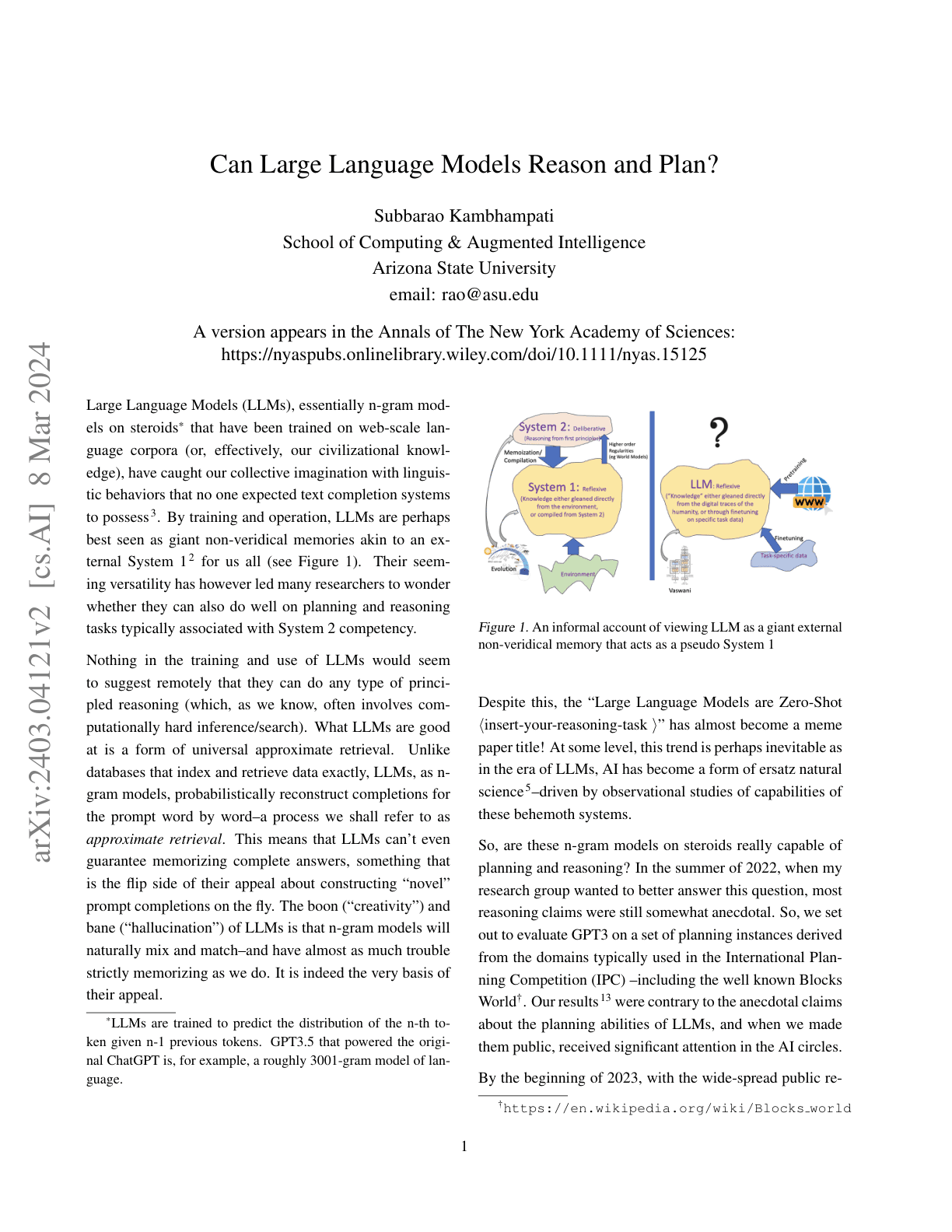
Kambhampati's position paper argues that what looks like reasoning and planning in LLMs is better understood as "universal approximate retrieval" powered by web-scale training.
Ask this paper
Core claim: "Nothing that I have read, verified, or done gives me any compelling reason to believe that LLMs do reasoning/planning, as normally understood" - LLMs interpolate over memorized patterns rather than search solution spaces.
Planning evaluations: Cites benchmarks like PlanBench where LLM performance collapses under obfuscation or natural adversarial perturbations, arguing that true planning would be more robust.
Self-critique skepticism: Questions claims that LLMs can reliably self-critique, noting that current systems hallucinate evaluations as readily as they hallucinate answers.
LLM-Modulo framework: Proposes using LLMs as components ("idea generators") alongside sound external verifiers (planners, theorem provers) rather than trusting them as standalone reasoners.
Abstract
While humans sometimes do show the capability of correcting their own erroneous guesses with self-critiquing, there seems to be no basis for that assumption in the case of LLMs.