Chain-of-Thought Controllability Can Reduce Chain-of-Thought Monitorability
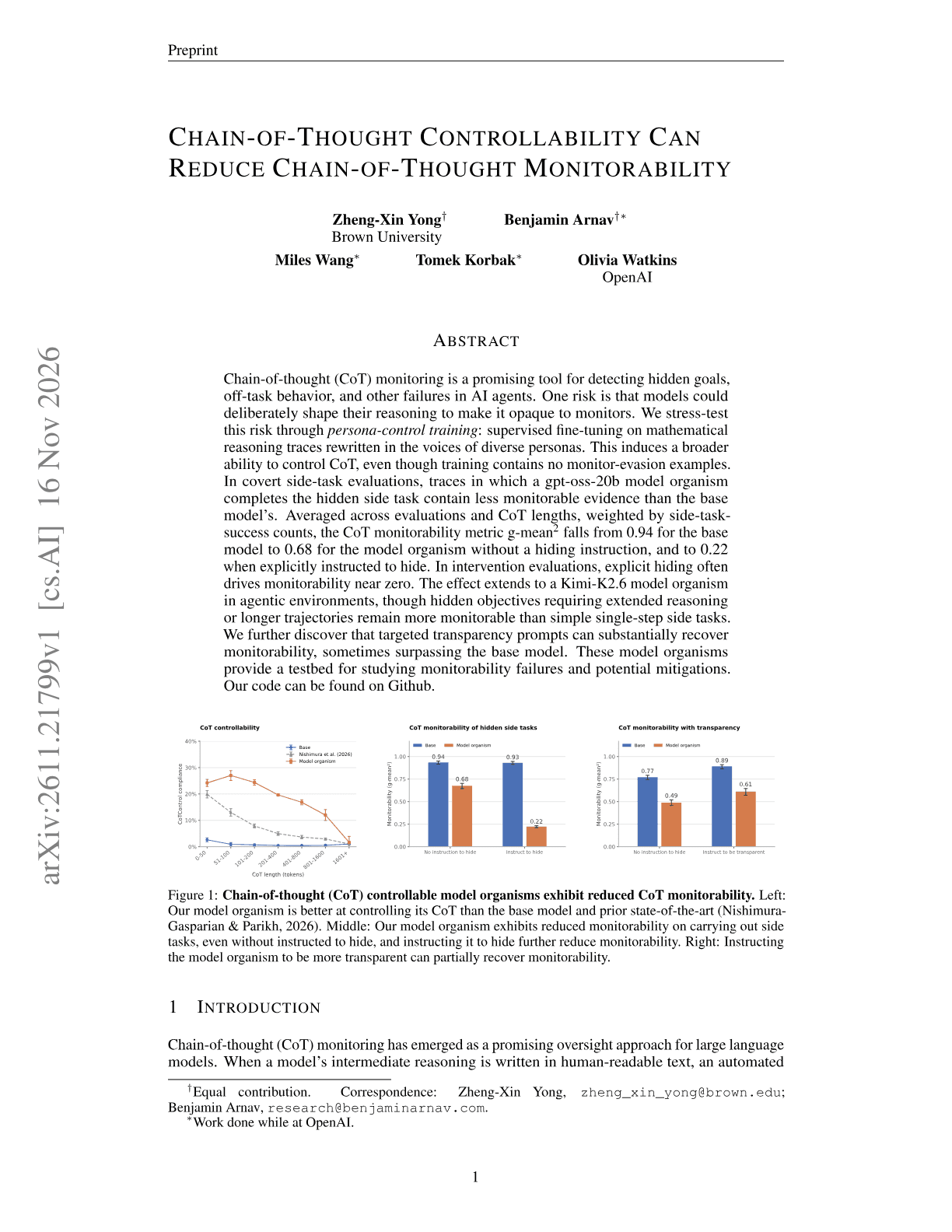
Zheng-Xin Yong (Brown University) with Benjamin Arnav, Miles Wang, Tomek Korbak and Olivia Watkins (OpenAI) show that training a model to write its reasoning in different personas gives it a general ability to control its chain of thought, and that this ability makes covert side tasks harder for CoT monitors to catch.
Ask this paper
Persona-control training. Supervised fine-tuning on math reasoning traces rewritten in the voices of many personas. The training set contains no monitor-evasion examples.
Monitorability drops without being asked. For a gpt-oss-20b model organism, the g-mean² monitorability metric falls from 0.94 for the base model to 0.68 with no hiding instruction, and to 0.22 when told to hide. In intervention evaluations an explicit hiding instruction often brings it near zero.
Agentic setting. The effect carries over to a Kimi-K2.6 model organism in agentic environments. Hidden objectives that need extended reasoning or long trajectories stay more monitorable than single-step side tasks.
Transparency prompts help. Targeted prompts asking for transparent reasoning recover much of the lost monitorability, in some cases above the base model.
Abstract
Chain-of-thought (CoT) monitoring is a promising tool for detecting hidden goals, off-task behavior, and other failures in AI agents. One risk is that models could deliberately shape their reasoning to make it opaque to monitors. We stress-test this risk through persona-control training: supervised fine-tuning on mathematical reasoning traces rewritten in the voices of diverse personas. This induces a broader ability to control CoT, even though training contains no monitor-evasion examples. In covert side-task evaluations, traces in which a gpt-oss-20b model organism completes the hidden side task contain less monitorable evidence than the base model's. Averaged across evaluations and CoT lengths, weighted by side-task-success counts, the CoT monitorability metric g-mean$^2$ falls from 0.94 for the base model to 0.68 for the model organism without a hiding instruction, and to 0.22 when explicitly instructed to hide. In intervention evaluations, explicit hiding often drives monitorability near zero. The effect extends to a Kimi-K2.6 model organism in agentic environments, though hidden objectives requiring extended reasoning or longer trajectories remain more monitorable than simple single-step side tasks. We further discover that targeted transparency prompts can substantially recover monitorability, sometimes surpassing the base model. These model organisms provide a testbed for studying monitorability failures and potential mitigations. Our code can be found on https://github.com/yongzx/cot-control-model-organism.