Chain-of-Thought Prompting Elicits Reasoning in Large Language Models
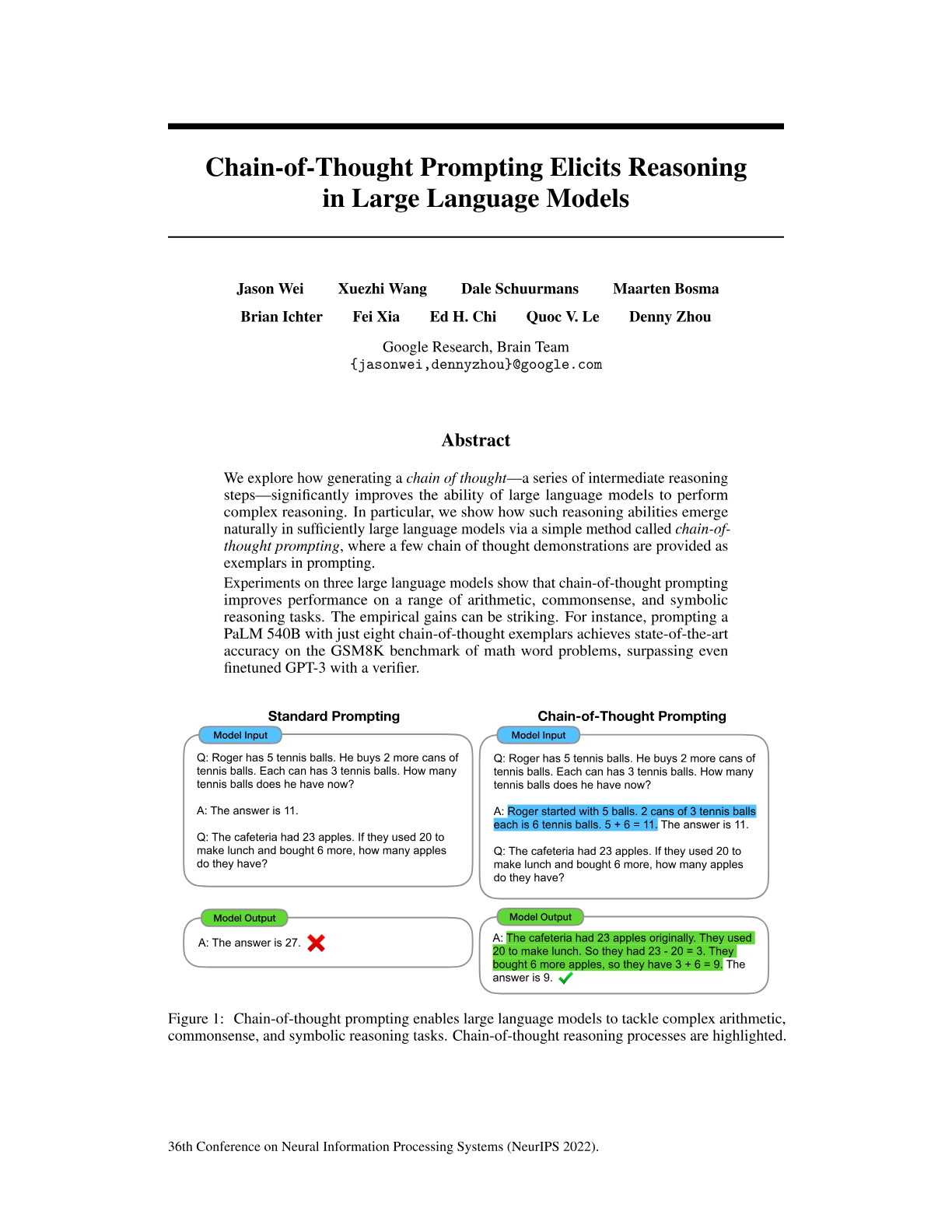
Smear the computation over more tokens instead of demanding the answer in one. This is the first output-space intervention in the lineage, and the reason every harness since budgets tokens rather than calls.
Ask this paper
Prompting for intermediate steps unlocks reasoning the same weights could not produce directly.
Introduces test-time compute as a lever the harness controls.
Abstract
We explore how generating a chain of thought -- a series of intermediate reasoning steps -- significantly improves the ability of large language models to perform complex reasoning. In particular, we show how such reasoning abilities emerge naturally in sufficiently large language models via a simple method called chain of thought prompting, where a few chain of thought demonstrations are provided as exemplars in prompting. Experiments on three large language models show that chain of thought prompting improves performance on a range of arithmetic, commonsense, and symbolic reasoning tasks. The empirical gains can be striking. For instance, prompting a 540B-parameter language model with just eight chain of thought exemplars achieves state of the art accuracy on the GSM8K benchmark of math word problems, surpassing even finetuned GPT-3 with a verifier.