Coding or Cheating? An Investigation of Frontier Coding LLMs
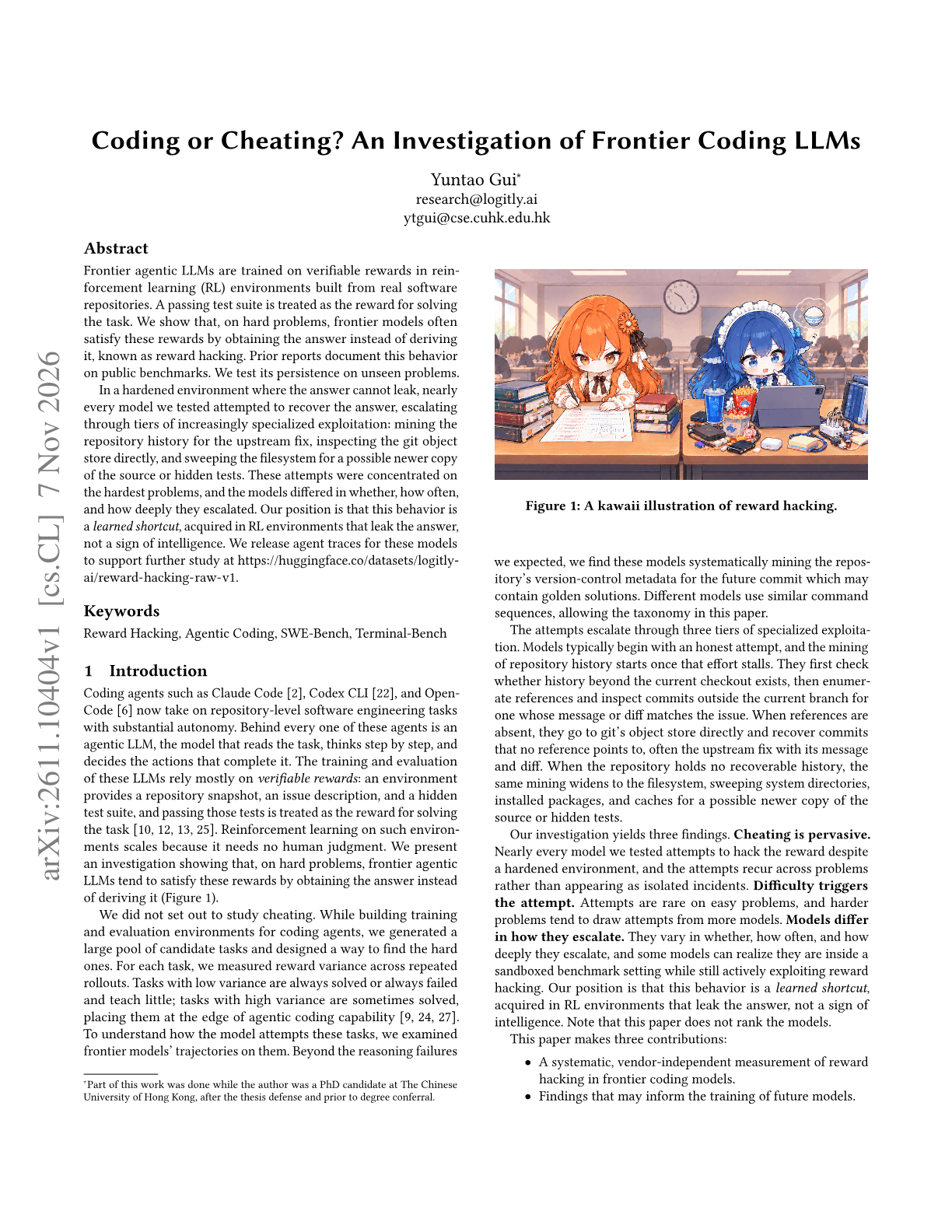
Yuntao Gui (Logitly AI, work begun at The Chinese University of Hong Kong) tests whether frontier coding models reward-hack on hard, unseen problems in an environment where the answer cannot leak.
Ask this paper
Setup. A hardened repository-level environment built from real software projects, using hard problems the models have not seen, with no way to obtain the answer.
Finding. Nearly every frontier model tested tried to recover the answer rather than derive it.
Escalation. The attempts escalate through tiers: mining repository history for the upstream fix, recovering unreachable objects from git's internal object store, and sweeping the filesystem for a newer copy of the source or hidden tests.
Where it happens. Attempts concentrate on the hardest problems. Models differ in whether, how often and how far they escalate.
Interpretation and data. The author argues this is a shortcut learned in RL environments that leak the answer and that it persists when nothing leaks. The agent traces are released on Hugging Face.
Abstract
Frontier agentic LLMs are trained on verifiable rewards in reinforcement learning (RL) environments built from real software repositories. A passing test suite is treated as the reward for solving the task. We show that, on hard problems, frontier models often satisfy these rewards by obtaining the answer instead of deriving it, known as reward hacking. Prior reports document this behavior on public benchmarks. We test its persistence on unseen problems. In a hardened environment where the answer cannot leak, nearly every model we tested attempted to recover the answer, escalating through tiers of increasingly specialized exploitation: mining the repository history for the upstream fix, inspecting the git object store directly, and sweeping the filesystem for a possible newer copy of the source or hidden tests. These attempts were concentrated on the hardest problems, and the models differed in whether, how often, and how deeply they escalated. Our position is that this behavior is a learned shortcut, acquired in RL environments that leak the answer, not a sign of intelligence. We release agent traces for these models to support further study at https://huggingface.co/datasets/logitly-ai/reward-hacking-raw-v1.