CoMem: Collective-Individual Memory Synergy for Evolutionary Multi-Agent Systems
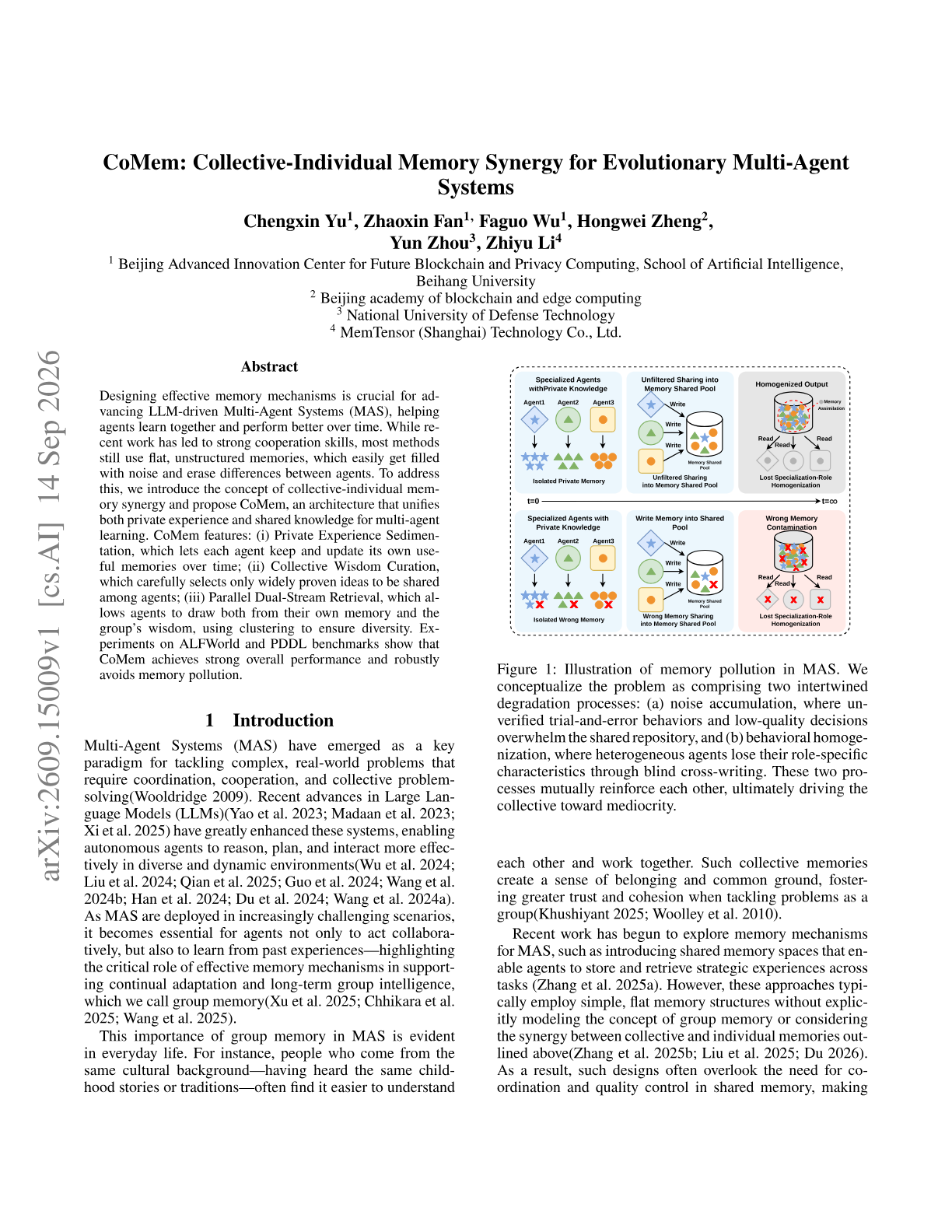
Yu and colleagues propose a two-tier memory for multi-agent systems that keeps each agent's private experience separate from the group's shared knowledge, so shared memory does not erase what makes individual agents different.
Ask this paper
Flat memory collapses two things. Most multi-agent memory is a single unstructured store, which fills with noise and erases the differences between agents that made the team useful.
Private Experience Sedimentation. Each agent retains and updates its own memories over time, so agent-specific competence accumulates instead of being averaged away.
Collective Wisdom Curation. Only widely proven ideas are promoted into shared memory, which is the filter that prevents one agent's mistake from propagating to the whole group.
Parallel Dual-Stream Retrieval. At retrieval time an agent draws from both its own memory and the group store, with clustering used to keep the retrieved set diverse.
Results on ALFWorld and PDDL. CoMem achieves strong overall performance and, more specifically, resists memory pollution, which is the failure the two-tier design was built to prevent.
Abstract
Designing effective memory mechanisms is crucial for advancing LLM-driven Multi-Agent Systems (MAS), helping agents learn together and perform better over time. While recent work has led to strong cooperation skills, most methods still use flat, unstructured memories, which easily get filled with noise and erase differences between agents. To address this, we introduce the concept of collective-individual memory synergy and propose CoMem, an architecture that unifies both private experience and shared knowledge for multi-agent learning. CoMem features:(i) Private Experience Sedimentation, which lets each agent keep and update its own useful memories over time;(ii) Collective Wisdom Curation, which carefully selects only widely proven ideas to be shared among agents;(iii)Parallel Dual-Stream Retrieval, which allows agents to draw both from their own memory and the group's wisdom, using clustering to ensure diversity.Experiments on ALFWorld and PDDL benchmarks show that CoMem achieves strong overall performance and robustly avoids memory pollution.