Computer Science Achievement and Writing Skills Predict Vibe Coding Proficiency
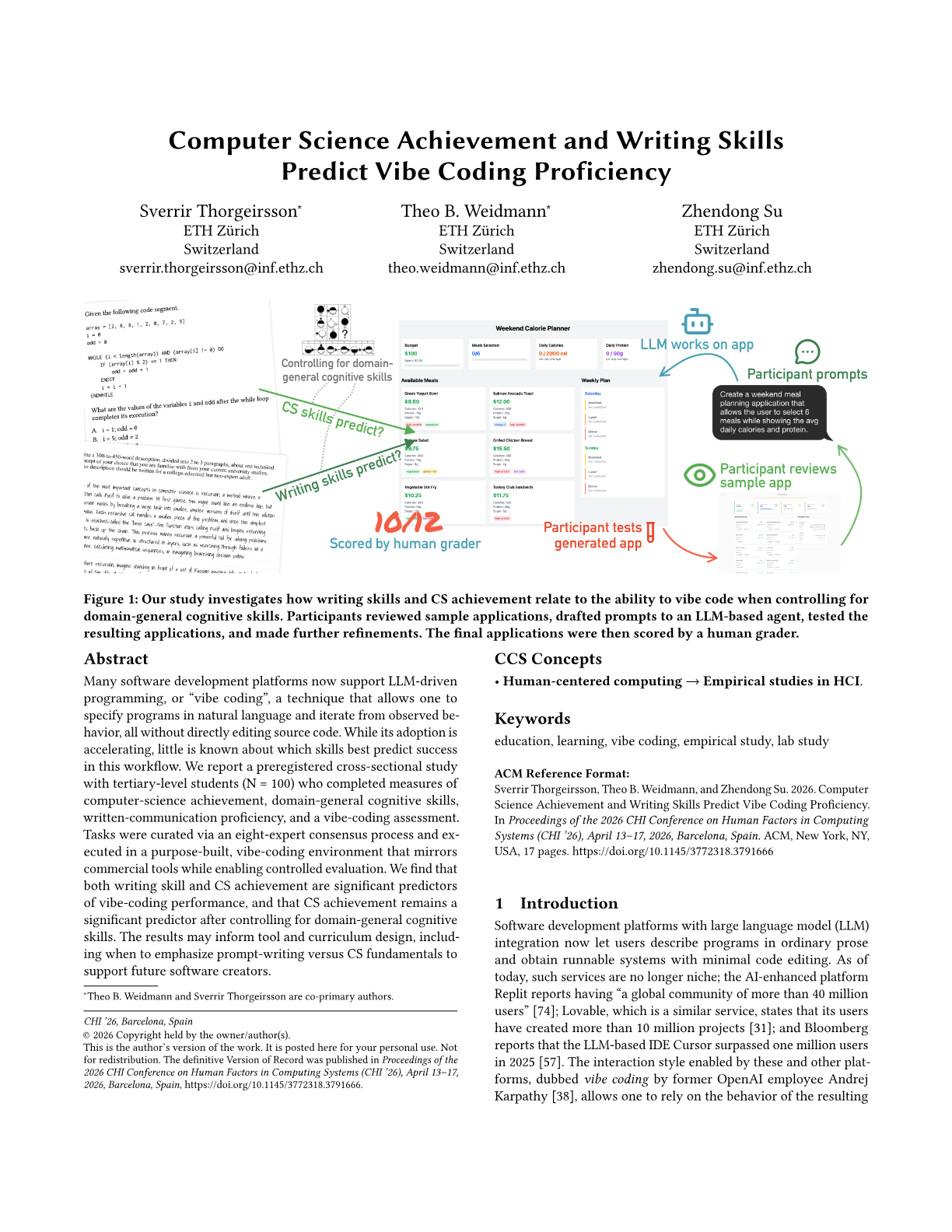
Sverrir Thorgeirsson, Theo B. Weidmann and Zhendong Su at ETH Zurich run a preregistered cross-sectional study of 100 tertiary-level students to find out which measured skills predict how well someone performs at vibe coding.
Ask this paper
Preregistered design. 100 students completed measures of computer-science achievement, domain-general cognitive skills, and written-communication proficiency, plus a vibe-coding assessment. Preregistration matters here because the obvious result, that writing skill alone carries it, is exactly the kind of claim a post-hoc analysis would produce.
Tasks were built for controlled evaluation. An eight-expert consensus process curated the tasks, which ran in a purpose-built vibe-coding environment that mirrors commercial tools while allowing controlled measurement.
Both predictors are significant. Writing skill and CS achievement each significantly predict vibe-coding performance, so natural-language ability alone does not account for the outcome.
CS achievement survives the obvious control. It remains a significant predictor after controlling for domain-general cognitive skills, which rules out the reading that it is a proxy for general intelligence.
Where it applies. The authors frame the result for tool and curriculum design, specifically the question of when to emphasize prompt writing against CS fundamentals.
Abstract
Many software development platforms now support LLM-driven programming, or "vibe coding", a technique that allows one to specify programs in natural language and iterate from observed behavior, all without directly editing source code. While its adoption is accelerating, little is known about which skills best predict success in this workflow. We report a preregistered cross-sectional study with tertiary-level students (N = 100) who completed measures of computer-science achievement, domain-general cognitive skills, written-communication proficiency, and a vibe-coding assessment. Tasks were curated via an eight-expert consensus process and executed in a purpose-built, vibe-coding environment that mirrors commercial tools while enabling controlled evaluation. We find that both writing skill and CS achievement are significant predictors of vibe-coding performance, and that CS achievement remains a significant predictor after controlling for domain-general cognitive skills. The results may inform tool and curriculum design, including when to emphasize prompt-writing versus CS fundamentals to support future software creators.