ComputeWise: Measuring and Fixing GPU Waste by AI Research Agents
Egor Pakhomov, Anurag Koul, Shafiq Joty and Erik Nijkamp (Salesforce AI Research, with Datadog) introduce ComputeWise, a benchmark that measures how much of the GPU time given to AI research agents goes to work the final answer actually needed, and a harness that cuts the waste.
Ask this paper
Simulated GPU. Nine research tasks are built from recorded GPU runs. A simulated GPU replays those runs to the agent's code, so hundreds of agent experiments can be run without real hardware, and each run is scored as time to a supported answer divided by the time of a comparison schedule.
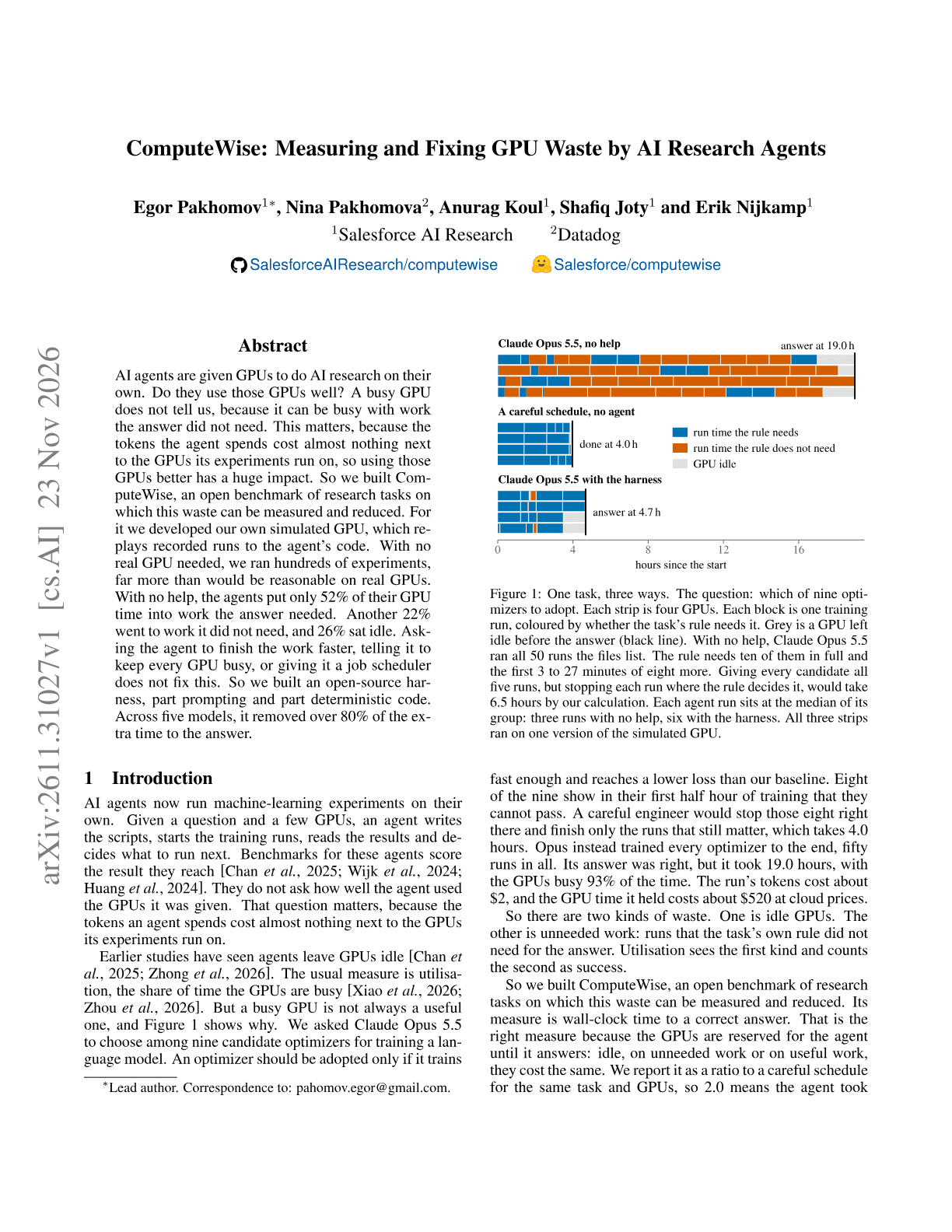
Measured waste. Pooled over 148 unaided runs, 52% of GPU time went to needed work, 22% to unneeded work and 26% sat idle. The median reading across 125 runs was 1.44, meaning agents took 44% longer than the comparison schedule.
Busy is not efficient. Of the 24 runs that kept GPUs at least 90% busy, 16 still read 1.25 or worse. Hint sentences, instructions to keep every GPU busy, or a job scheduler did not remove the waste on the nine final tasks.
Harness fix. In the harness, the model states what evidence it needs and judges results, while deterministic code dispatches jobs. With three Claude models in Claude Code it improved 25 of 26 model-task pairs and removed about 90% of the excess time; across five models it removed over 80%.
Abstract
AI agents are given GPUs to do AI research on their own. Do they use those GPUs well? A busy GPU does not tell us, because it can be busy with work the answer did not need. This matters, because the tokens the agent spends cost almost nothing next to the GPUs its experiments run on, so using those GPUs better has a huge impact. So we built ComputeWise, an open benchmark of research tasks on which this waste can be measured and reduced. For it we developed our own simulated GPU, which replays recorded runs to the agent's code. With no real GPU needed, we ran hundreds of experiments, far more than would be reasonable on real GPUs. With no help, the agents put only 52% of their GPU time into work the answer needed. Another 22% went to work it did not need, and 26% sat idle. Asking the agent to finish the work faster, telling it to keep every GPU busy, or giving it a job scheduler does not fix this. So we built an open-source harness, part prompting and part deterministic code. Across five models, it removed over 80% of the extra time to the answer.