Context as a Resource
Xufei Tian, Han Hu and Wenli Du at East China University of Science and Technology propose ClonAct, a routerless architecture for always-on personal agents that treats context blocks as a managed resource instead of routing work between role-based sub-agents.
Ask this paper
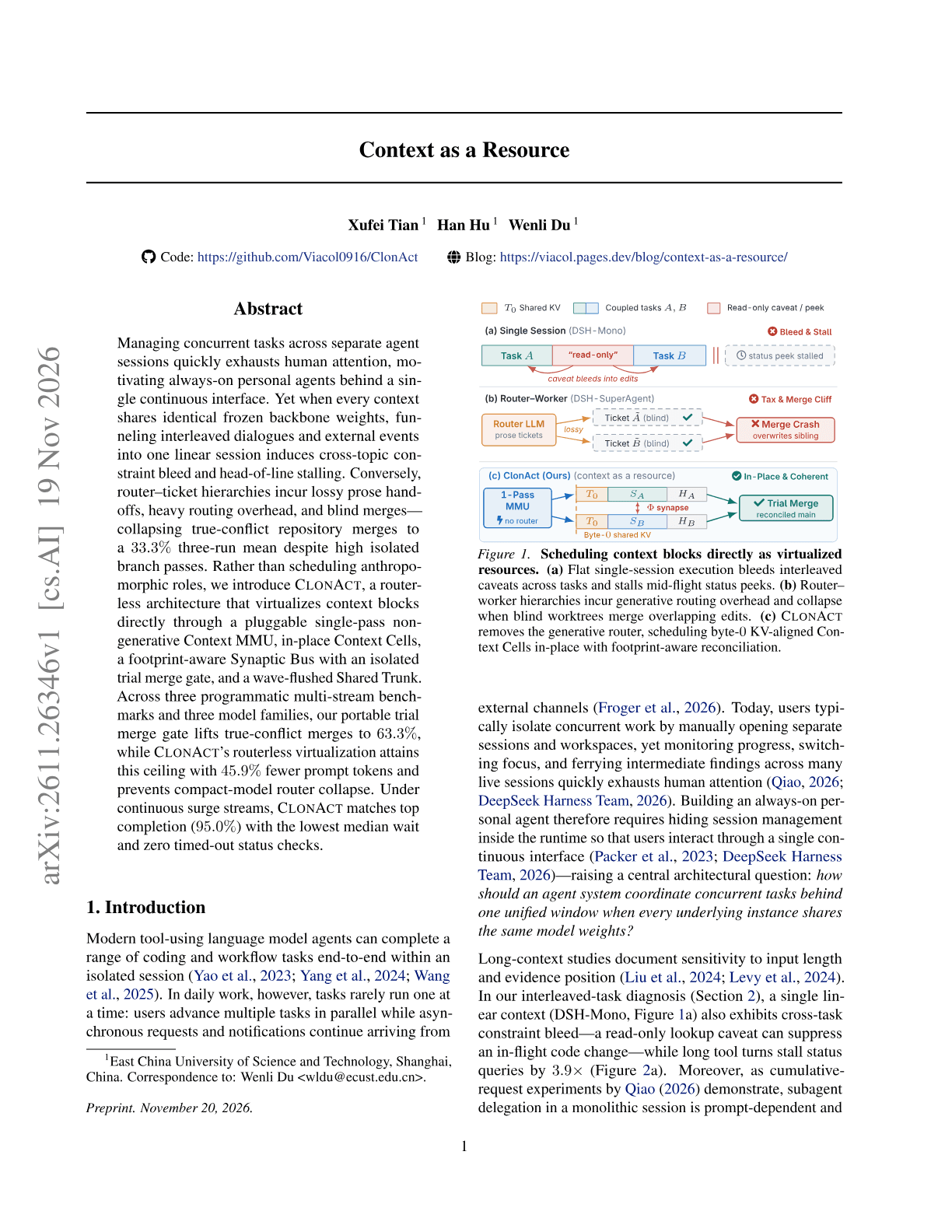
Problem. One linear session for interleaved tasks causes constraints to leak across topics and stalls later requests behind earlier ones. Router and ticket hierarchies lose detail in prose handoffs and merge blindly.
Architecture. A single-pass non-generative Context MMU, in-place Context Cells, a footprint-aware Synaptic Bus with an isolated trial merge gate, and a wave-flushed Shared Trunk.
Merge results. Router hierarchies resolve true-conflict repository merges in 33.3% of cases (three-run mean). The trial merge gate lifts this to 63.3%, and ClonAct reaches the same rate with 45.9% fewer prompt tokens.
Under load. On continuous surge streams, ClonAct matches the top completion rate of 95.0% with the lowest median wait and zero timed-out status checks.
Abstract
Managing concurrent tasks across separate agent sessions quickly exhausts human attention, motivating always-on personal agents behind a single continuous interface. Yet when every context shares identical frozen backbone weights, funneling interleaved dialogues and external events into one linear session induces cross-topic constraint bleed and head-of-line stalling. Conversely, router-ticket hierarchies incur lossy prose handoffs, heavy routing overhead, and blind merges - collapsing true-conflict repository merges to a 33.3% three-run mean despite high isolated branch passes. Rather than scheduling anthropomorphic roles, we introduce ClonAct, a routerless architecture that virtualizes context blocks directly through a pluggable single-pass non-generative Context MMU, in-place Context Cells, a footprint-aware Synaptic Bus with an isolated trial merge gate, and a wave-flushed Shared Trunk. Across three programmatic multi-stream benchmarks and three model families, our portable trial merge gate lifts true-conflict merges to 63.3%, while ClonAct's routerless virtualization attains this ceiling with 45.9% fewer prompt tokens and prevents compact-model router collapse. Under continuous surge streams, ClonAct matches top completion (95.0%) with the lowest median wait and zero timed-out status checks.