Contrastive Chain-of-Thought
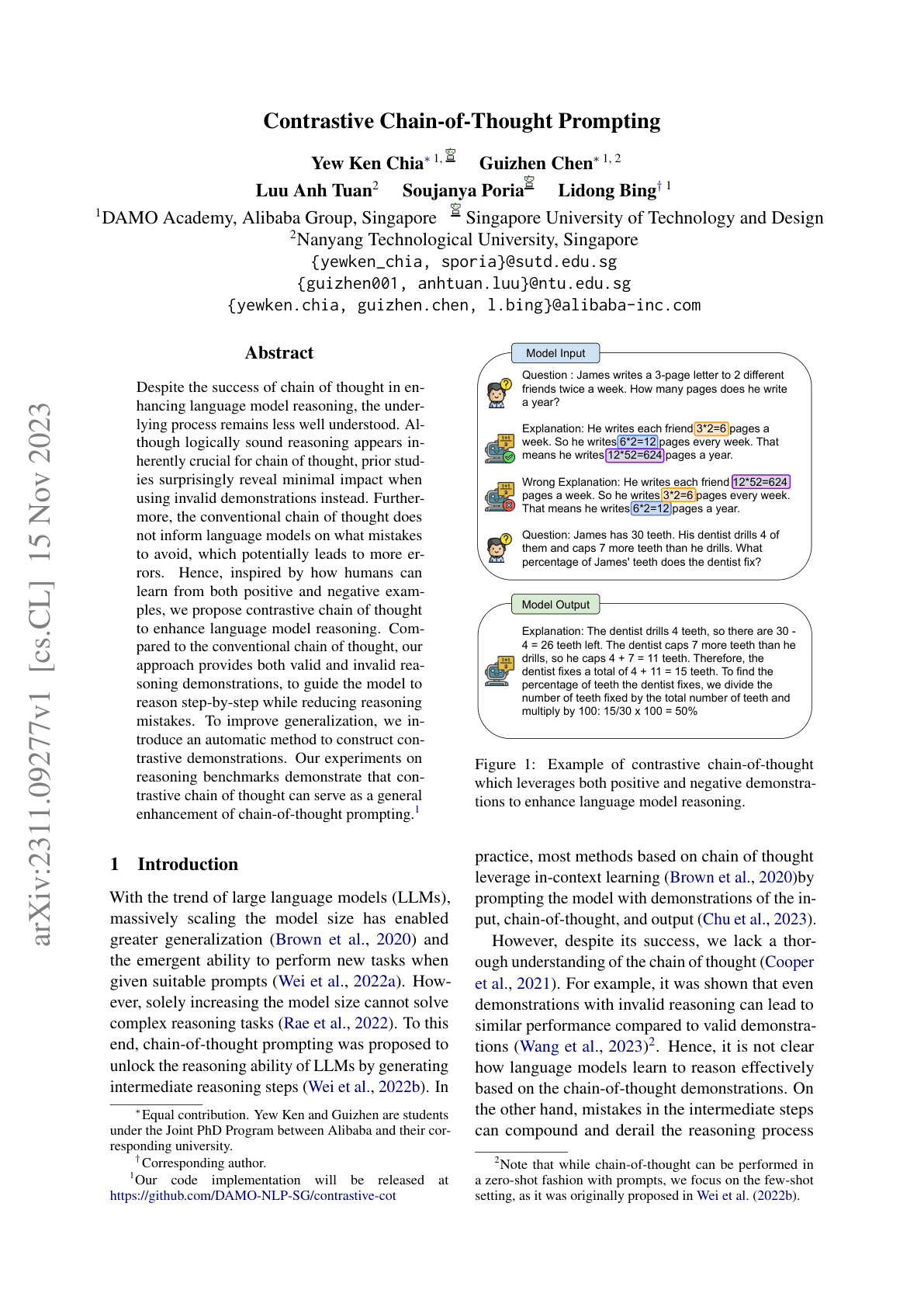
Proposes contrastive CoT prompting where models see both valid *and* invalid reasoning demonstrations to reduce reasoning errors.
Ask this paper
Valid + invalid demos: Demonstrations pair correct reasoning traces with common incorrect ones, teaching the model what not to do as well as what to do.
Automatic construction: Provides an automatic method to generate contrastive demonstrations, avoiding the manual curation bottleneck that limited prior CoT variants.
Improves over CoT: Outperforms standard CoT across reasoning benchmarks, with particularly strong gains on problems where common error patterns are predictable.
Pedagogical analog: The improvement mirrors human learning research showing that studying worked examples and errors side-by-side beats studying successes alone.
Abstract
Despite the success of chain of thought in enhancing language model reasoning, the underlying process remains less well understood. Although logically sound reasoning appears inherently crucial for chain of thought, prior studies surprisingly reveal minimal impact when using invalid demonstrations instead. Furthermore, the conventional chain of thought does not inform language models on what mistakes to avoid, which potentially leads to more errors. Hence, inspired by how humans can learn from both positive and negative examples, we propose contrastive chain of thought to enhance language model reasoning. Compared to the conventional chain of thought, our approach provides both valid and invalid reasoning demonstrations, to guide the model to reason step-by-step while reducing reasoning mistakes. To improve generalization, we introduce an automatic method to construct contrastive demonstrations. Our experiments on reasoning benchmarks demonstrate that contrastive chain of thought can serve as a general enhancement of chain-of-thought prompting.