CoReMem: Cost-Internalizing Memory for Successive Coding Tasks with Prospective Valuation
Peiwen Li and colleagues at Yale introduce CoReMem, a memory framework for coding agents that solve successive tasks on the same repository, which keeps only the memory segments that measurably help the next task.
Ask this paper
Setting. Coding agents work through successive issues on an evolving repository and must write memory before the next task is known, balancing usefulness against the cost of writing and reading it.
Prospective valuation. The next task is run with and without each trajectory segment. The memory kept is compact and built around anchors, which are repository locations and executable checks.
Actor training. RL compares rollouts with and without memory, rewards resolution, penalizes steps in successful runs and credits steps that used memory-supplied anchors.
Results. On ChainSWE the 27B agent resolve rate rises from 21.0% to 25.7% with 17% fewer steps and 11% fewer total tokens, including memory calls.
Abstract
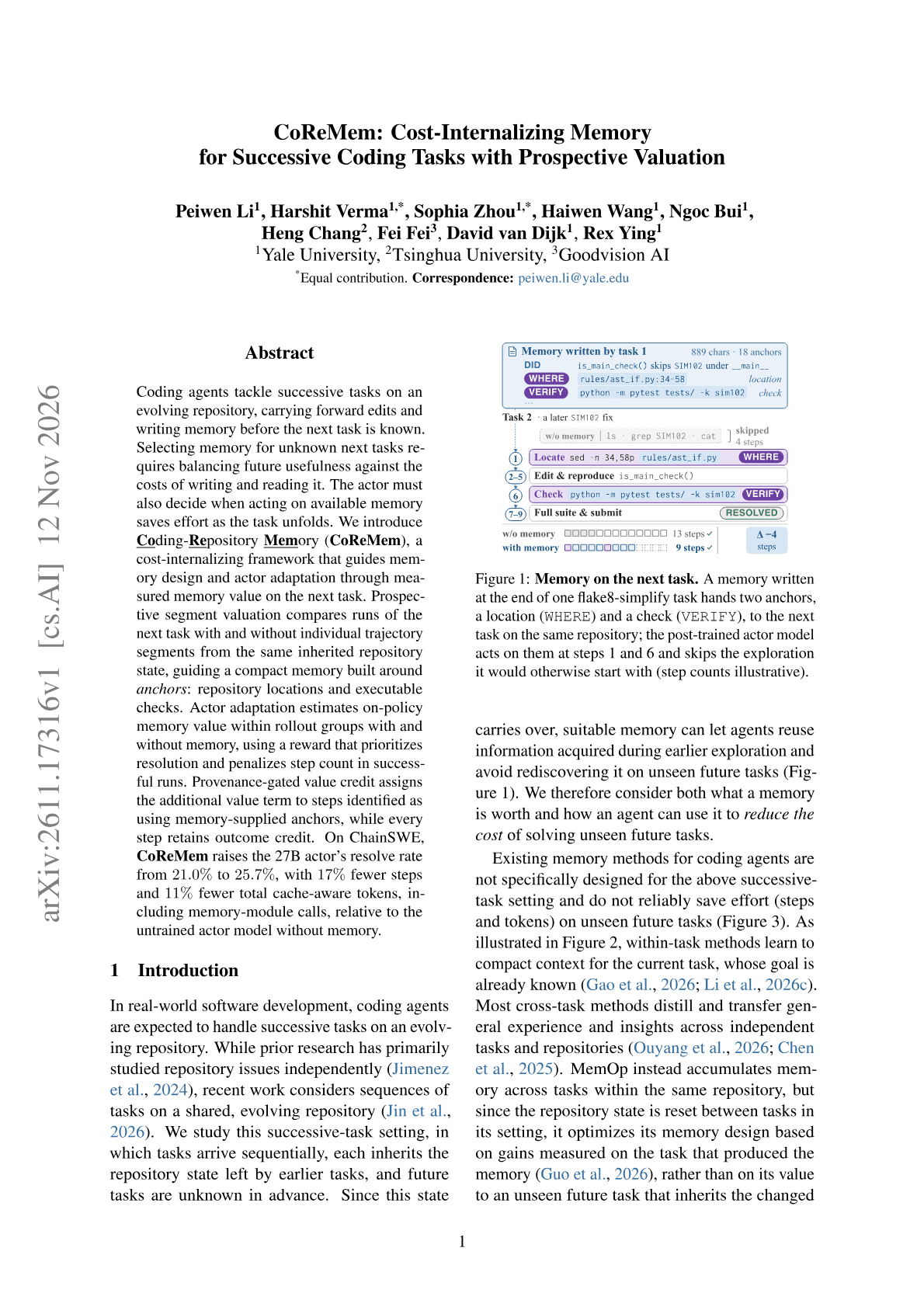
Coding agents tackle successive tasks on an evolving repository, carrying forward edits and writing memory before the next task is known. Selecting memory for unknown next tasks requires balancing future usefulness against the costs of writing and reading it. The actor must also decide when acting on available memory saves effort as the task unfolds. We introduce Coding-Repository Memory (CoReMem), a cost-internalizing framework that guides memory design and actor adaptation through measured memory value on the next task. Prospective segment valuation compares runs of the next task with and without individual trajectory segments from the same inherited repository state, guiding a compact memory built around anchors: repository locations and executable checks. Actor adaptation estimates on-policy memory value within rollout groups with and without memory, using a reward that prioritizes resolution and penalizes step count in successful runs. Provenance-gated value credit assigns the additional value term to steps identified as using memory-supplied anchors, while every step retains outcome credit. On ChainSWE, CoReMem raises the 27B actor's resolve rate from 21.0% to 25.7%, with 17% fewer steps and 11% fewer total cache-aware tokens, including memory-module calls, relative to the untrained actor model without memory.