CPU-ARC: Agentic Reasoning Caching for on-CPU Reasoning Reuse
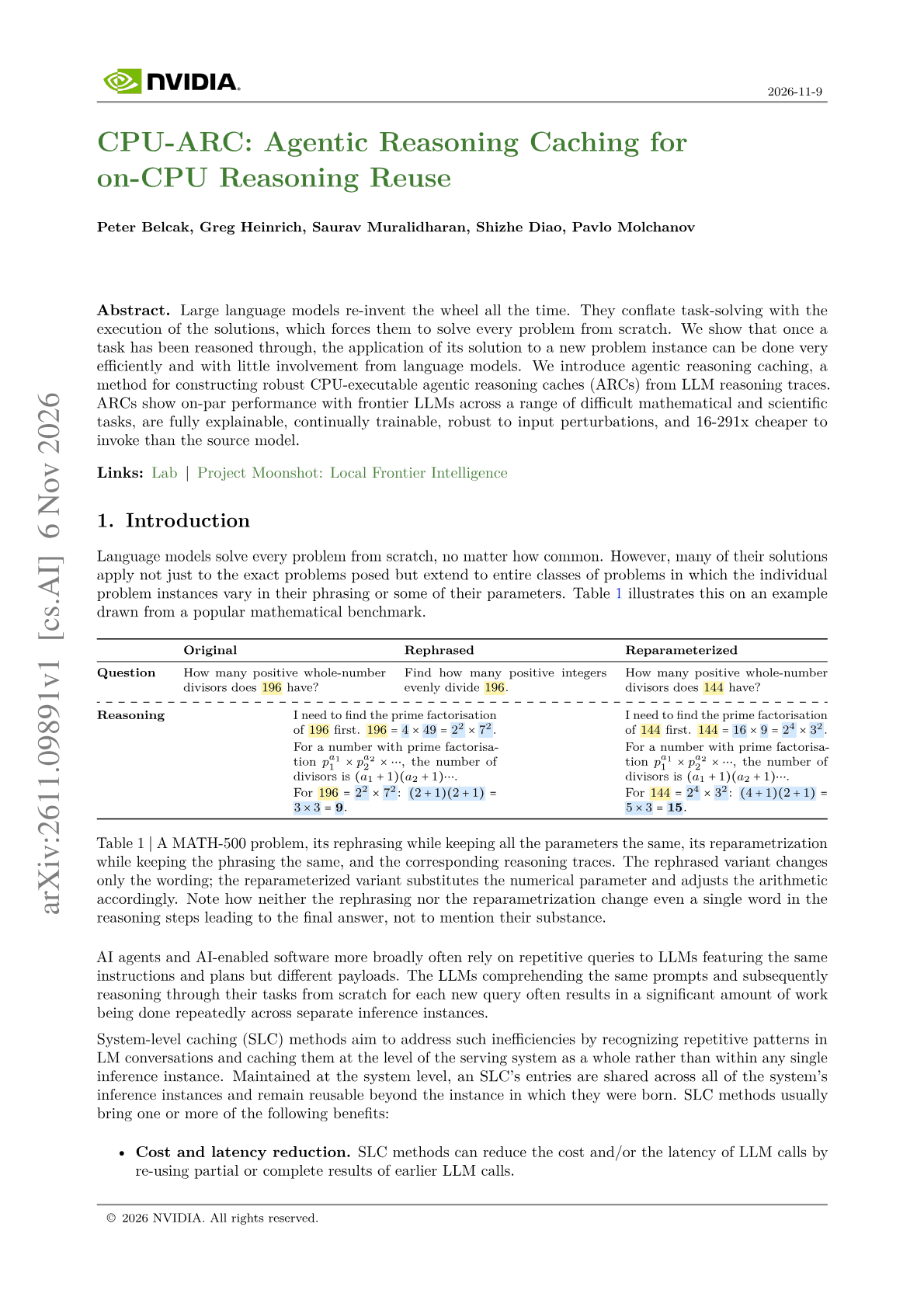
Peter Belcak, Greg Heinrich, Saurav Muralidharan, Shizhe Diao and Pavlo Molchanov (NVIDIA) introduce agentic reasoning caching, which turns an LLM's reasoning trace for one problem into a CPU-executable program that solves other instances of the same problem class.
Ask this paper
Observation. Many LLM solutions apply to a whole class of problems that differ only in phrasing or parameters, yet the model solves each instance from scratch.
Method. From reasoning traces, an agent builds agentic reasoning caches (ARCs) that run on a CPU with little or no LLM involvement for new instances.
Evaluation. ARCs are tested on MATH-500, AIME 2024 to 2026 and GPQA Diamond, including rephrased and reparameterized variants of the original problems.
Results. ARCs perform on par with the frontier LLMs they were built from, are robust to input perturbations, are fully inspectable, can be trained further, and cost 16x to 291x less to invoke than the source model.
Abstract
Large language models reinvent the wheel all the time. They conflate task-solving with the execution of the solutions, which forces them to solve every problem from scratch. We show that once a task has been reasoned through, the application of its solution to a new problem instance can be done very efficiently and with little involvement from language models. We introduce agentic reasoning caching, a method for constructing robust CPU-executable agentic reasoning caches (ARCs) from LLM reasoning traces. ARCs show on-par performance with frontier LLMs across a range of difficult mathematical and scientific tasks, are fully explainable, continually trainable, robust to input perturbations, and 16-291x cheaper to invoke than the source model.