CrossEnv: Synthesizing Verifiable Cross-Environment Tasks for Long-Horizon Agent Training
Zhengfeng Yu and colleagues at Beijing Institute of Technology and Alibaba Group synthesize executable, verifiable training tasks that span several environments, such as flight, hotel and restaurant services, and train agents with a curriculum that moves from single-environment tool use to multi-environment coordination.
Ask this paper
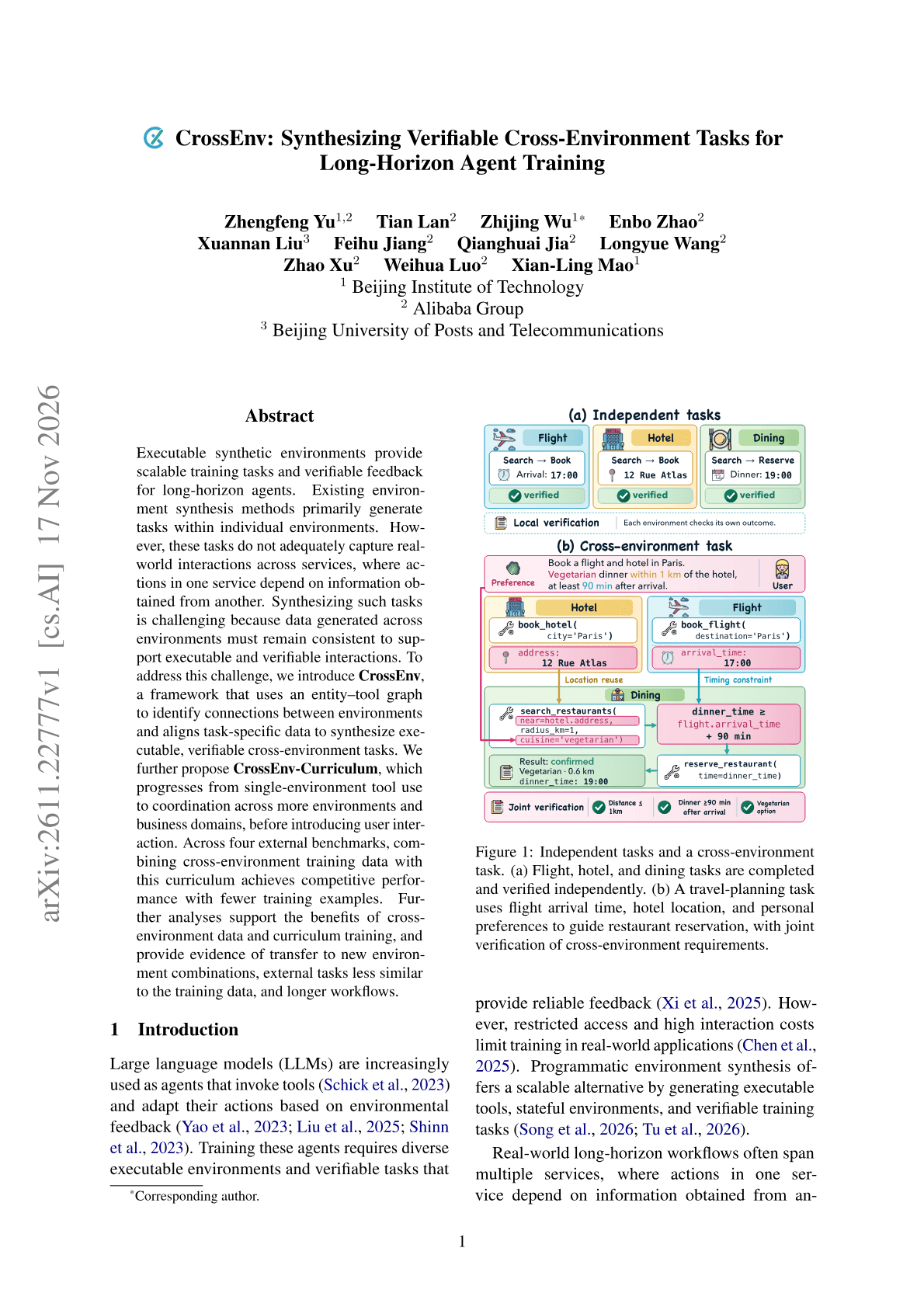
Entity-tool graph. Environments are linked through shared entities, and task data is aligned so that, for example, a hotel has the same address in the booking and navigation environments. Without this, cross-environment tasks cannot be executed or verified.
Curriculum. Training starts with tool use inside one environment, then adds more environments and business domains, and introduces user interaction last.
Coordination gains. On Qwen3-8B, cross-environment RL beats single-environment RL from the same SFT start on output reuse (11.7% vs 1.7%), later-step success (33.3% vs 28.3%) and joint success (8.3% vs 0.0%), and scores 20.0 vs 15.4 on Claw-Eval.
Fewer examples. Across four external benchmarks the approach is competitive with environment-trained baselines that use far more data, and construction cost falls to about 4.0k tokens per candidate task.
Abstract
Executable synthetic environments provide scalable training tasks and verifiable feedback for long-horizon agents. Existing environment synthesis methods primarily generate tasks within individual environments. However, these tasks do not adequately capture real-world interactions across services, where actions in one service depend on information obtained from another. Synthesizing such tasks is challenging because data generated across environments must remain consistent to support executable and verifiable interactions. To address this challenge, we introduce CrossEnv, a framework that uses an entity-tool graph to identify connections between environments and aligns task-specific data to synthesize executable, verifiable cross-environment tasks. We further propose CrossEnv-Curriculum, which progresses from single-environment tool use to coordination across more environments and business domains, before introducing user interaction. Across four external benchmarks, combining cross-environment training data with this curriculum achieves competitive performance with fewer training examples. Further analyses support the benefits of cross-environment data and curriculum training, and provide evidence of transfer to new environment combinations, external tasks less similar to the training data, and longer workflows.