Decentralized LLM Workflows via Sequential Auctions
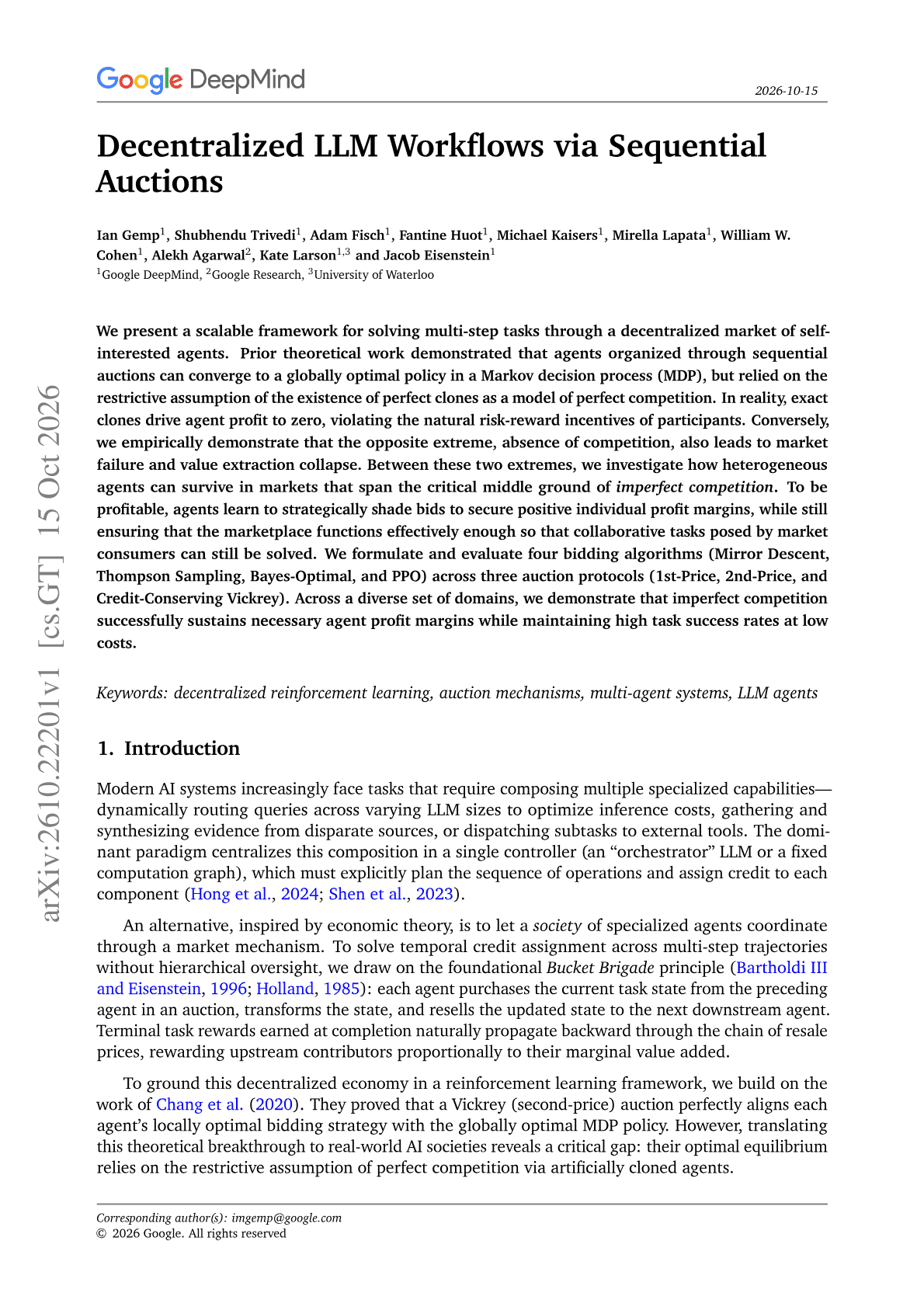
Ian Gemp, Alekh Agarwal, Jacob Eisenstein and colleagues at Google DeepMind build a decentralized market in which self-interested LLM agents bid in sequential auctions to execute the steps of a multi-step task, and study how such a market can stay profitable for agents and still solve the task.
Ask this paper
Theory gap. Earlier results proved sequential auctions converge to an optimal MDP policy only if perfect clones compete. Perfect clones drive agent profit to zero, so the assumption fails for real participants.
Both extremes fail. The authors show empirically that the opposite case, no competition, also breaks the market: value extraction collapses.
Imperfect competition. Heterogeneous agents learn to shade their bids to keep a positive margin while the market still completes the consumer's task.
Design space. Four bidding algorithms (Mirror Descent, Thompson Sampling, Bayes-Optimal, PPO) are tested across three auction protocols (first-price, second-price, Credit-Conserving Vickrey) on several domains.
Result. Imperfect competition sustains agent profit margins while keeping task success high and consumer cost low.
Abstract
We present a scalable framework for solving multi-step tasks through a decentralized market of self-interested agents. Prior theoretical work demonstrated that agents organized through sequential auctions can converge to a globally optimal policy in a Markov decision process (MDP), but relied on the restrictive assumption of the existence of perfect clones as a model of perfect competition. In reality, exact clones drive agent profit to zero, violating the natural risk-reward incentives of participants. Conversely, we empirically demonstrate that the opposite extreme, absence of competition, also leads to market failure and value extraction collapse. Between these two extremes, we investigate how heterogeneous agents can survive in markets that span the critical middle ground of imperfect competition. To be profitable, agents learn to strategically shade bids to secure positive individual profit margins, while still ensuring that the marketplace functions effectively enough so that collaborative tasks posed by market consumers can still be solved. We formulate and evaluate four bidding algorithms (Mirror Descent, Thompson Sampling, Bayes-Optimal, and PPO) across three auction protocols (1st-Price, 2nd-Price, and Credit-Conserving Vickrey). Across a diverse set of domains, we demonstrate that imperfect competition successfully sustains necessary agent profit margins while maintaining high task success rates at low costs.