Depth Anything
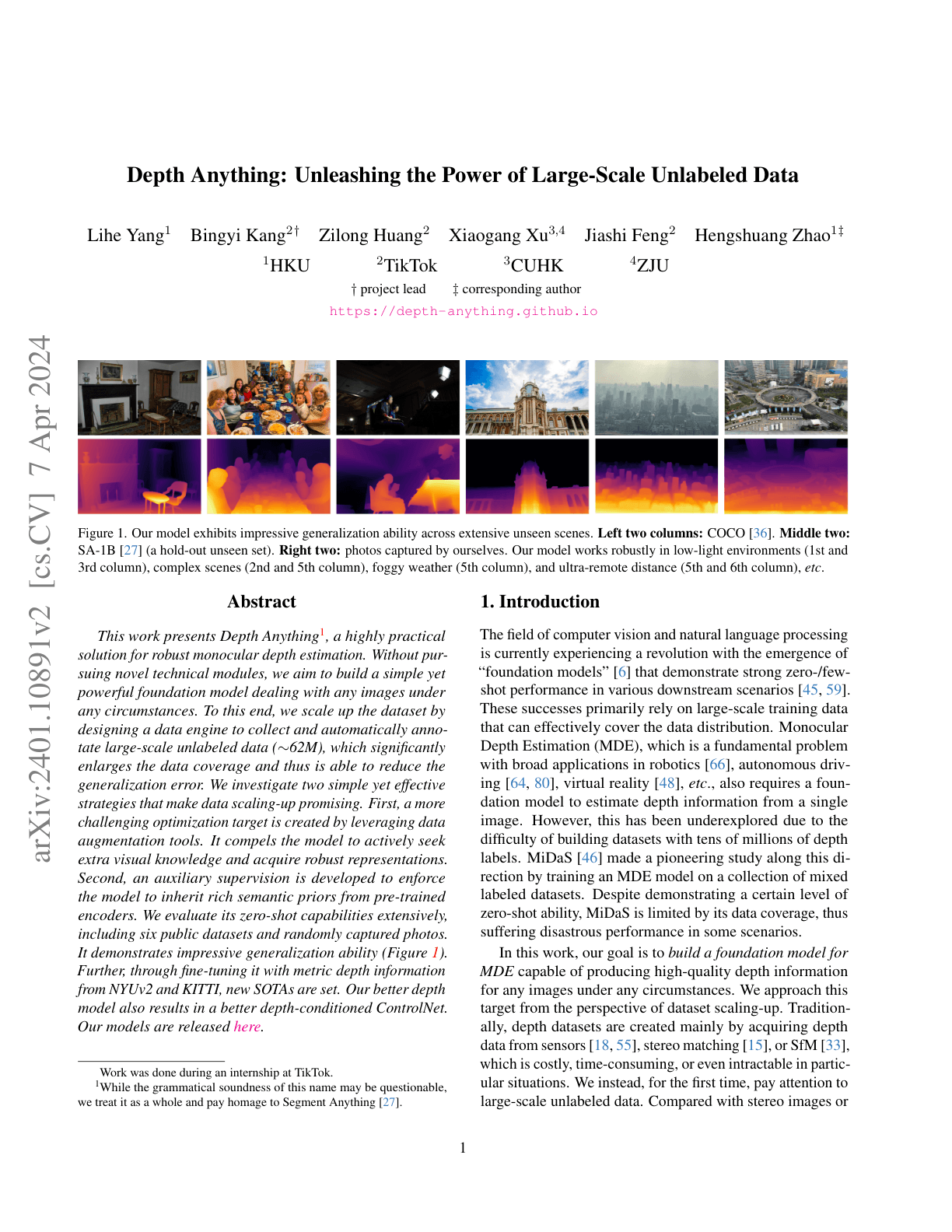
A robust monocular depth estimator designed to handle "any image under any circumstance" by scaling self-training on unlabeled data rather than hunting for bigger labeled sets.
Ask this paper
62M unlabeled images: The data engine automatically annotates ~62M unlabeled images using a teacher model, then uses these pseudo-labels for student training - a classic but here-industrialized recipe.
Stronger supervision signals: Introduces auxiliary supervision that forces the student to inherit semantic priors from a pretrained encoder, preventing the usual failure modes of naive self-training at this scale.
SoTA with fine-tuning: Beyond strong zero-shot generalization, fine-tuning on downstream depth datasets sets new state-of-the-art on standard benchmarks.
Enhanced ControlNet: Depth-conditioned ControlNet built on Depth Anything produces noticeably cleaner depth-guided image generation, highlighting downstream impact beyond perception tasks.
Abstract
This work presents Depth Anything, a highly practical solution for robust monocular depth estimation. Without pursuing novel technical modules, we aim to build a simple yet powerful foundation model dealing with any images under any circumstances. To this end, we scale up the dataset by designing a data engine to collect and automatically annotate large-scale unlabeled data (~62M), which significantly enlarges the data coverage and thus is able to reduce the generalization error. We investigate two simple yet effective strategies that make data scaling-up promising. First, a more challenging optimization target is created by leveraging data augmentation tools. It compels the model to actively seek extra visual knowledge and acquire robust representations. Second, an auxiliary supervision is developed to enforce the model to inherit rich semantic priors from pre-trained encoders. We evaluate its zero-shot capabilities extensively, including six public datasets and randomly captured photos. It demonstrates impressive generalization ability. Further, through fine-tuning it with metric depth information from NYUv2 and KITTI, new SOTAs are set. Our better depth model also results in a better depth-conditioned ControlNet. Our models are released at https://github.com/LiheYoung/Depth-Anything.