DiscoveryRSI: Recursively Learning to Discover Valuable Hypotheses
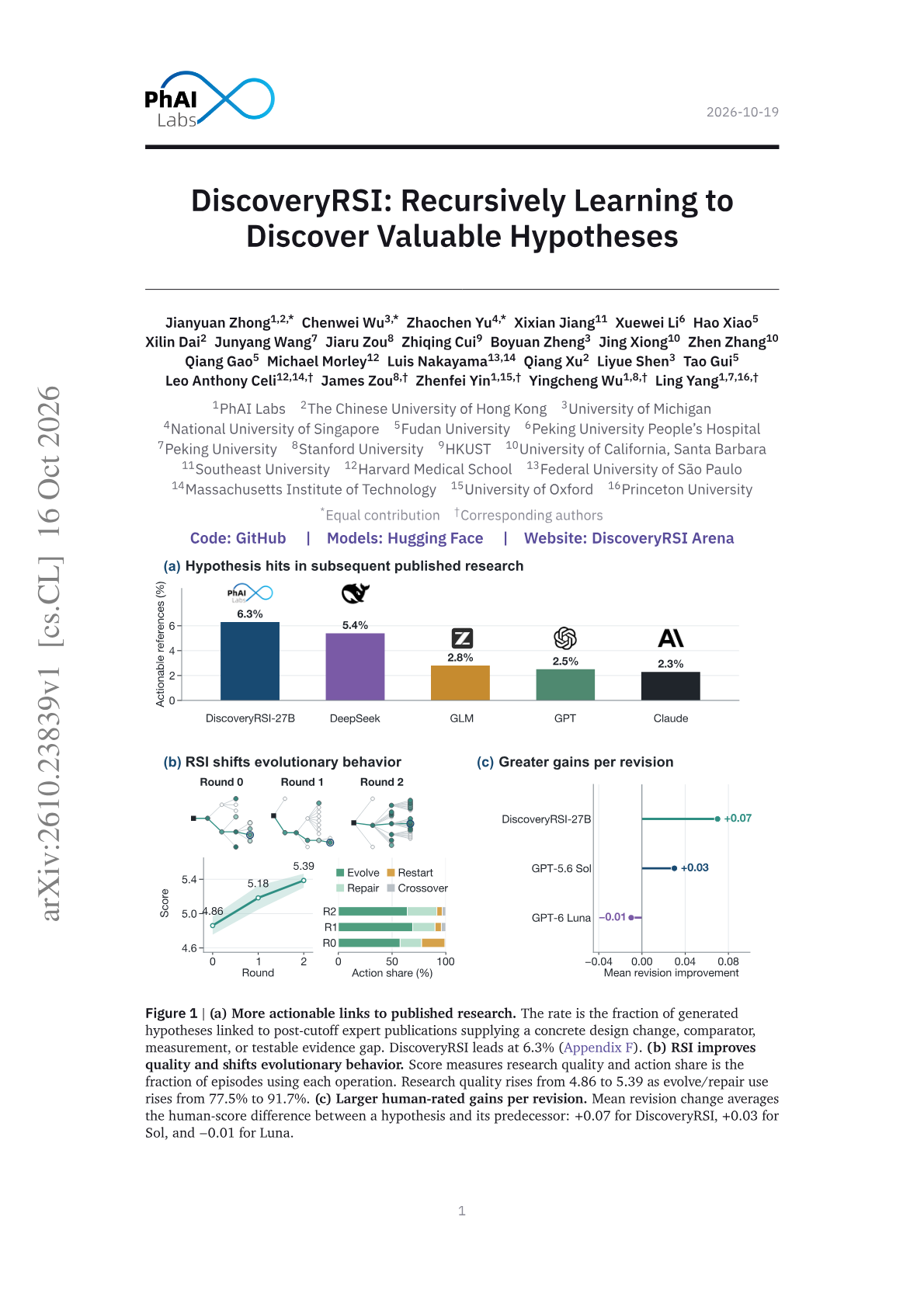
Jianyuan Zhong, Chenwei Wu, Zhaochen Yu, James Zou, Ling Yang and colleagues (PhAI Labs, CUHK, Stanford, Princeton, Michigan and others) introduce DiscoveryRSI, a framework that develops research hypothesis trees by multi-agent evolutionary search and recursively learns from the investigations it runs.
Ask this paper
Definition. A valuable hypothesis is an evidence-grounded claim about a consequential uncertainty, paired with a feasible investigation, explicit decision criteria and alternative explanations.
Three learning mechanisms. Hypothesis credit optimization attributes assessments to documented contributions, harness replay identifies productive strategies and recurring failures, and rediscovery applies accepted improvements to new investigations. Selected investigations compile into executable Harbor tasks.
Benchmark. DFM-Bench scores hypothesis quality and cumulative progress at the level of hypotheses, revisions, development paths and research runs.
Results. Across four life-science domains, automated hypothesis quality rises from 4.86 to 5.39 after two rounds of self-improvement, with the largest gains in falsifiability and data resolvability. Preliminary human review rates DiscoveryRSI-27B above GPT-6 Luna on importance and evidence-bounded claims.
Forward check. 6.3% of DiscoveryRSI-27B's hypotheses correspond to research published after the model cutoff, against 2.5% for GPT-6 and 2.3% for Claude Opus 5.
Abstract
Scientific discovery requires developing worthwhile hypotheses into practical investigations, yet learning from this evolving research process remains challenging. We introduce an operational definition of valuable and testable research hypotheses: evidence-grounded claims about consequential uncertainties, coupled with feasible investigations, explicit decision criteria, and alternative explanations. Our DiscoveryRSI framework develops hypothesis trees through multi-agent evolutionary search, compiles selected investigations into executable Harbor tasks, and recursively learns through three mechanisms: hypothesis credit optimization attributes scientific assessments to documented research contributions; harness replay identifies productive strategies and recurring failures to refine research workflows; and rediscovery applies accepted improvements to new investigations, generating further experience for subsequent learning. We also introduce DFM-Bench, which provides comprehensive assessment of hypothesis quality and cumulative research progress at the levels of hypotheses, revisions, development paths and research runs. Across four life-science domains, automated evaluation shows that hypothesis quality rises from 4.86 for the base model to 5.39 after two rounds of self-improvement, with the large gains in falsifiability and data resolvability. We further validate hypothesis quality through expert review, comparing our DiscoveryRSI-27B with other research agents. Preliminary human assessments show that DiscoveryRSI-27B scores higher than GPT-6 Luna on hypothesis importance and whether claims are plausible and evidence-bounded. DiscoveryRSI-27B achieved a 6.3% rate of hypothesis correspondence with research published after the model cutoff, largely outperform GPT-6 with 2.5% and Claude Opus 5 with 2.3%, while delivering greater human-rated improvement along research paths.