Divide, Diagnose, and Compose: Optimizing Agentic Pipelines and Harnesses
Divij Handa, Christopher Tensmeyer, Jihyung Kil and Vlad Morariu at Adobe and Arizona State University introduce DeCAF, which optimizes agent pipelines and harnesses one design dimension at a time with coding-agent sessions and then combines the compatible changes.
Ask this paper
Problem. Prompts, topology, model choice and tool policies are coupled, and existing optimizers either search a fixed subset of them or edit the whole pipeline at once with little evidence for each change.
Method. DeCAF identifies the relevant dimensions for a benchmark, runs a separate coding-agent session per dimension with a restricted edit scope, and logs every hypothesis, edit and outcome.
Compose. A synthesis session merges compatible findings and uses rubrics derived from each agent's instructions to find underperforming components.
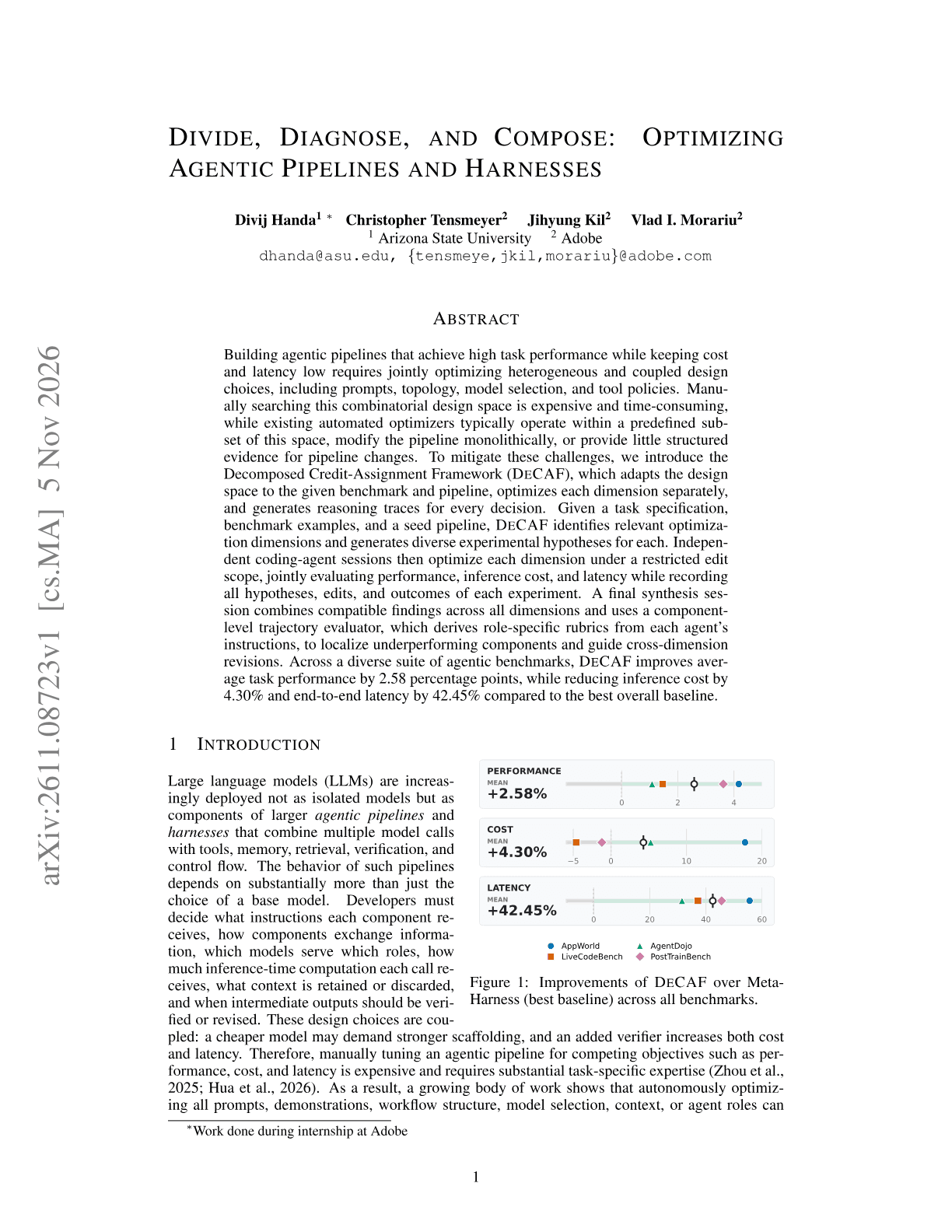
Results. Against Meta-Harness, the strongest baseline, it improves average task performance by 2.58 points, lowers inference cost by 4.30% and lowers end-to-end latency by 42.45%.
Abstract
Building agentic pipelines that achieve high task performance while keeping cost and latency low requires jointly optimizing heterogeneous and coupled design choices, including prompts, topology, model selection, and tool policies. Manually searching this combinatorial design space is expensive and time-consuming, while existing automated optimizers typically operate within a predefined subset of this space, modify the pipeline monolithically, or provide little structured evidence for pipeline changes. To mitigate these challenges, we introduce the Decomposed Credit-Assignment Framework (DeCAF), which adapts the design space to the given benchmark and pipeline, optimizes each dimension separately, and generates reasoning traces for every decision. Given a task specification, benchmark examples, and a seed pipeline, DeCAF identifies relevant optimization dimensions and generates diverse experimental hypotheses for each. Independent coding-agent sessions then optimize each dimension under a restricted edit scope, jointly evaluating performance, inference cost, and latency while recording all hypotheses, edits, and outcomes of each experiment. A final synthesis session combines compatible findings across all dimensions and uses a component-level trajectory evaluator, which derives role-specific rubrics from each agent's instructions, to localize underperforming components and guide cross-dimension revisions. Across a diverse suite of agentic benchmarks, DeCAF improves average task performance by 2.58 percentage points, while reducing inference cost by 4.30% and end-to-end latency by 42.45% compared to the best overall baseline.