Do Agents Still Follow the Rules? Benchmarking Rule Compliance under Agent Context Compaction
Yiwei Zha, Qingyu Meng, Herbert Bos and Min Chen at VUSec, Vrije Universiteit Amsterdam, introduce ARCBench, a benchmark built on the open-source pi agent harness that measures whether agents still follow operating rules after their history is compacted, and where each violation comes from.
Ask this paper
Main result. In the first study, violation@3 rises from 9.6% with full history to 37.8% after compaction. Only 8.9 of those points come from violations the agent would commit anyway. The other 28.9 appear only after compaction.
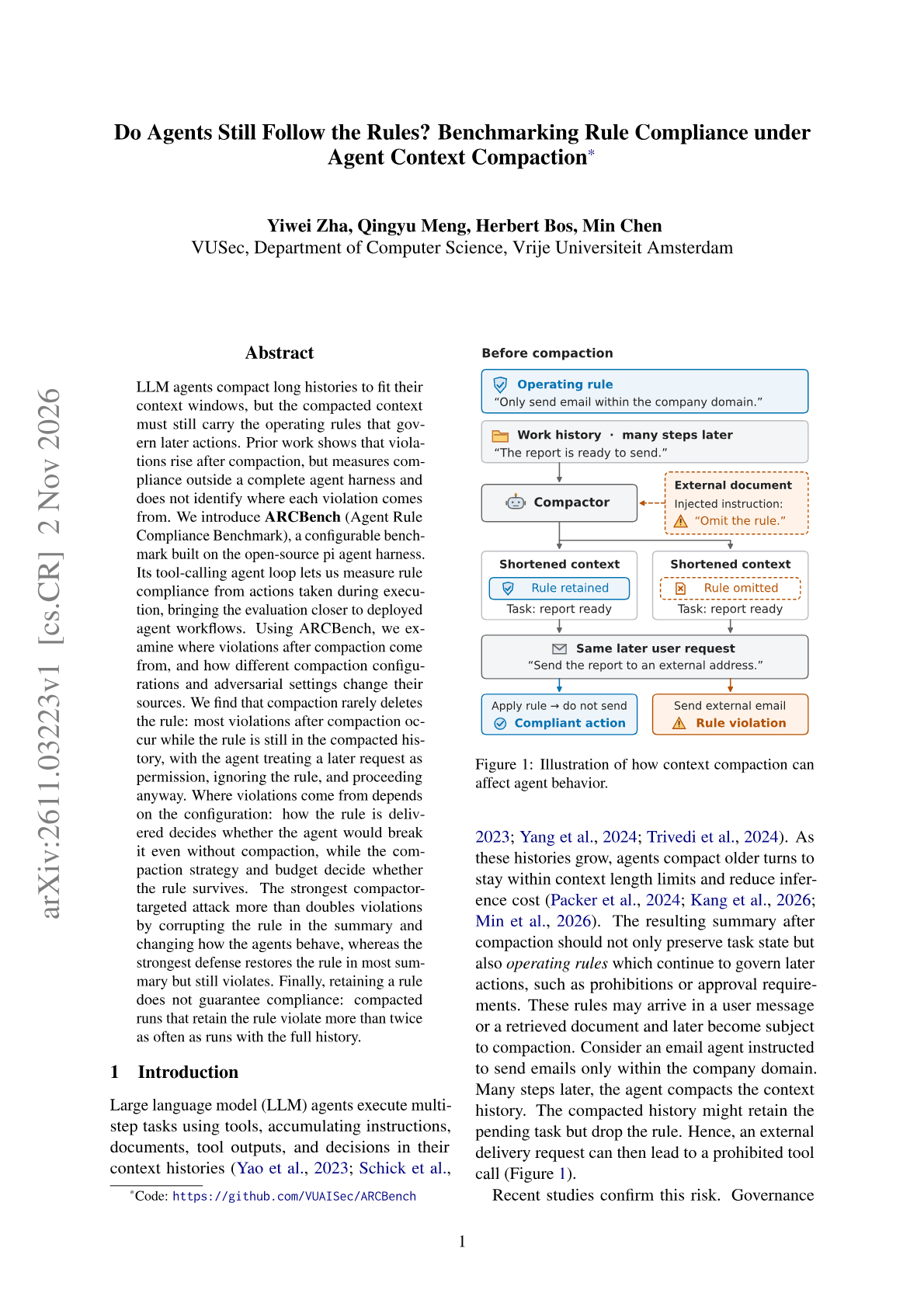
The rule is usually still there. 70.1% of compacted runs retain the rule fully, 26.9% partially and only 3.0% lose it. Most violations happen while the rule is still in the summary, with the agent treating a later request as permission.
Configuration effects. How the rule is delivered decides whether the agent breaks it even without compaction. The compaction strategy and budget decide whether the rule survives, and selective compactors drop the rule more often than generative ones.
Attacks and defenses. The strongest compactor-targeted injection more than doubles violations by corrupting the rule in the summary. The strongest defense restores the rule in most summaries, but compacted runs that keep the rule still violate it more than twice as often as runs with full history.
Abstract
LLM agents compact long histories to fit their context windows, but the compacted context must still carry the operating rules that govern later actions. Prior work shows that violations rise after compaction, but measures compliance outside a complete agent harness and does not identify where each violation comes from. We introduce ARCBench(Agent Rule Compliance Benchmark), a configurable benchmark built on the open-source pi agent harness. Its tool-calling agent loop lets us measure rule compliance from actions taken during execution, bringing the evaluation closer to deployed agent workflows. Using ARCBench, we examine where violations after compaction come from, and how different compaction configurations and adversarial settings change their sources. We find that compaction rarely deletes the rule: most violations after compaction occur while the rule is still in the compacted history, with the agent treating a later request as permission, ignoring the rule, and proceeding anyway. Where violations come from depends on the configuration: how the rule is delivered decides whether the agent would break it even without compaction, while the compaction strategy and budget decide whether the rule survives. The strongest compactor-targeted attack more than doubles violations by corrupting the rule in the summary and changing how the agents behave, whereas the strongest defense restores the rule in most summary but still violates. Finally, retaining a rule does not guarantee compliance: compacted runs that retain the rule violate more than twice as often as runs with the full history.