Do Coding Agents Still Need a Debugger? Frontier-Model-Based Fault Localization at the Accuracy Ceiling
Christoph Daxerer, Johann Glock, Martin Pinzger, Josef Pichler and colleagues (Software Competence Center Hagenberg, University of Klagenfurt) test whether frontier coding agents still benefit from an interactive debugger for fault localization, using 610 seeded faults and behavior-preserving program rewrites.
Ask this paper
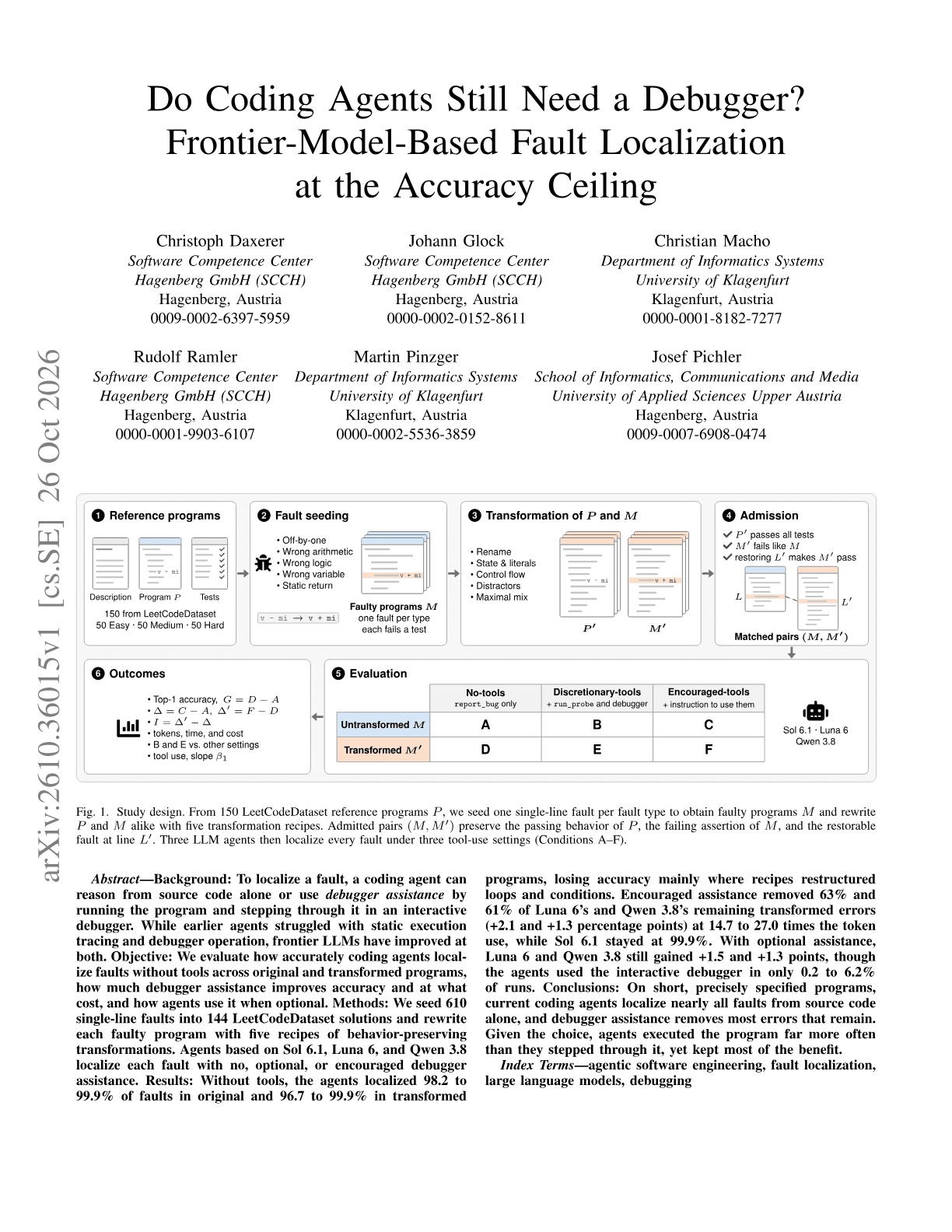
Setup. 610 single-line faults are seeded into 144 LeetCodeDataset solutions, and each faulty program is rewritten with five behavior-preserving transformation recipes. Agents on Sol 6.1, Luna 6 and Qwen 3.8 run with no, optional or encouraged debugger use.
No tools. Without tools the agents localize 98.2 to 99.9% of faults in original programs and 96.7 to 99.9% in transformed ones. Errors cluster where recipes restructure loops and conditions.
Encouraged debugger. Encouraged debugger use removes 63% and 61% of Luna 6's and Qwen 3.8's remaining errors on transformed programs at 14.7 to 27.0 times the token use. Sol 6.1 stays at 99.9%.
Optional debugger. When the debugger is optional, agents step through code in only 0.2 to 6.2% of runs and mostly just execute the program, yet keep most of the accuracy gain.
Abstract
Background: To localize a fault, a coding agent can reason from source code alone or use debugger assistance by running the program and stepping through it in an interactive debugger. While earlier agents struggled with static execution tracing and debugger operation, frontier LLMs have improved at both. Objective: We evaluate how accurately coding agents localize faults without tools across original and transformed programs, how much debugger assistance improves accuracy and at what cost, and how agents use it when optional. Methods: We seed 610 single-line faults into 144 LeetCodeDataset solutions and rewrite each faulty program with five recipes of behavior-preserving transformations. Agents based on Sol 6.1, Luna 6, and Qwen 3.8 localize each fault with no, optional, or encouraged debugger assistance. Results: Without tools, the agents localized 98.2 to 99.9% of faults in original and 96.7 to 99.9% in transformed programs, losing accuracy mainly where recipes restructured loops and conditions. Encouraged assistance removed 63% and 61% of Luna 6's and Qwen 3.8's remaining transformed errors (+2.1 and +1.3 percentage points) at 14.7 to 27.0 times the token use, while Sol 6.1 stayed at 99.9%. With optional assistance, Luna 6 and Qwen 3.8 still gained +1.5 and +1.3 points, though the agents used the interactive debugger in only 0.2 to 6.2% of runs. Conclusions: On short, precisely specified programs, current coding agents localize nearly all faults from source code alone, and debugger assistance removes most errors that remain. Given the choice, agents executed the program far more often than they stepped through it, yet kept most of the benefit.