Do Language Models Know Which Words Steer Their Reasoning?
Yanbei Jiang, Chao Lei, Jey Han Lau, Krista A. Ehinger and Rena Gao Wei at the University of Melbourne show that chain-of-thought is often changed by semantically irrelevant words in the prompt, while the same model says those words do not matter, and use this gap to improve reasoning at inference time.
Ask this paper
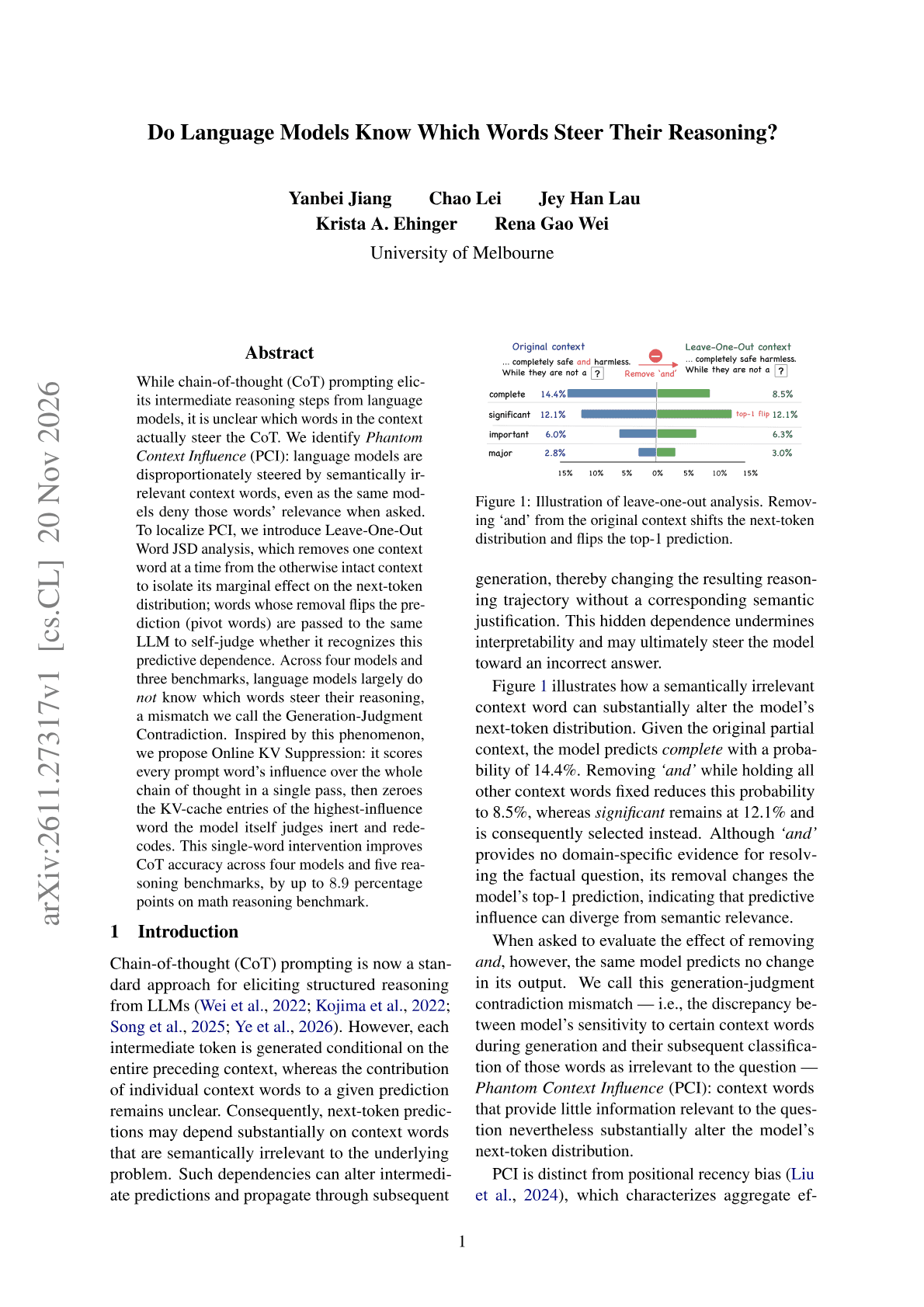
Phantom Context Influence. Leave-One-Out Word JSD removes one context word at a time and measures the shift in the next-token distribution. Words whose removal flips the prediction are "pivot words".
Generation-Judgment Contradiction. The same model is asked whether each pivot word matters. On GSM8K, TruthfulQA and MMLU, Qwen models deny the relevance of 31.3-79.7% of their pivot words and Gemma models 10.7-46.4%. Larger models in a family do not show lower rates.
Online KV Suppression. In one pass, the method scores each prompt word's influence over the whole chain of thought, zeroes the KV-cache entries of the highest-influence word the model judges irrelevant, and decodes again.
Results. Across four models and five benchmarks, accuracy improves by up to 8.9 points on arithmetic tasks. The smallest model gains most (+3.9 points on average) and every model gains.
Abstract
While chain-of-thought (CoT) prompting elicits intermediate reasoning steps from language models, it is unclear which words in the context actually steer the CoT. We identify Phantom Context Influence (PCI): language models are disproportionately steered by semantically irrelevant context words, even as the same models deny those words' relevance when asked. To localize PCI, we introduce Leave-One-Out Word JSD analysis, which removes one context word at a time from the otherwise intact context to isolate its marginal effect on the next-token distribution; words whose removal flips the prediction (pivot words) are passed to the same LLM to self-judge whether it recognizes this predictive dependence. Across four models and three benchmarks, language models largely do not know which words steer their reasoning, a mismatch we call the Generation-Judgment Contradiction. Inspired by this phenomenon, we propose Online KV Suppression: it scores every prompt word's influence over the whole chain of thought in a single pass, then zeroes the KV-cache entries of the highest-influence word the model itself judges inert and redecodes. This single-word intervention improves CoT accuracy across four models and five reasoning benchmarks, by up to 8.9 percentage points on math reasoning benchmark.