Do LLMs Exhibit Coherent Knowledge Structures in Mathematical Reasoning? A Perspective from Knowledge Space Theory
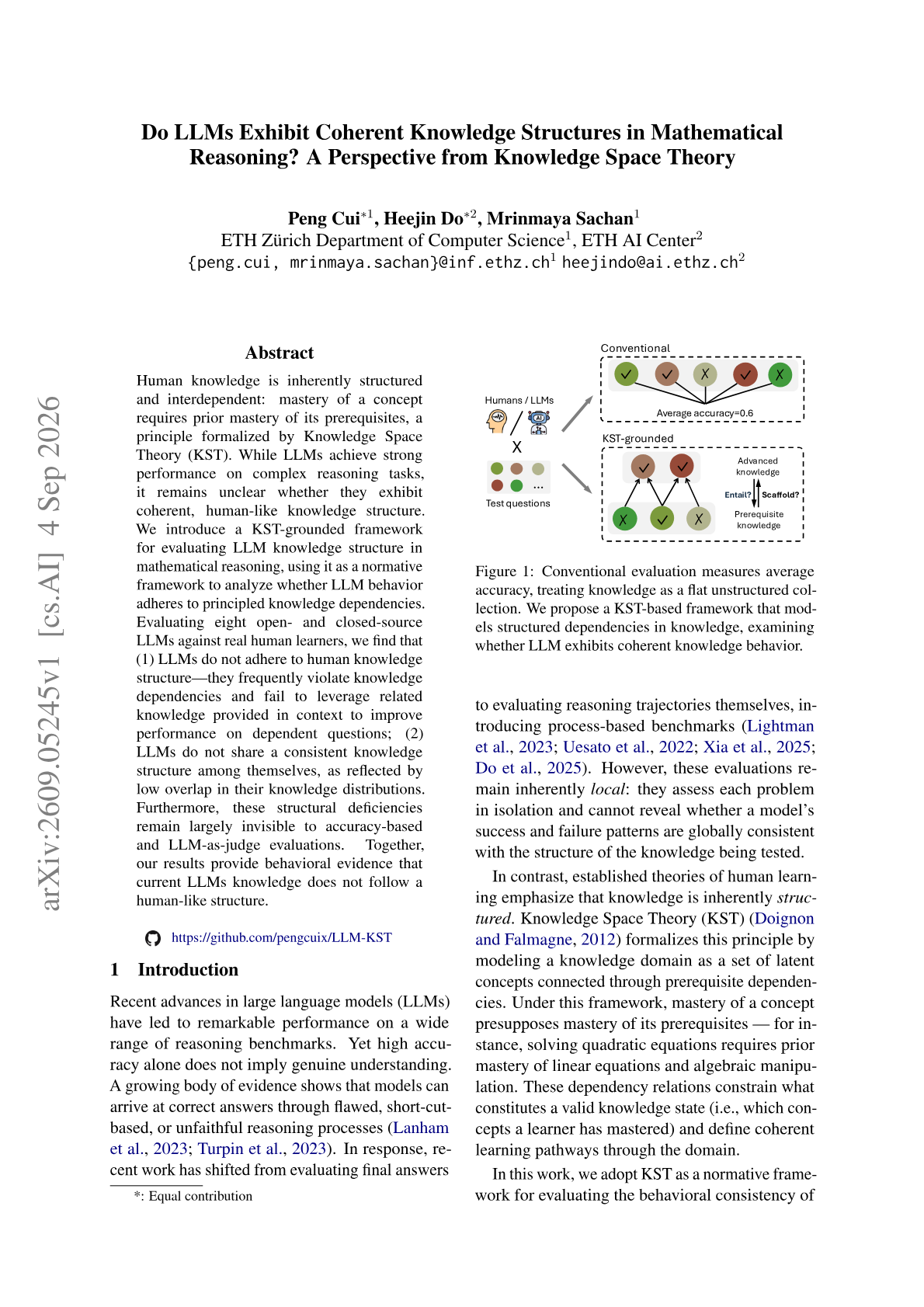
Peng Cui, Heejin Do and Mrinmaya Sachan at ETH Zurich apply Knowledge Space Theory, which formalizes the idea that mastering a concept requires mastering its prerequisites, as a normative standard for LLM mathematical knowledge, and compare eight models against real human learners.
Ask this paper
Dependency violations: LLMs frequently answer a dependent question correctly while failing its prerequisite, and do not use related knowledge supplied in context to improve on the dependent question.
No shared structure across models: The eight open and closed models show low overlap in their knowledge distributions, so they are not converging on a common competence ordering either.
These deficits are invisible to standard metrics: Accuracy-based scoring and LLM-as-judge evaluation both miss the structural failures, because both score items independently.
What the framework provides: A behavioral test that scores the dependency graph rather than the item list, which is the level at which a tutoring or curriculum system needs its model to be reliable.
Abstract
Human knowledge is inherently structured and interdependent: mastery of a concept requires prior mastery of its prerequisites, a principle formalized by Knowledge Space Theory (KST). While LLMs achieve strong performance on complex reasoning tasks, it remains unclear whether they exhibit coherent, human-like knowledge structure. We introduce a KST-grounded framework for evaluating LLM knowledge structure in mathematical reasoning, using it as a normative framework to analyze whether LLM behavior adheres to principled knowledge dependencies. Evaluating eight open- and closed-source LLMs against real human learners, we find that (1) LLMs do not adhere to human knowledge structure -- they frequently violate knowledge dependencies and fail to leverage related knowledge provided in context to improve performance on dependent questions; (2) LLMs do not share a consistent knowledge structure among themselves, as reflected by low overlap in their knowledge distributions. Furthermore, these structural deficiencies remain largely invisible to accuracy-based and LLM-as-judge evaluations. Together, our results provide behavioral evidence that current LLMs knowledge does not follow a human-like structure.