Do We Still Need Reinforcement Learning When We Can Read the World Model?
Mingchao Zhang, Zhiwei Xu and colleagues (Shandong University, Institute of Automation CAS, Tsinghua, NTU) test whether coding agents that read an environment's source code can write control policies directly, and find these policies match or beat standard RL with far less interaction.
Ask this paper
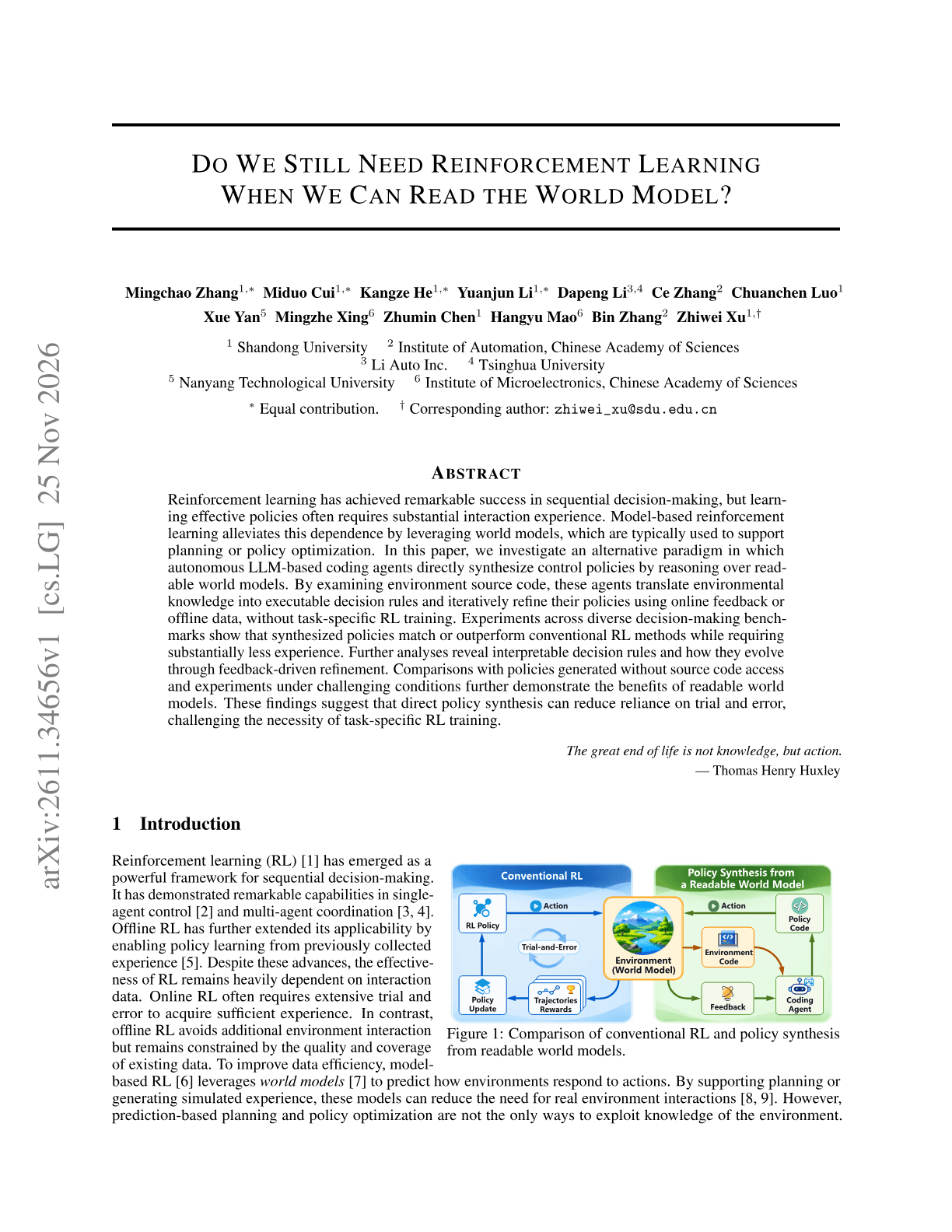
Method (PS-RWM). An autonomous coding agent reads the environment source as a readable world model, writes an executable policy, and refines it with online feedback or offline data. There is no task-specific RL training.
Breadth of evaluation. Online tests cover SMAC, MPE, MiniGrid and Box2D against QMIX, MAPPO, DQN, PPO, MBVD, SeqWM and DreamerV3, which get 2M to 10M environment steps. Offline tests cover D4RL and BabyAI.
Results. Synthesized policies match or exceed the RL baselines while using substantially fewer environment interactions. In some tasks a working policy comes from the source code with no trial and error. On D4RL maze2d-umaze, PS-RWM scores 154.0 against 94.7 for CQL.
Source access is the cause. Policies written without access to the source code perform worse, and the source-code advantage holds under sparse rewards, partial observability and environment variations.
Abstract
Reinforcement learning has achieved remarkable success in sequential decision-making, but learning effective policies often requires substantial interaction experience. Model-based reinforcement learning alleviates this dependence by leveraging world models, which are typically used to support planning or policy optimization. In this paper, we investigate an alternative paradigm in which autonomous LLM-based coding agents directly synthesize control policies by reasoning over readable world models. By examining environment source code, these agents translate environmental knowledge into executable decision rules and iteratively refine their policies using online feedback or offline data, without task-specific RL training. Experiments across diverse decision-making benchmarks show that synthesized policies match or outperform conventional RL methods while requiring substantially less experience. Further analyses reveal interpretable decision rules and how they evolve through feedback-driven refinement. Comparisons with policies generated without source code access and experiments under challenging conditions further demonstrate the benefits of readable world models. These findings suggest that direct policy synthesis can reduce reliance on trial and error, challenging the necessity of task-specific RL training.