DuoDiscover: Scaling Autonomous Discovery Beyond the Evaluation Bottleneck
Shubham Agarwal, Akshat Gupta, Mike Heddes, Dilara Soylu and colleagues (UC Berkeley, Stanford, Google) present DuoDiscover, a fleet of coding agents that each discover an optimization target together with a fast proxy evaluator, so search is not limited by hours-long true evaluations.
Ask this paper
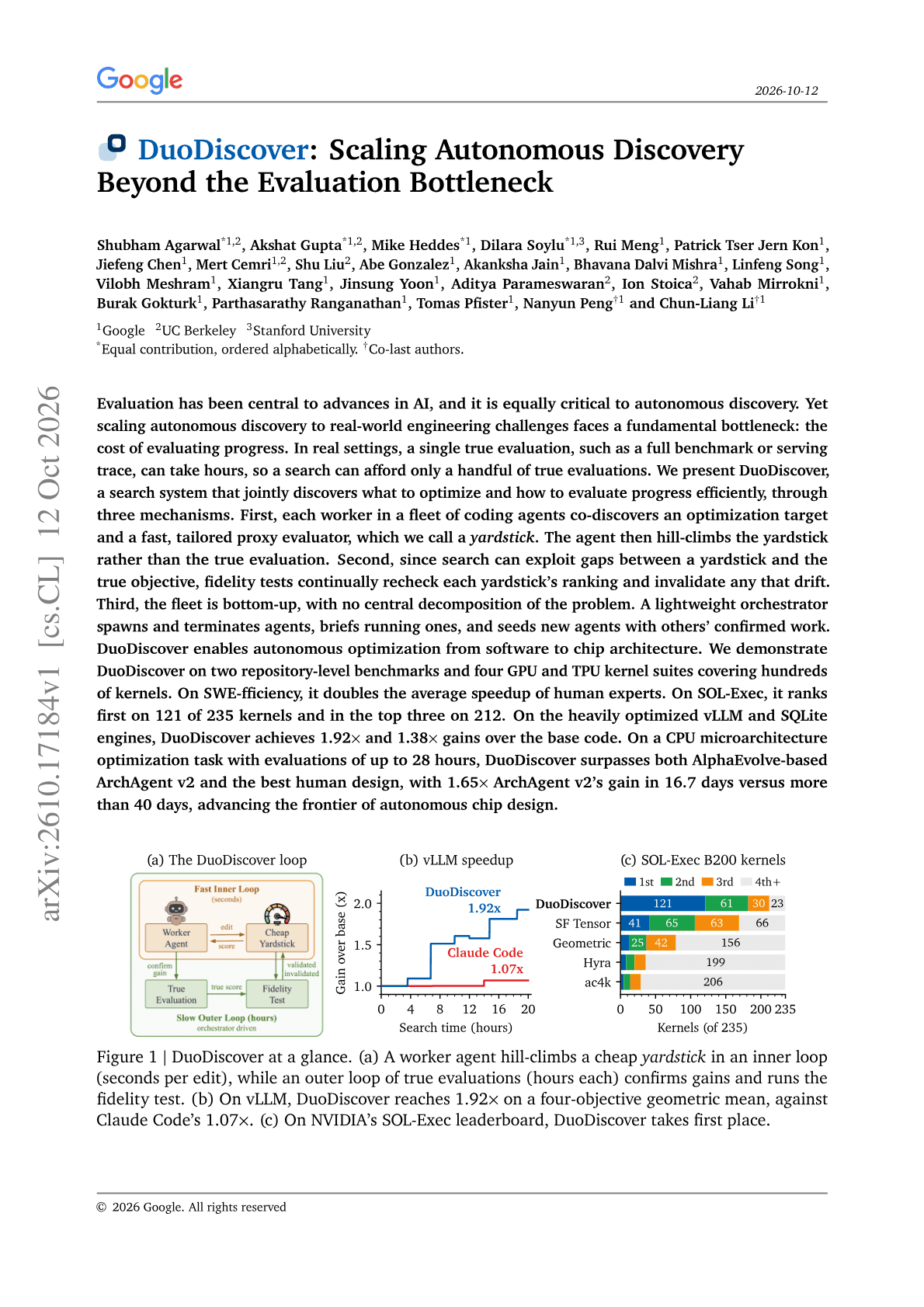
Yardsticks. Each agent builds a cheap, task-specific proxy evaluator (a yardstick) for its own target and hill-climbs on it instead of the true evaluation.
Fidelity tests. Fidelity tests keep checking that each yardstick ranks candidates the same way the true objective does, and invalidate any that drift, which limits exploiting the proxy.
Bottom-up fleet. There is no central decomposition. A lightweight orchestrator spawns and stops agents, briefs running ones, and seeds new agents with others' confirmed work.
Software results. It doubles the human-expert speedup on SWE-fficiency, beats the strongest baseline on FormulaCode by 21%, and gets 1.92x on vLLM (with 3.61x lower first-token latency) and 1.38x on SQLite.
Kernels and chips. It ranks first on 121 of 235 SOL-Exec kernels. On a CPU microarchitecture task with evaluations up to 28 hours, it gets 1.65x the gain of AlphaEvolve-based ArchAgent v2 in 16.7 days against more than 40.
Abstract
Evaluation has been central to advances in AI, and it is equally critical to autonomous discovery. Yet scaling autonomous discovery to real-world engineering challenges faces a fundamental bottleneck: the cost of evaluating progress. In real settings, a single true evaluation, such as a full benchmark or serving trace, can take hours, so a search can afford only a handful of true evaluations. We present DuoDiscover, a search system that jointly discovers what to optimize and how to evaluate progress efficiently, through three mechanisms. First, each worker in a fleet of coding agents co-discovers an optimization target and a fast, tailored proxy evaluator, which we call a yardstick. The agent then hill-climbs the yardstick rather than the true evaluation. Second, since search can exploit gaps between a yardstick and the true objective, fidelity tests continually recheck each yardstick's ranking and invalidate any that drift. Third, the fleet is bottom-up, with no central decomposition of the problem. A lightweight orchestrator spawns and terminates agents, briefs running ones, and seeds new agents with others' confirmed work. DuoDiscover enables autonomous optimization from software to chip architecture. We demonstrate DuoDiscover on two repository-level benchmarks and four GPU and TPU kernel suites covering hundreds of kernels. On SWE-fficiency, it doubles the average speedup of human experts. On SOL-Exec, it ranks first on 121 of 235 kernels and in the top three on 212. On the heavily optimized vLLM and SQLite engines, DuoDiscover achieves 1.92$\times$ and 1.38$\times$ gains over the base code. On a CPU microarchitecture optimization task with evaluations of up to 28 hours, DuoDiscover surpasses both AlphaEvolve-based ArchAgent v2 and the best human design, with 1.65$\times$ ArchAgent v2's gain in 16.7 days versus more than 40 days, advancing the frontier of autonomous chip design.