Empowering MLLM with o1-like Reasoning and Reflection
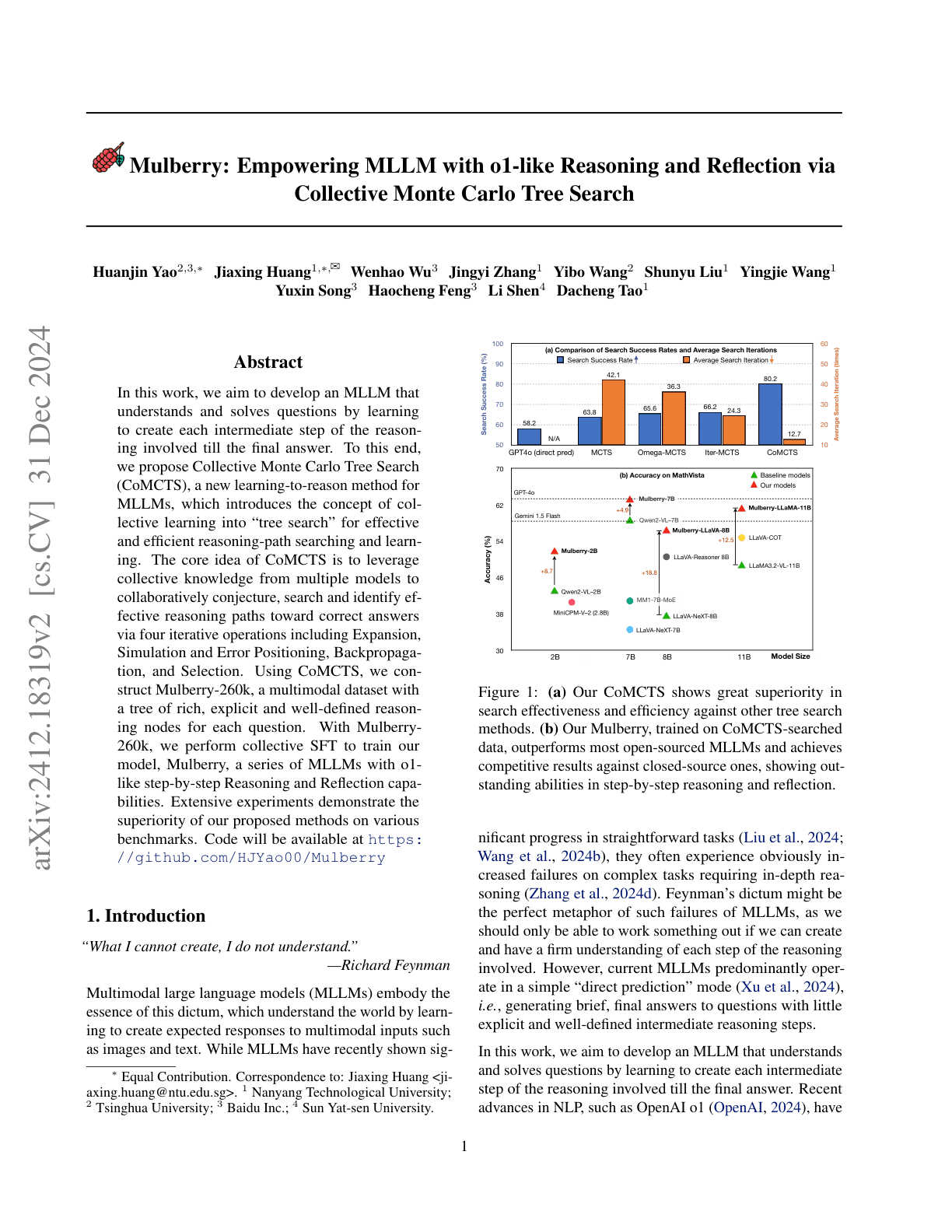
proposes a new learning-to-reason method called CoMCTS that enables multimodal language models to develop step-by-step reasoning capabilities by leveraging collective knowledge from multiple models; the approach was used to create Mulberry-260k, a dataset with explicit reasoning trees, which was then used to train the Mulberry model series; the method demonstrates strong performance on benchmarks, with the models showing improved reasoning and reflection capabilities.
Ask this paper
Abstract
In this work, we aim to develop an MLLM that understands and solves questions by learning to create each intermediate step of the reasoning involved till the final answer. To this end, we propose Collective Monte Carlo Tree Search (CoMCTS), a new learning-to-reason method for MLLMs, which introduces the concept of collective learning into ``tree search'' for effective and efficient reasoning-path searching and learning. The core idea of CoMCTS is to leverage collective knowledge from multiple models to collaboratively conjecture, search and identify effective reasoning paths toward correct answers via four iterative operations including Expansion, Simulation and Error Positioning, Backpropagation, and Selection. Using CoMCTS, we construct Mulberry-260k, a multimodal dataset with a tree of rich, explicit and well-defined reasoning nodes for each question. With Mulberry-260k, we perform collective SFT to train our model, Mulberry, a series of MLLMs with o1-like step-by-step Reasoning and Reflection capabilities. Extensive experiments demonstrate the superiority of our proposed methods on various benchmarks. Code will be available at https://github.com/HJYao00/Mulberry