EurekaBench: Measuring Agentic Ability to Discover New Scientific Insights
Jiayi Geng, Graham Neubig, Howard Chen and colleagues at Carnegie Mellon University and Stanford, working with domain scientists from Yale, Princeton, Columbia, MIT and others, introduce EurekaBench to test whether agents can find mechanisms that explain data and yield scientific insight, not only fit it.
Ask this paper
Benchmark. 26 expert-built long-horizon tasks across neuroscience, computer science, chemistry, astrophysics, geophysics and plasma physics, with 306 expert-written insight questions that a correct mechanism should answer.
Three axes. Whether the discovered mechanism respects known domain constraints, how accurately it predicts held-out measurements, and how many scientific insights a judge can derive from it.
Main result. Claude Fable 5.1 and GPT 6 Astra reach 47.4% predictive accuracy, close to the 48.8% of human solutions, but their insight scores are 42.4% and 29.4% against 69.7% for human-discovered mechanisms.
Failure modes. Agents treat discovery as optimization: their mechanisms often violate basic domain assumptions, rest on untested assumptions, leave uncertainty unresolved and stop exploring early.
Expert check. A fusion expert rated the strongest ARC tokamak submission closer to a master's student's work than to a researcher's, and the authors note the automated insight judge is sometimes too generous.
Abstract
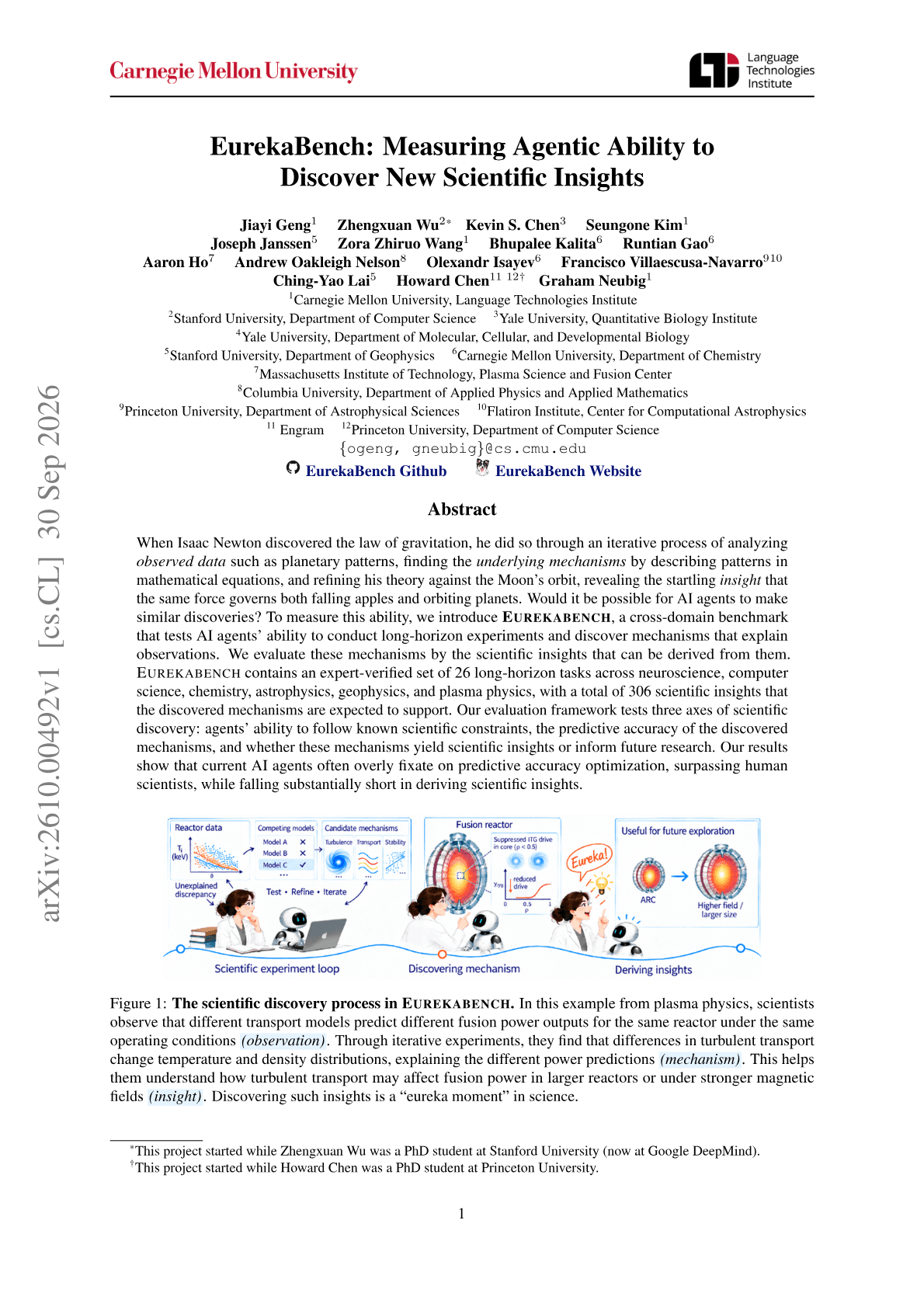
When Isaac Newton discovered the law of gravitation, he did so through an iterative process of analyzing observed data such as planetary patterns, finding the underlying mechanisms by describing patterns in mathematical equations, and refining his theory against the Moon's orbit, revealing the startling insight that the same force governs both falling apples and orbiting planets. Would it be possible for AI agents to make similar discoveries? To measure this ability, we introduce EurekaBench, a cross-domain benchmark that tests AI agents' ability to conduct long-horizon experiments and discover mechanisms that explain observations. We evaluate these mechanisms by the scientific insights that can be derived from them. EurekaBench contains an expert-verified set of 26 long-horizon tasks across neuroscience, computer science, chemistry, astrophysics, geophysics, and plasma physics, with a total of 306 scientific insights that the discovered mechanisms are expected to support. Our evaluation framework tests three axes of scientific discovery: agents' ability to follow known scientific constraints, the predictive accuracy of the discovered mechanisms, and whether these mechanisms yield scientific insights or inform future research. Our results show that current AI agents often overly fixate on predictive accuracy optimization, surpassing human scientists, while falling substantially short in deriving scientific insights.