EvoAlloc: A Self-Evolving Resource Allocation Agent for Efficient Program Evolution
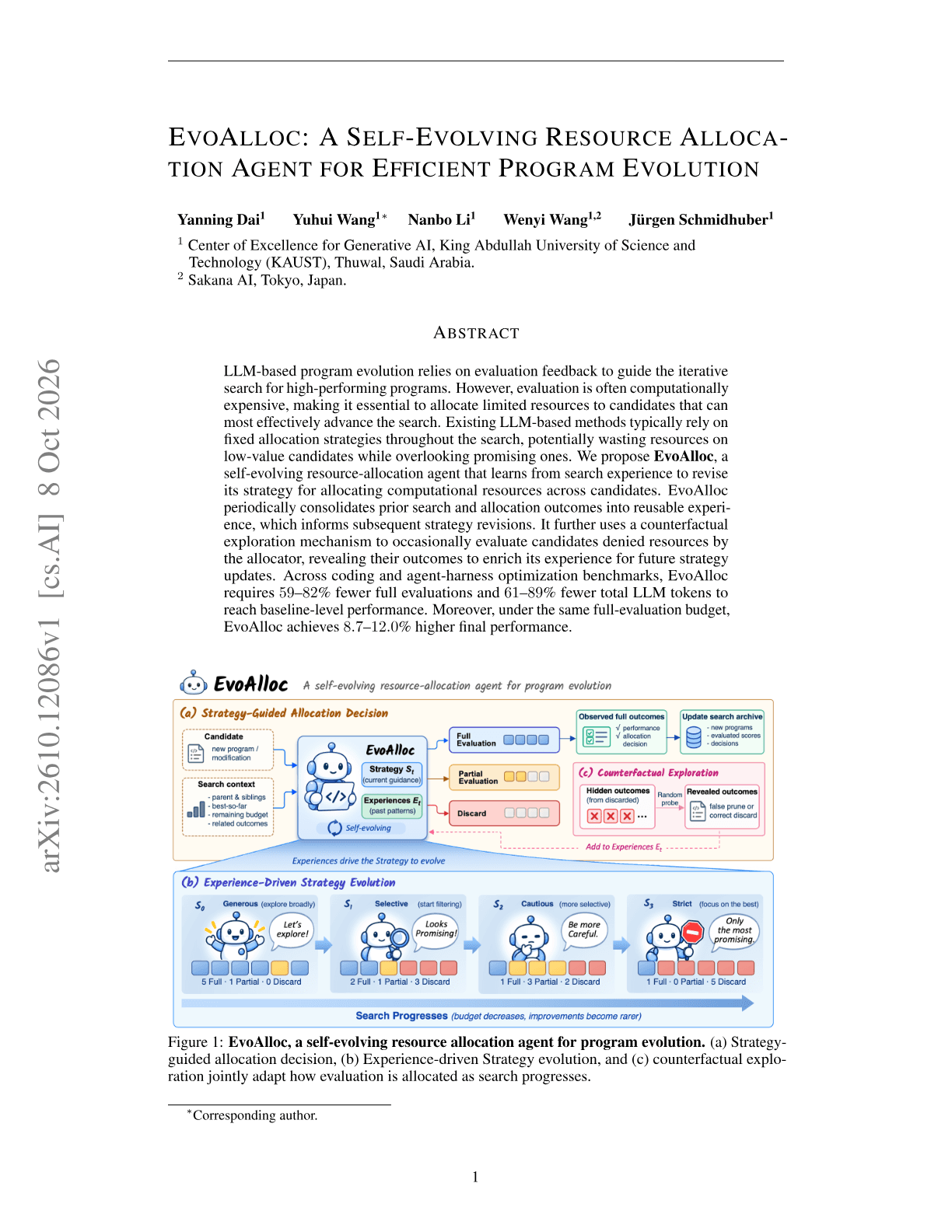
Yanning Dai, Wenyi Wang, Jürgen Schmidhuber and colleagues (KAUST Center of Excellence for Generative AI, Sakana AI) present EvoAlloc, an agent that learns from search history how to allocate expensive evaluations across candidates in LLM-driven program evolution.
Ask this paper
Problem. Program-evolution systems such as ShinkaEvolve use a fixed rule to decide which candidates get full evaluation, which spends budget on weak candidates and skips promising ones.
Experience consolidation. EvoAlloc periodically summarizes past search and allocation outcomes into reusable experience and revises its allocation strategy from it.
Counterfactual exploration. It occasionally evaluates candidates it had decided not to fund, so it learns what its own rejections cost.
Results. On ADAS-AIME and Circle Packing, it reaches ShinkaEvolve's final performance with 59% to 82% fewer full evaluations and 61% to 89% fewer LLM tokens. At equal budget, final performance is 12.0% higher on ADAS-AIME and 8.7% higher on Circle Packing.
Abstract
LLM-based program evolution relies on evaluation feedback to guide the iterative search for high-performing programs. However, evaluation is often computationally expensive, making it essential to allocate limited resources to candidates that can most effectively advance the search. Existing LLM-based methods typically rely on fixed allocation strategies throughout the search, potentially wasting resources on low-value candidates while overlooking promising ones. We propose EvoAlloc, a self-evolving resource-allocation agent that learns from search experience to revise its strategy for allocating computational resources across candidates. EvoAlloc periodically consolidates prior search and allocation outcomes into reusable experience, which informs subsequent strategy revisions. It further uses a counterfactual exploration mechanism to occasionally evaluate candidates denied resources by the allocator, revealing their outcomes to enrich its experience for future strategy updates. Across coding and agent-harness optimization benchmarks, EvoAlloc requires 59-82% fewer full evaluations and 61-89% fewer total LLM tokens to reach baseline-level performance. Moreover, under the same full-evaluation budget, EvoAlloc achieves 8.7-12.0% higher final performance.