Forget Freely, Grep Later: Lossless, Index-Free Memory for Long-Horizon LLM Agents
Ziyan Yang, Taiwei Shi and Jieyu Zhao at the University of Southern California propose GrepMem, an agent memory made of an append-only plain-text log of the full history plus a regular-expression search tool.
Ask this paper
Nothing is discarded. Summarization, masking and structured memory all decide what to keep before future needs are known. GrepMem keeps everything in a text log and lets the agent search it when needed.
No infrastructure. It requires no embeddings, retrieval index, memory extraction step or extra model.
Training setup. The authors train Qwen3.5-9B with reinforcement learning under five context-management strategies and test on multi-question research sessions, long-stream recall and trajectory question answering.
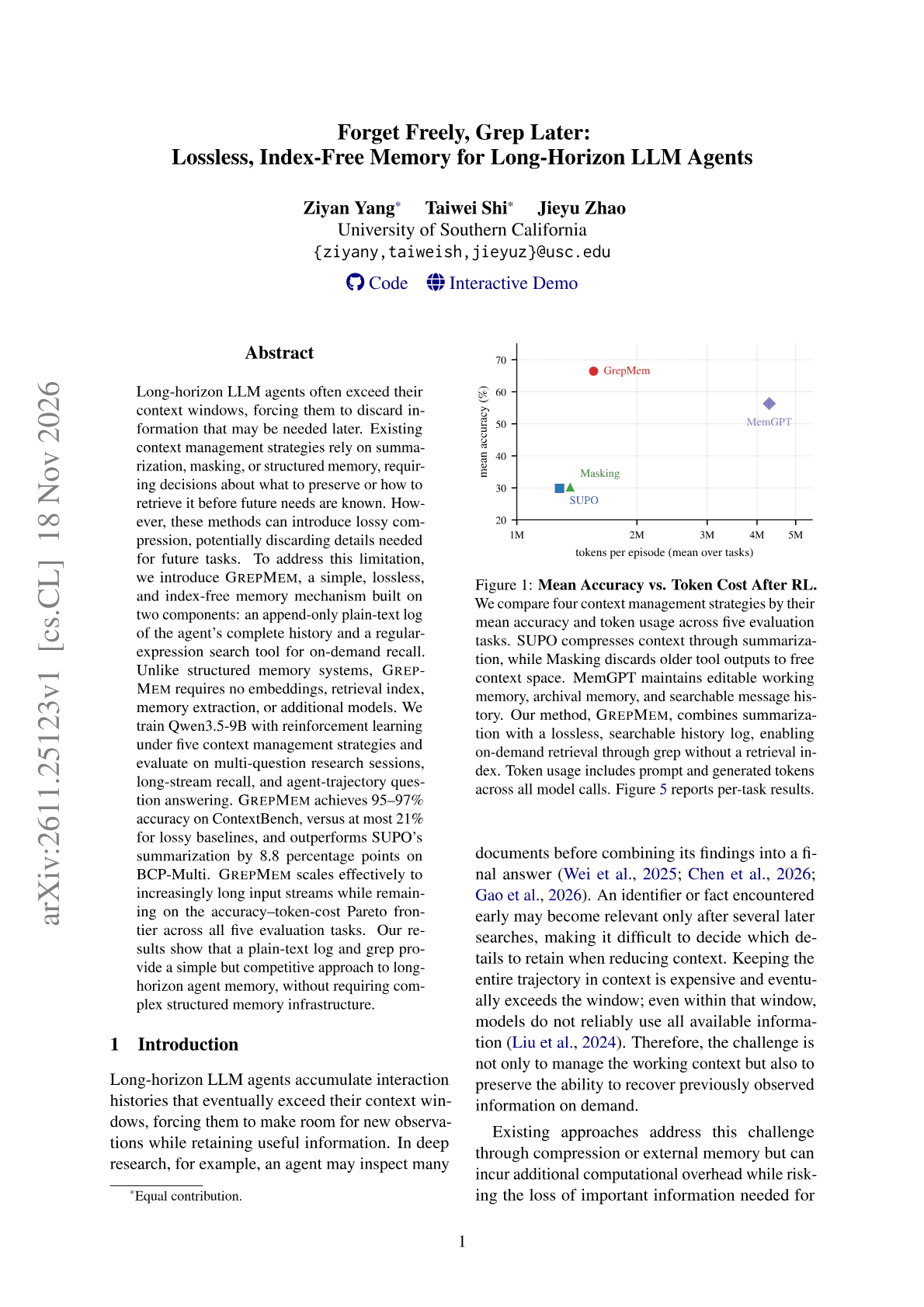
Results. GrepMem reaches 95-97% on ContextBench against at most 21% for lossy baselines, beats SUPO summarization by 8.8 points on BCP-Multi, and stays on the accuracy-token-cost Pareto frontier on all five tasks.
Abstract
Long-horizon LLM agents often exceed their context windows, forcing them to discard information that may be needed later. Existing context management strategies rely on summarization, masking, or structured memory, requiring decisions about what to preserve or how to retrieve it before future needs are known. However, these methods can introduce lossy compression, potentially discarding details needed for future tasks. To address this limitation, we introduce GrepMem, a simple, lossless, and index-free memory mechanism built on two components: an append-only plain-text log of the agent's complete history and a regular-expression search tool for on-demand recall. Unlike structured memory systems, GrepMem requires no embeddings, retrieval index, memory extraction, or additional models. We train Qwen3.5-9B with reinforcement learning under five context management strategies and evaluate on multi-question research sessions, long-stream recall, and agent-trajectory question answering. GrepMem achieves 95-97% accuracy on ContextBench, versus at most 21% for lossy baselines, and outperforms SUPO's summarization by 8.8 percentage points on BCP-Multi. GrepMem scales effectively to increasingly long input streams while remaining on the accuracy-token-cost Pareto frontier across all five evaluation tasks. Our results show that a plain-text log and grep provide a simple but competitive approach to long-horizon agent memory, without requiring complex structured memory infrastructure.