From Rollout to Reset: A Graph-Based Harness for Autonomous Long-Horizon Manipulation Evaluation
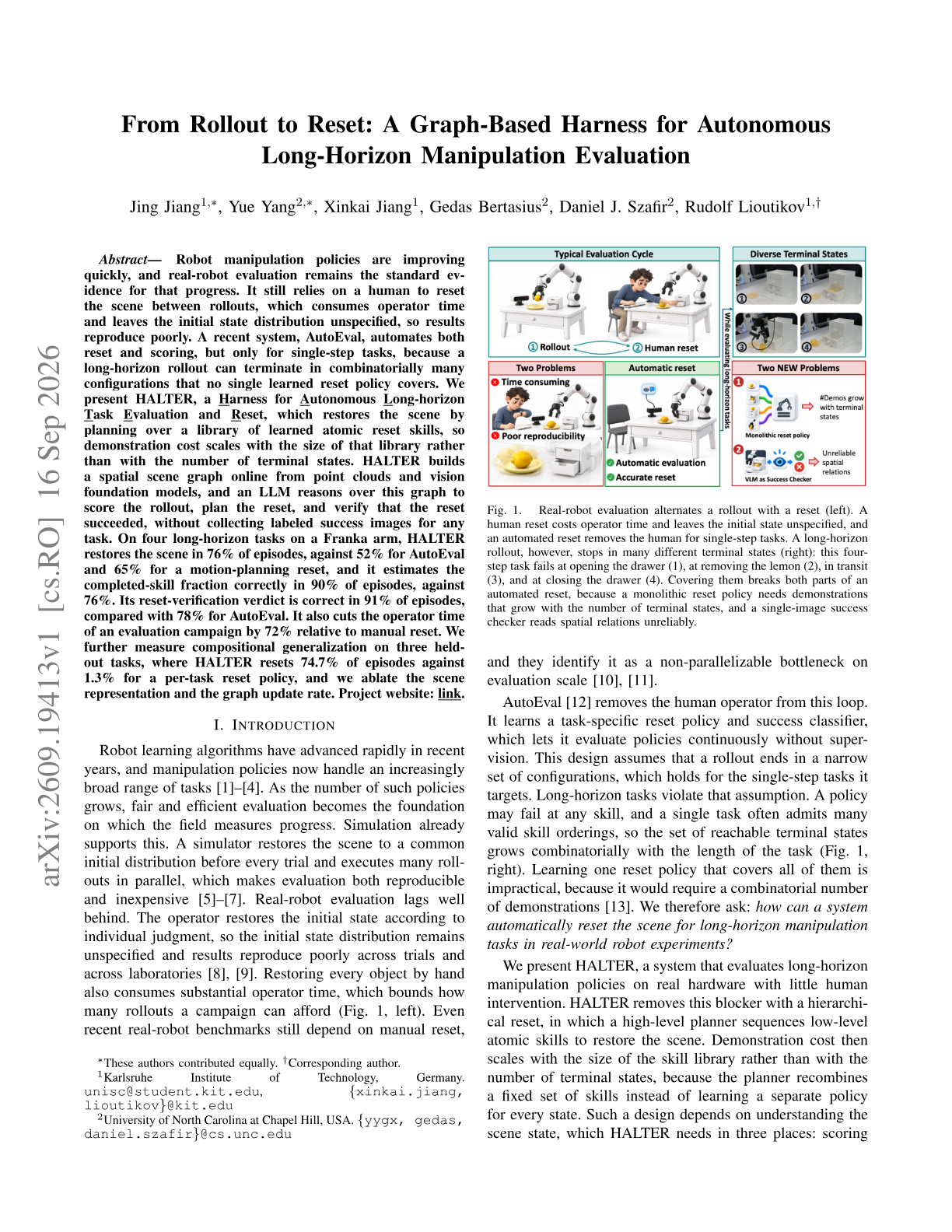
Jing Jiang and colleagues present HALTER, which restores a robot workspace between rollouts by planning over a library of learned atomic reset skills, so demonstration cost scales with the library rather than with the number of terminal states.
Ask this paper
Reset success reaches 76 percent. On four long-horizon tasks on a Franka arm, against 52 percent for AutoEval and 65 percent for a motion-planning reset.
Scoring is done without labeled success images. A spatial scene graph is built online from point clouds and vision foundation models, and an LLM reasons over it to score the rollout, plan the reset and verify it.
Verification is correct in 91 percent of episodes. Against 78 percent for AutoEval, and the completed-skill fraction is estimated correctly in 90 percent of episodes against 76 percent.
Operator time drops 72 percent. Relative to manual reset across an evaluation campaign, which is the cost that currently limits how much real-robot evidence anyone collects.
Compositional generalization is measured. On three held-out tasks HALTER resets 74.7 percent of episodes against 1.3 percent for a per-task reset policy.
Abstract
Robot manipulation policies are improving quickly, and real-robot evaluation remains the standard evidence for that progress. It still relies on a human to reset the scene between rollouts, which consumes operator time and leaves the initial state distribution unspecified, so results reproduce poorly. A recent system, AutoEval, automates both reset and scoring, but only for single-step tasks, because a long-horizon rollout can terminate in combinatorially many configurations that no single learned reset policy covers. We present HALTER, a Harness for Autonomous Long-horizon Task Evaluation and Reset, which restores the scene by planning over a library of learned atomic reset skills, so demonstration cost scales with the size of that library rather than with the number of terminal states. HALTER builds a spatial scene graph online from point clouds and vision foundation models, and an LLM reasons over this graph to score the rollout, plan the reset, and verify that the reset succeeded, without collecting labeled success images for any task. On four long-horizon tasks on a Franka arm, HALTER restores the scene in 76% of episodes, against 52% for AutoEval and 65% for a motion-planning reset, and it estimates the completed-skill fraction correctly in 90% of episodes, against 76%. Its reset-verification verdict is correct in 91% of episodes, compared with 78% for AutoEval. It also cuts the operator time of an evaluation campaign by 72% relative to manual reset. We further measure compositional generalization on three held-out tasks, where HALTER resets 74.7% of episodes against 1.3% for a per-task reset policy, and we ablate the scene representation and the graph update rate.